
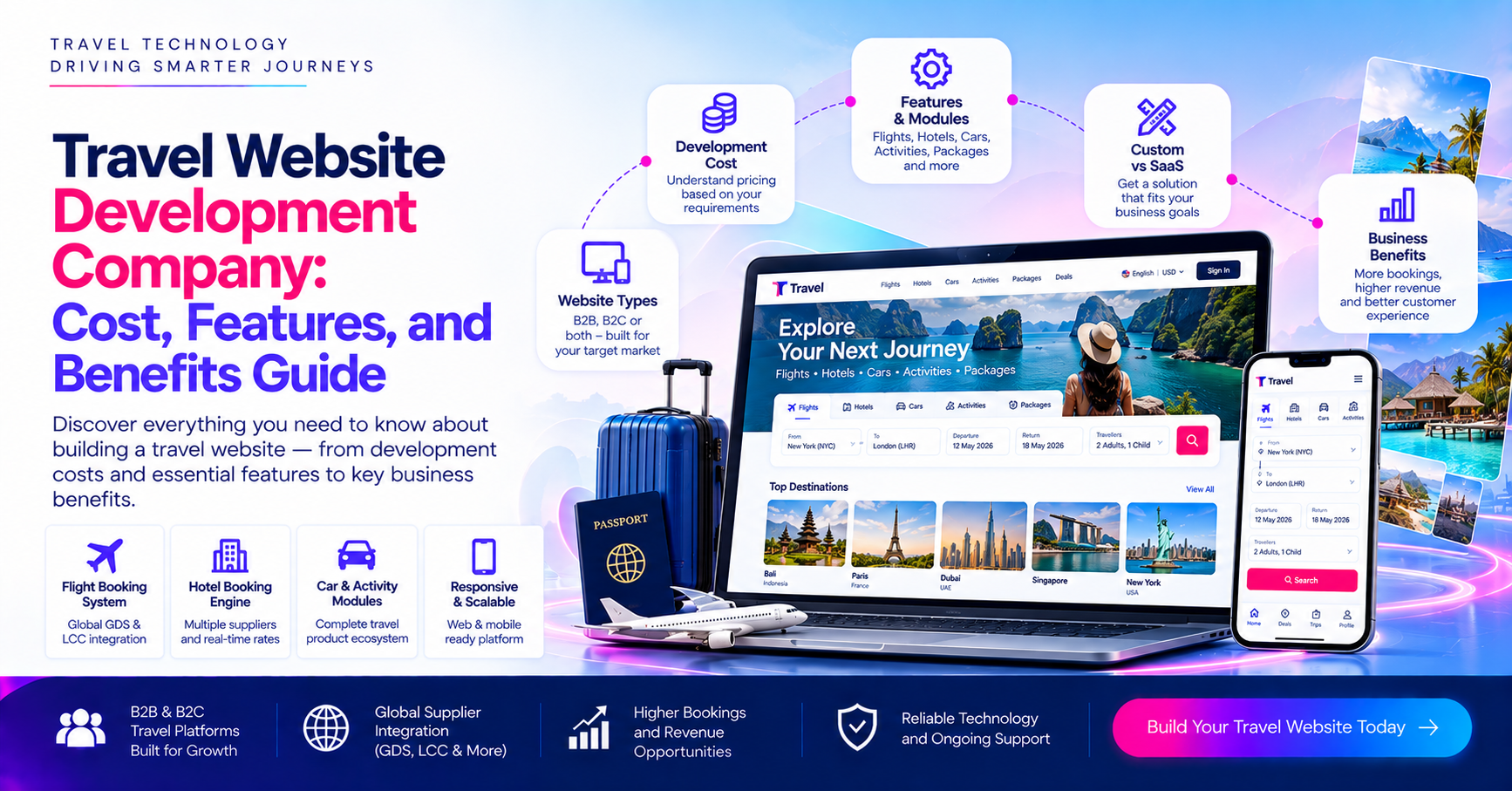
Travel Website Development Company: Cost, Features, and Benefits Guide
A travel website can look really simple from the outside. Your customer searches for flights, selects hotels, enters all the details, pays and receives confirmation. It might feel like a simple website journey. Behind that experience there can be a lot happening. The website might need to connect with flight or hotel APIs, check live availability, apply pricing rules, process payments and send confirmations. If your business also works with travel agents the same platform might need agent logins or markups. That is the only reason why choosing the right travel website development company is different from hiring someone to build a standard business website. Technology must support how your travel business actually sells and manages bookings.
A travel website is more than a website with a booking button
Think about a customer booking a flight through your website. They enter the destination and search available flights, choose an itinerary, provide traveller details and make a payment. The system then needs to create the reservation and return a confirmation. For your customer they might only take a few minutes. For the technology behind it the process is long. Same goes for hotels, car rentals and transfers.
1. Informational travel website
An informational travel website is basically designed to present your business and its offerings. It might contain destination pages, tour packages, and company information. There might be no live inventor automated booking at all.
2. Booking based travel website
A booking-based website goes further, according to travel website developers. Your customers can search for products, compare available options and choose what they want and then receive booking confirmations after making payments.
3. Full booking platform
A larger travel business might want one platform for several products like flights, hotels , car rentals and transfers. It might also need B2B& B2C booking journeys, multiple suppliers besides different pricing rules and a back office system for managing reservations. 2 travel websites can therefore look almost identical on the front end while having completely different technology and development requirements behind them. That difference has a direct effect on travel website development cost.
4. First decide what your travel website actually needs to sell
Before discussing design with travel website developers you need to understand the basics. A flight focused website needs airline or gds or API connectivity and flight specific booking workflows. A booking hotel website needs hotel inventory room rate and reservation management. If you are a tour operator you might have a completely different setup. OTA usually has more moving parts and needs multiple inventory sources and an online payment system. If you are a dmc then you need destination specific products itinerary And supplier coordination.
What goes into travel website development?
-
Customer facing layer
This is everything the traveller or agent interacts with. It can include the home page search filters and result pages besides product information and customer accounts according to experts at travel website development companies. The goal is not simply to make these pages attractive, they need to guide users through the booking journey without creating unnecessary confusion.
-
Booking layer
This is exactly where the actual reservation workflow happens. The platform might need to manage availability pricing confirmation cancellation and modification. For example your hotel booking might need to check whether a room is still available before confirming the reservation.
-
Connectivity layers
Travel websites often depend on external inventory. This can include travel APIs hotel suppliers flight suppliers car rental providers and other sources.
-
Business layer
This is where your business rules come in. The platform might need to handle markups, commissions , promotions and currencies. For example you need different pricing rules or categories for different agencies or agent groups if you are running a B2B business.
Essential features your travel website might need
The right features depend on your travel product but most booking focused platforms need to support the main customer journey.
1. Search and availability
Your customers should be able to enter destination dates and travel information and receive relevant options. For live travel products the search might need to communicate with an external supplier or API rather than just simply displaying information stored in your website.
2. Results and filters
Once the results are returned your customers need a practical way to compare them. Depending on the product, filters might include price duration, rating location and airline.
3. Customer account
Customer accounts can provide access to booking history, upcoming trips and profile information. If you are offering service this can reduce the number of simple requests reaching the support team.
4. Payment integration
Payment is another important part of the booking system. Your platform might need to support payment gateways different currencies and payment status tracking.
Travel website development cost: What actually determines the price
There is no reliable single feature for travel website development costs because travel websites can be built for different purposes.
1. Website type
An informational website is fundamentally different from a live booking platform. A website with destinations and packages requires minimum booking infrastructure then just one supports real time search or payment.
2. Products
A website selling one product like hotels might have a simpler architecture as compared to a platform combining flights or hotels. Every additional product can introduce new supplier connections and booking tools.
3. Booking complexity
Your inquiry form is relatively very simple. Automated search availability checks and reservation creation requires much more development.
4. Payment
The payment setup can affect your development requirements especially when your platform needs multiple currencies and payment methods or refund workflows.
The more control your internal team needs the more extensive the back office system becomes.
5. Mobile experience
A responsive website has different requirements from a project that also includes separate native or cross platform mobile applications.
Travel Website Development Cost: A Practical Project Breakdown
| Project Type | Typical Scope | Main Cost Drivers |
| Travel information website | Content, destinations, enquiries | Design, CMS, pages |
| Package booking website | Packages, availability, enquiry/booking | Booking logic, payment |
| Hotel booking website | Search, rooms, rates, reservation | Hotel APIs, mapping, booking |
| Flight booking website | Search, fares, reservation, ticketing | GDS/API, ticketing, servicing |
| B2B travel portal | Agent login, booking, markup, reporting | Agent workflows, pricing, credit |
| Multi-product OTA | Flights, hotels, cars and more | Multiple APIs, orchestration, booking lifecycle |
Where travel website developers spend most of the technical work
-
API and Supplier Mapping
Different suppliers might structure locations, hotel room types and vehicle categories differently. Their platform needs to just convert that information into a format your booking system can understand.
-
Booking status management
Your system should distinguish different states. A payment might be successful while the booking is still pending or a booking can later become confirmed or move into a cancellation or refund process.
-
Error handling
What if a supplier is temporarily unavailable? A good booking platform should have a defined response rather than just simply showing a technical error to the customer.
-
Security
Travel websites can handle customer information payment workflows and account credentials. These areas need appropriate security controls and careful access management.
When should you build a new travel website instead of improving the existing one?
Not every outdated travel website needs to be rebuilt from scratch. Sometimes a redesign or integration upgrade is enough. A completely new development project might make more sense when your existing platform cannot support online booking so bookings are heavily manual. The same applies when agents still depend on separate manual processes . The platform still cannot support new travel products or pricing and markup management has become difficult. Operational problems are often a better reason to consider a rebuild as compared to an old looking home page.
So you need to know that your website should be treated as a part of the wider booking project operation rather than a standalone front end project operation. Traveltekpro can be positioned around requirements like travel booking websites, flight and hotel booking B2B portals and booking engines and preservation management. But a travel agency might need a customer facing website connected to the existing supplier while keeping reservation management within one administration system. The technology should start with the companies products, users inventory sources and booking processes and then the website architecture can be built around those requirements.
Read More: Online Travel Reservation Systems: What You Need to Know in 2026
FAQ'S
Related Blogs

Get in touch
Email Us
sales@traveltekprogroup.com“We opted for Traveltekpro to construct and implement our Flight booking system, and I am thoroughly pleased with the outcomes. Their team displays remarkable efficiency, expertise, and utmost professionalism throughout the project.”

Arun Neli
Chief Operating Officer
“I had a fantastic experience with Traveltekpro! Their custom booking system designed for our platform is not only sleek and easy to use,but it has also received excellent feedback rom our customers. Kudos to the Traveltekpro team for their outstanding work!”

Benjamin Smith
Product Manager
“Traveltekpro has been a delight to collaborate with on two distinct occasions, showcasing professionalism and expertise. Their team demonstrates a commitment to surpassing expectations and adheringto deadlines.”

Kevin Brown
CTO
“We partnered with Traveltekpro for our travel booking platform, and the experience was excellent. The team understood our requirements quickly, delivered on time, and provided great support throughout the project. Highly recommended.”

Manish Singh
Director of IT
“Great experience working with Traveltekpro. They were responsive, knowledgeable, and always ready to suggest better solutions. The final product exceeded our expectations, and the after-launch support has been excellent.”

Shubham Rawat
Founder & CEO