
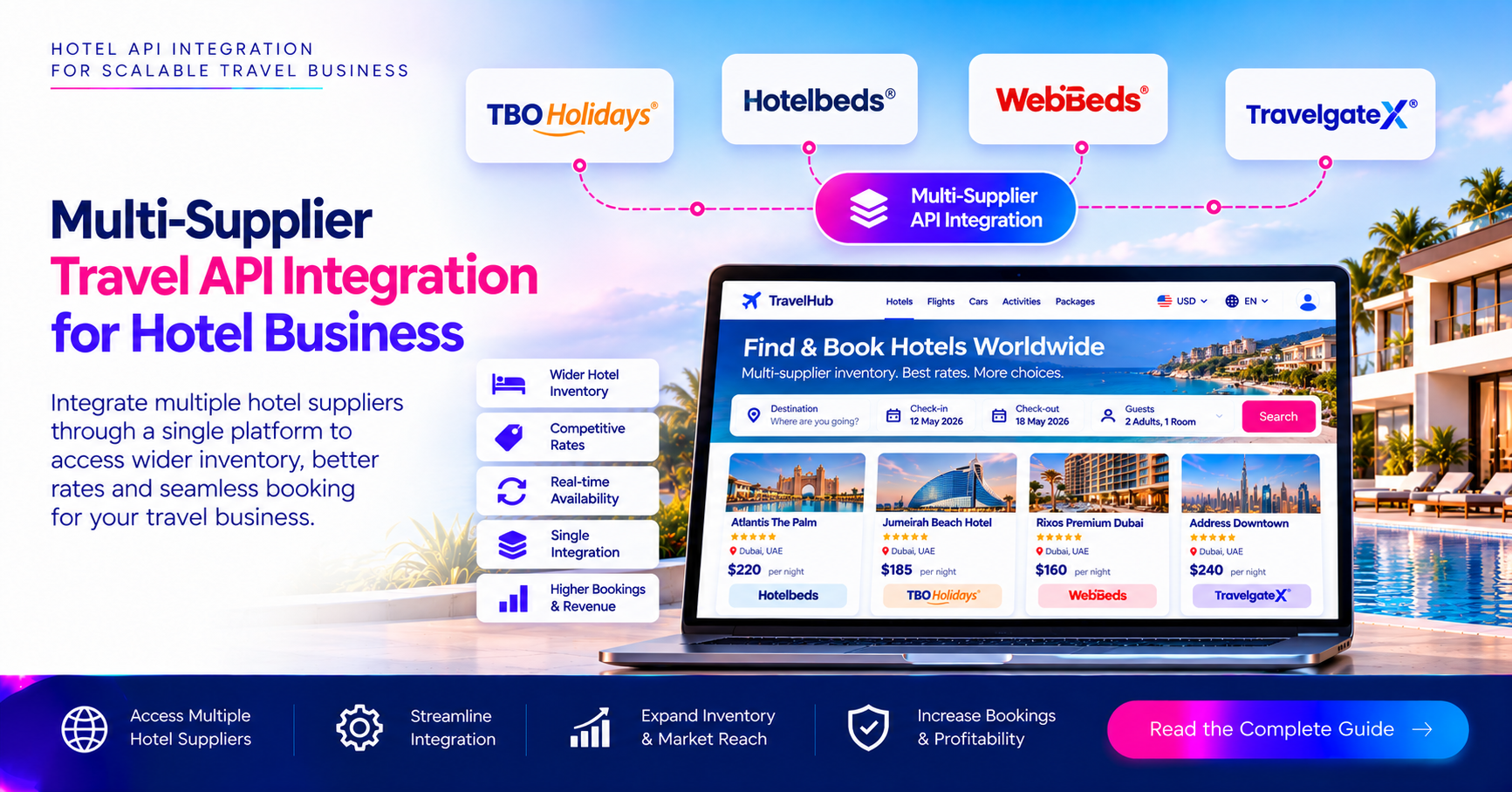
Multi-Supplier Travel API Integration for Hotel Business
Hotel businesses often work with multiple suppliers to offer customers a wider choice of properties and home categories so starting managing inventory from different sources can become complicated when each supplier follows its own data format or pricing structure. If you are an online travel agency or a hotel wholesaler connecting multiple suppliers is just one part of the process. The real challenge is bringing the data together in a way that makes hotel reach rate comparison and booking management consistent across platforms. This is exactly where multi supplier Travel API Integration truly comes into the picture. It allows your booking platform to access hotel inventory from different sources while using a common system to organize property information and manage reservation. A well planned hotel API integration strategy also needs to account for duplicate hotel listings and changing rates. Without the right approach, adding more suppliers can increase technical complexity instead of just improving the booking experience.
Why hotel businesses need more than one travel API supplier
A single hotel supplier might provide you a useful inventory but it might not cover every destination or property category. Connecting additional suppliers can help fill the gaps and give your platform more options to compare. For example, one supplier might offer a wide selection of hotels in Dubai while another has better coverage for smaller properties in Abu Dhabi. A 3rd might provide suitable rates for a particular customer market. Using multiple sources can help your business expand the inventory without depending entirely on one provider. But each supplier maintains its own data and operating rules which means your platform must handle several differences. The same property might appear under different names and IDs.
Room descriptions might not match, and one supplier might include breakfast while another one offers a room-only rate. These differences affect how your customers search, compare, and book accommodation. If the platform displays duplicate hotels, your customers might struggle to identify the right property. If it compares rates without accounting for meal plans or cancellation conditions, it might present offers as equivalent when they are not. The goal is not to connect more suppliers, it is to make inventory work as one coherent booking experience.
What supplier travel API integration means for hotel business?
Multi supplier integration connects your booking platform to several hotel inventory providers through individual APIs or aggregation layers. The platform retrieves property details, room rates and booking information then presents that results through one search and booking experience. Your customer needs to know which supplier provides each offer. Behind the scenes however the platform must preserve the supplier details required to check rates and create reservations.
1. Direct Hotel API Integration
Direct integration connects your platform to an individual hotel group or accommodation provider. This makes sense when your business is in a strategic relationship with a hotel chain or needs specific inventory that is not available through the existing suppliers. For example a platform specializing in a particular hotel group might benefit from accessing the availability and rates booking functions directly. The trade off is that every connection requires technical work. Your developers need to understand the supplier’s authentication method and data formats. If you can be next to several independent hotel providers your team must maintain each integration separately.
2. Hotel wholesalers and bed bank apis
Hotel wholesalers and bed banks aggregate accommodation inventory and distribute it to travel sellers through commercial agreements and technical connections. For a travel agency or OTA these suppliers can provide access to hotels across multiple destinations without requiring separate direct agreement with every property. But several providers differ in destination coverage and cancellation conditions. 2 bed banks might return different offers for the same hotel so adding another connection does not automatically guarantee better rates or for order useful coverage.
3. Using a travel API aggregator
A travel API aggregator provides a common integration layer for accessing inventory from multiple suppliers. Instead of just building a separate connection for every source your platform might be able to use one interface for several inventory providers. This can just simplify parts of development and make it easier to add suppliers depending on the architecture and coverage. You need to ask which suppliers are available, which booking operations are supported and whether any suppliers require separate commercial agreements.
How to plan Hotel API Integration before development starts
Many integration problems begin even before coding starts. If your business has not defined the inventory requirements pricing or rules developers might start to redesign important parts of the system later on.
-
Define your hotel inventory requirements
You need to list the destinations and customer markets or platforms intended to serve. Consider whether you focus on luxury hotels and regional properties. You should also estimate your expected search and booking volumes, identify the currencies you need to support and decide whether the platform will serve individual travellers.
-
Review each Travel API Supplier
Before development begins, review the supplier’s documentation and test environment. You should check authentication requirements and rate limits. Do not stop at the search point. Your team should understand how the API supports rate revalidation and reservation. Some suppliers might require commercial agreements or technical approvals before live bookings can be made. You just need to confirm the requirements early so that you do not delay the launch.
-
Decide how supplier results will be compared in
The platform needs a consistent approach to displaying offers from different sources. You need to define how you will handle currencies fees and meal plans and cancellation conditions. Decide how markups will be applied and how the system will distinguish between offers that are genuinely comparable and those with important differences. For example, a room with breakfast and free cancellation should not automatically be treated as equivalent to a non-refundable room-only offer because both are labeled deluxe rooms.
The biggest challenge in multi supplier integration: hotel and room mapping
Hotel mapping is one of the most important parts of a multi supplier booking platform. Without it your system might struggle to recognize that different supply records refer to the same property.
1. Mapping the same hotel across different suppliers
Every supplier might assign its own ID to a hotel. Property names, descriptions and other attributes can also vary. A mapping process links records that refer to the same property allowing the platform to group supplier offers under one hotel identity. Hotel mapping tools can automate much of the work but the quality of the result depends on the data available and how uncertain matches are handled.
2. Matching room types correctly
Property mapping alone is not enough. The platform might identify the hotel correctly but still receive inconsistent room descriptions. One supplier might list a superior twin room while another uses twin superior and 3rd provides a supplier specific room code. Bed configuration and meal plans must be considered. Rate competitions also matter to offers for a similar room might have different cancellation deadlines or payment requirements.
3. Managing unmatched or uncertain records
Not every record can be managed confidently. A supplier might provide an incomplete address or generic property name. In these cases the platform should also be able to flag the record for further review then automatically just combining it with potentially different hotels. False matches can create more serious problems compared to unmatched records. If 2 separate properties are treated as one your customers might see incorrect information or book accommodation they did not intend to select.
4. Managing rates markups and commercial rules across suppliers
Connecting multiple suppliers creates more opportunities to compare rates but it also means your platform must apply pricing rules consistently. Suppliers might return net rates, commissionable net rates and prices under different commercial arrangements. You might apply a written markup before displaying the selling price for a B2C platform, and for a B2B platform you need separate pricing rules for different travel agents. The system should also calculate the selling price according to the agreed rules while retaining the original supplier return relevant booking conditions. You need to consider supply rates and commissions taxes and fees currency conversion and duplicate offers.
How to Test a Multi-Supplier Hotel API Integration Before Launch
| Test scenario | What to check |
| Three suppliers return the same hotel | Correct property mapping and duplicate handling |
| Two suppliers return different prices | Rate comparison, inclusions and cancellation conditions |
| Selected rate changes before checkout | Revalidation and customer approval |
| One supplier returns an error | Availability of results from other suppliers and error logging |
| Booking request times out | Status recovery and prevention of duplicate reservations |
| Cancellation remains pending | Accurate status tracking and support escalation |
| Hotel or room match is uncertain | Review process and prevention of false matches |
How Traveltekpro fits into a multi supplier Travel API Integration?
Traveltekpro Offers travel technology development and API supplier integration services. But successful integration depends on more than just the number of connections your platform supports. The platform must recognize duplicate hotels, organize room data, and preserve the conditions. If you are planning hotel API integration the practical approach is to start with suppliers that offer relevant inventory and establish clear rules for mapping and error handling.
Read More: How to Select a Travel API Provider 2026: Full Guide
FAQ'S
Related Blogs
GIATA vs Vervotech: Hotel Mapping Tool Explained in 2026
GIATA vs Vervotech: Hotel Mapping Tool Explained in 2026 When you connect multiple hotel suppliers to a travel booking platform you might expect each supplier to return a different selection of properties. But sometimes several…
Oct 29, 2026Read More
Get in touch
Email Us
sales@traveltekprogroup.com“We opted for Traveltekpro to construct and implement our Flight booking system, and I am thoroughly pleased with the outcomes. Their team displays remarkable efficiency, expertise, and utmost professionalism throughout the project.”

Arun Neli
Chief Operating Officer
“I had a fantastic experience with Traveltekpro! Their custom booking system designed for our platform is not only sleek and easy to use,but it has also received excellent feedback rom our customers. Kudos to the Traveltekpro team for their outstanding work!”

Benjamin Smith
Product Manager
“Traveltekpro has been a delight to collaborate with on two distinct occasions, showcasing professionalism and expertise. Their team demonstrates a commitment to surpassing expectations and adheringto deadlines.”

Kevin Brown
CTO
“We partnered with Traveltekpro for our travel booking platform, and the experience was excellent. The team understood our requirements quickly, delivered on time, and provided great support throughout the project. Highly recommended.”

Manish Singh
Director of IT
“Great experience working with Traveltekpro. They were responsive, knowledgeable, and always ready to suggest better solutions. The final product exceeded our expectations, and the after-launch support has been excellent.”

Shubham Rawat
Founder & CEO