
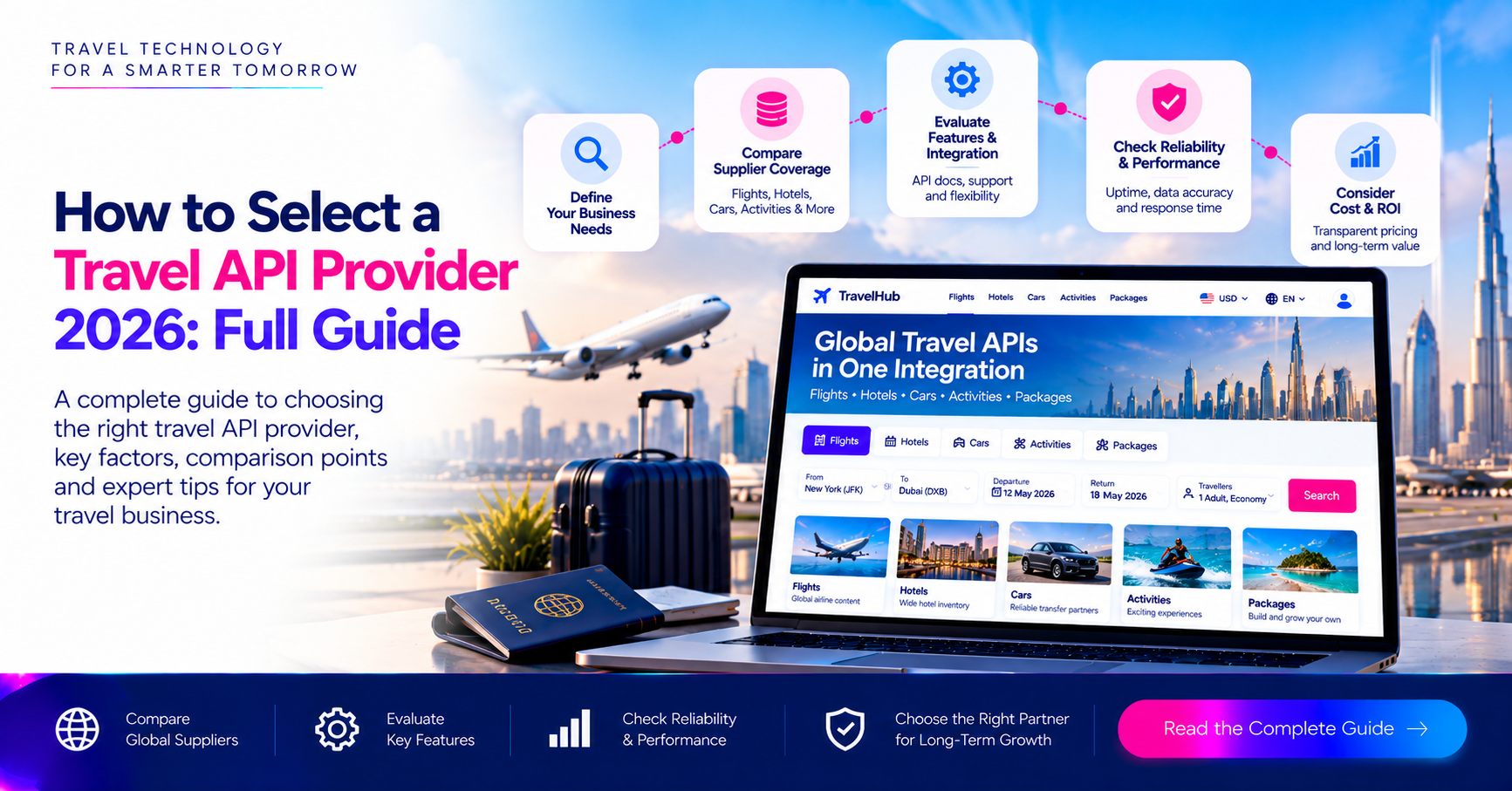
How to Select a Travel API Provider 2026: Full Guide
Choosing a Travel API provider is a very important decision for any business building or upgrading travel booking platform. The right provider can help you access the inventory you need, manage bookings effectively and offer customers a smoother booking experience. The wrong choice can leave your development team dealing with inconsistent data, failed reservations, complicated integrations, and unexpected operational costs. When evaluating a travel API you need to look beyond the supplier count and advertised features. You also need to consider inventory quality, booking performance, documentation, integration effort, commercial terms, and post-booking support.
Decide which travel products your API needs to support
Before comparing providers, define what your problem will sell. A hotel booking website has different technical requirements from an OTA offering flights transfers and activities through one interface.
1. Flight APIs for airline search and booking
A flight Travel API Integration can connect your platform to airline content and support functions like flight search fare comparison and reservations depending on the integration of ticket issuance and post-booking servicing. But not every flight API provides the same content or capabilities. Global distribution systems and new distribution capability can differ in the return the airlines they cover and the booking functions they support. For example a flight fare is only one part of the process. Your system also needs to revalidate the fair booking, confirm the reservation and verify ticket issuance. And reviewing the provider you need to ask which airlines and distribution sources are available to your business.
2. Hotel APIs for room availability and rates
Hotel APIs also provide access to property details, room availability rates and reservation functions. Depending on the supplier they might also return images and meal plans besides other property information. The challenge is that the hotel content can be inconsistent. The same property might appear under different names, room descriptions might vary and amenities or meal plans might not be presented uniformly across suppliers. A provider advertising a large hotel inventory is not automatically the best option. Your team also needs to check whether the properties are relevant to your markets, whether room information is clear and whether the displayed rates remain available when your customers are ready to book.
3. APIs for cars, transfers and activities
If your business sells complete holidays rather than individual travel products you also need a Travel API Provider For airport transfers, car rentals, sightseeing activities and local experiences. A destination management company for example might need to combine hotel accommodation with airport pickup and tours. These products introduce their own requirements including pick up locations or vehicle capacity activity schedules and availability rules. Before connecting these services you need to decide whether they are essential to your launch or part of a later expansion plan.
Single-Product API vs. Unified Travel API
| Approach | Main advantage | What to consider |
| Individual supplier APIs | Greater control over specific supplier connections | More integrations to build, test and maintain |
| Aggregator or unified API | Can reduce the number of integrations required | Coverage, data consistency and servicing capabilities depend on the provider |
| Hybrid approach | Combines selected direct connections with aggregated inventory | Requires careful supplier prioritisation and management |
Evaluate the travel API by following a real booking from search to service end
A successful search response does not prove that an API can support a complete travel transaction. Your development team needs to test what happens after a customer selects a flight or hotel.
-
Search and compare
Start with the basic search process. Check response times the relevance of results and availability of the returned data. For hotels you need to verify that the room types occupancy and meal plans are displayed correctly. For flights you need to review connections, baggage information and other relevant details. The objective is to confirm that the results are useful to customers.
-
Revalidate the selected offer
Once a customer selects an option the system should check whether the room rate is still available before committing to the reservation where the supplier workflow requires it. Test how the API responds when a rate changes and offer expires when inventory becomes unavailable. Also check whether the response provides enough information for your system to explain what happened.
-
Create and confirm booking
Next, test the reservation process. Check how the API returns booking references supplier confirmation details and the final booking status. For flight bookings verify the ticketing workflow separately. A reservation reference does not necessarily mean an electronic ticket has been issued. Your system should distinguish between a confirmed reservation pending transaction and a failed booking.
-
Handle changes and cancellations
The booking journey continues after confirmation. Your customers may change the dates, cancel the reservation or request a refund. Ask which amendments, cancellations, and refunds the API supports directly. Some providers expose those operations through the APIs while others might require manual intervention. A system that handles search and reservations well might still create significant work for your support team if changes and cancellations are difficult to manage.
Check API documentation sandbox quality and integration effort
The quality of a provider’s technical resources can affect both initial development time and long term maintenance. Even a useful API can become expensive to integrate if its documentation is incomplete or its test environment does not reflect bookings and are used.
1. Documentation that explains the full workflow
Good documentation should explain authentication endpoints, request formats and error codes. It should also describe version changes and requirements for the production process. Your developers need to understand not just how to retrieve search results but also to create reservations and handle errors.
2. Consistent data across suppliers
If you are using an aggregator, check whether information from different suppliers follows a consistent structure. If the API normalizes these details effectively your development team might need less additional mapping. The same principle applies to other products. Consistent data can simplify the booking interface.
3. A sandbox that tests more than successful searches
A sandbox is a test environment where developers can explore the API without relying entirely on live transactions. You need to check whether it supports realistic scenarios including unavailable inventory and price changes. If a sandbox only demonstrates successful searches your team might discover important problems much later. You need to also ask how closely sandbox behavior matches the production environment.
4. Clear integration and certification requirements
Some suppliers require separate commercial agreements, certification, and additional credentials before production access is guaranteed. Ask which steps your business must complete, who is responsible for them, and how long they take. A development team might finish the integration but still be unable to launch until the necessary supplier approvals are in place.
A practical checklist for shortlisting travel API providers
Use a structured process instead of just relying on entirely sales presentations.
-
List your documents
Document the product’s destination supplier sources and booking functions your business needs.
-
Shortlist suitable providers
Remove options that cannot supply essential inventory or support your business model.
-
Review technical resources
Examine documentation, sandbox access, and support arrangements.
-
Test a complete booking
You need to follow representative transactions from search through confirmation.
-
Test failure scenarios
Check fare changes unavailable inventory timeouts and other relevant servicing operations.
-
Compare the total cost
Estimate setup search booking and supplier maintenance.
How Traveltekpro Fits Into Your Travel API Integration Plans
Traveltekpro Provides travel technology development and supply and integration services for travel businesses. When evaluating the company you need to ask which suppliers are available for your intended markets, which booking and post booking operations are supported and whether the integration can connect on your existing website or booking engine. Choosing a travel API provider involves way more than just checking into which airlines or hotels it can connect to. You also need to know whether the inventory is relevant to your customers, whether the complete booking process works reliably and whether the commercial arrangement makes sense for your business.
Read More: Sabre vs Amadeus vs Travelport: Which GDS Fits Your Travel Business?
FAQ'S
Related Blogs

Get in touch
Email Us
sales@traveltekprogroup.com“We opted for Traveltekpro to construct and implement our Flight booking system, and I am thoroughly pleased with the outcomes. Their team displays remarkable efficiency, expertise, and utmost professionalism throughout the project.”

Arun Neli
Chief Operating Officer
“I had a fantastic experience with Traveltekpro! Their custom booking system designed for our platform is not only sleek and easy to use,but it has also received excellent feedback rom our customers. Kudos to the Traveltekpro team for their outstanding work!”

Benjamin Smith
Product Manager
“Traveltekpro has been a delight to collaborate with on two distinct occasions, showcasing professionalism and expertise. Their team demonstrates a commitment to surpassing expectations and adheringto deadlines.”

Kevin Brown
CTO
“We partnered with Traveltekpro for our travel booking platform, and the experience was excellent. The team understood our requirements quickly, delivered on time, and provided great support throughout the project. Highly recommended.”

Manish Singh
Director of IT
“Great experience working with Traveltekpro. They were responsive, knowledgeable, and always ready to suggest better solutions. The final product exceeded our expectations, and the after-launch support has been excellent.”

Shubham Rawat
Founder & CEO