
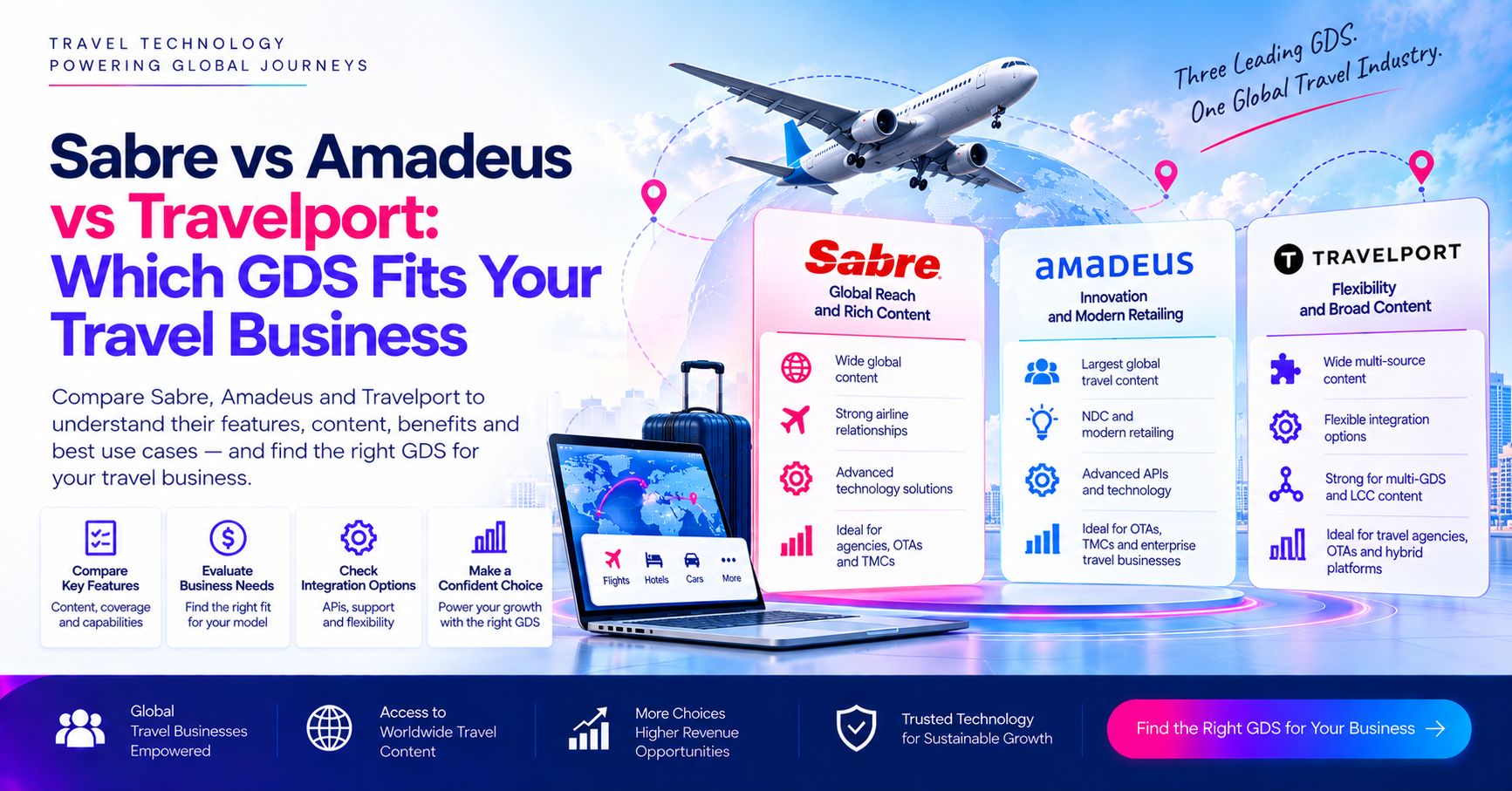
Sabre vs Amadeus vs Travelport: Which GDS Fits Your Travel Business?
Closing a GDS is rarely as simple as comparing the 3 names and picking the one with the longest feature list. A travel agency might need reliable airline content for a specific set of international routes while an OTA might care more about API integration and search performance. B2B Travel companies might be more concerned with agent access and markups. That is the only reason why the real comparison between Sabre Amadeus and Travelport Needs to go beyond a basic feature by feature table. All 3 operate in travel distribution space but the right fit depends on your barcode airline content booking model and technology setup. In this guide you can learn everything about the Sabre GDS system, Travelport GDS system and Amadeus GDS system.
Amadeus Sabre and Travelport: what are you actually comparing?
Before comparing the 3 you need to understand what a GDS is actually doing inside a travel business. A global distribution system can sit between travel suppliers and travel sellers providing access to travel content and supporting booking workflow. The GDS is a part of distribution and resolution infrastructure; it is not the same thing as your website or booking engine. If you are running a travel company you might have several components working together: customer facing website booking engine payment gateway CRM and reporting system. So instead of asking which GDS is the best, a more useful question is which GDS aligns with the market’s airline content booking model and servicing requirements of my business?
Where does a GDS fit inside a travel booking platform?
For example your customer searches for a flight through an OTA. They enter their origin destination and dates. The booking platform then sends the request through its connectivity layer. The GDS returns available flight and fare information the platform represents the results the customer selects an option the booking process continues through reservation and ticketing. So GDS is behind the booking experience. Your business might still need separate technology for the customer interface payment pricing and customer accounts. This matters when comparing GDS providers because you are not simply buying access to the flight information, you are choosing a connectivity layer that needs to work with the rest of your travel technology.
Sabre GDS system: what should you evaluate?
The sabre gds system can be evaluated from the same practical questions you should ask about GDS. Does it provide the content your business needs? Can it integrate with your technology? Does IT support the booking workflow you require?
1. Start with the airline content
The first question should be about your actual customers. Which airlines do they book? Which routes generate the most business? GDS might have extensive content but that does not mean automatically all of it equally is relevant to your particular business. A travel agency focused on specific India Middle East routes for example should investigate the airline and route content that matters to the customers rather than just relying on a broad inventory statement.
2. Look at API connectivity
For a digital travel business the API layer is just as important as the underlying content. You need to understand how the required Sabre content will connect with your booking platform and whether the available API supports the workflows your developers need.
Amadeus GDS system: Where could it fit?
The system should be evaluated according to what your travel business is trying to build. For one main business the main requirement might be the airline content in flight booking. For another the requirement could be broader travel technology and multi product travel workflows. One practical question can help you narrow down the discussion: do you need a GDS mainly for air bookings or are you looking for a broader travel technology ecosystem?
Travelport GDS system: what makes it different?
The Travelport GDS system can be considered in the context of a wider multi source travel content strategy. The evaluation might include traditional GDS content alongside areas like hotel content, car rental API connectivity and content aggregation. This becomes relevant when your travel platform is not building an air only operation. A useful question here would be do you want your GDS connection to be one part of a wider multi source travel content strategy?
Sabre vs Amadeus vs Travelport at a Glance
| Area | Sabre | Amadeus | Travelport |
| Core role | GDS and travel technology platform | GDS and broader travel platform | GDS and modern travel retailing platform |
| Air content | Airline/GDS content | Airline/GDS content | Traditional GDS plus NDC content |
| API access | Available through the Sabre technology ecosystem | Amadeus APIs and platform connectivity | APIs including Travelport+ and TripServices |
| NDC direction | Evaluate based on required airline and content coverage | Strong focus on NDC-enabled solutions | Traditional GDS plus NDC and multi-source content |
| Other travel content | Air plus broader travel content depending on solution | Air, hotel, rail, car and other travel content | Air, hotel, car, rail and other sources |
| Main comparison factor | Market, content and workflow requirements | Content, ecosystem and market requirements | Content, modern retailing and API strategy |
Don’t compare GDS providers by inventory count alone
A large inventory number sounds really impressive but it does not tell you whether the GDS is suitable for your travel business. Your customers might look for more useful evaluation starts with questions like which airlines do your customers use? Which countries generate most of your bookings? Do you really need answers for any products? What servicing capabilities are required? Global inventory and relevant inventory are not necessarily the same thing. You need to consider everything when you are comparing GDS.
GDS versus NDC
If you are comparing GDS providers in 2026, NDC needs to be a part of the conversation. Traditional GDS systems provide established infrastructure connecting travel suppliers and sellers. The architecture might involve gds and other API connections.
Which GDS model fits different businesses?
The answer can change depending on what your company does.
-
For traditional travel agencies
A traditional travel agency might care most about the daily workflow. Important considerations can include airline coverage, ticketing servicing and ease of use. You need to search, compare and later modify reservations for a customer as an agent.
-
For OTA
As an OTA you usually have a stronger focus on technology and automation. The evaluation might center around API connectivity search performance and customer experience. The GDS has to work behind a customer facing working engine so that the ABI and booking workflow becomes especially important.
-
For B2B travel companies
B2B Platform might need to support multiple agents or business customers. That can bring requirements around agent accounts markups, commissions , credit controls and distribution.
-
For tour operators
As the tour operator, you need to connect air content with other parts of the package. The requirement can include air hotel or transfer integration besides supplier connectivity and itinerary management.
Don’t just watch the demo: test the same booking scenarios
A vendor demonstration can make almost any booking platform look simple. A better way to compare Amadeus Sabre and Travelport is to give the same booking scenarios to each option and see how the workflows actually behave.
1. Simple domestic booking
Can you search and book a normal domestic itinerary? How much information is returned?
2. International connecting flights
You need to test an itinerary with connecting flights. Look at how the options returned and how the booking platform handles the itinerary.
3. Fare change
What happens when the fare changes between search and booking? Does the system recognise the change and return the correct status?
4. Ticketing failure
Can your system distinguish between reservation status and ticketing status?
5. Can you use more than one gds?
Yes a travel business might use multiple distribution sources when its requirements justify the additional complexity. There can be several reasons for doing this. For example you might want regional airline coverage, broader inventory or commercial flexibility. But adding another GDS also adds work. You have to manage multiple contracts, multiple integrations, data normalization and duplicate results. This is the only reason more GDS connections should not be automatically treated as a better architecture.
So you must know that Sabre Amadeus and Travelport can be all part of travel companies distribution strategy. But the right evaluation starts with your own requirements. If you are a travel agency your priorities might center around airline coverage ticketing and servicing. If you operate an OTA, API connectivity search booking automation and the customer journey might receive more attention. If you are building a larger travel platform the question might extend beyond the GDS itself to how GDS and direct API connections can work together. So rather than asking which provider is the best, build your comparison around the routes you sell and the airlines customers use. To learn more about GDS options you can connect with experts at Traveltekpro.
Re ad More: What Is a GDS Flight Booking System Essential for Travel Agents
FAQ'S
Related Blogs
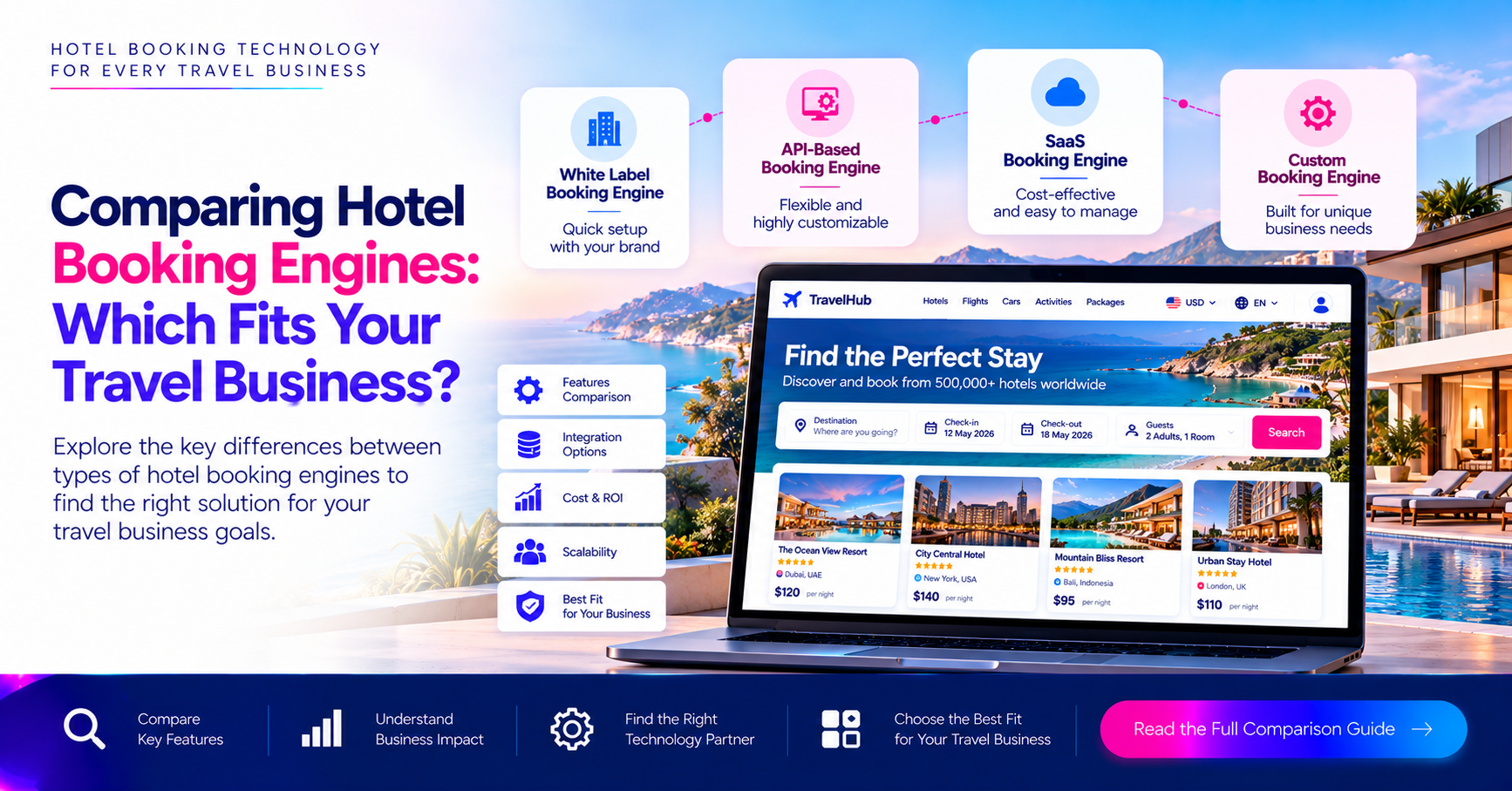
Comparing Hotel Booking Engines: Which Fits Your Travel Agency Best?
Comparing Hotel Booking Engines: Which Fits Your Travel Agency Best? Choosing a Hotel Booking Engine is way more than just finding a system that displays room rates and lets your customers make a reservation. For…
Oct 20, 2026Read More
Get in touch
Email Us
sales@traveltekprogroup.com“We opted for Traveltekpro to construct and implement our Flight booking system, and I am thoroughly pleased with the outcomes. Their team displays remarkable efficiency, expertise, and utmost professionalism throughout the project.”

Arun Neli
Chief Operating Officer
“I had a fantastic experience with Traveltekpro! Their custom booking system designed for our platform is not only sleek and easy to use,but it has also received excellent feedback rom our customers. Kudos to the Traveltekpro team for their outstanding work!”

Benjamin Smith
Product Manager
“Traveltekpro has been a delight to collaborate with on two distinct occasions, showcasing professionalism and expertise. Their team demonstrates a commitment to surpassing expectations and adheringto deadlines.”

Kevin Brown
CTO
“We partnered with Traveltekpro for our travel booking platform, and the experience was excellent. The team understood our requirements quickly, delivered on time, and provided great support throughout the project. Highly recommended.”

Manish Singh
Director of IT
“Great experience working with Traveltekpro. They were responsive, knowledgeable, and always ready to suggest better solutions. The final product exceeded our expectations, and the after-launch support has been excellent.”

Shubham Rawat
Founder & CEO