
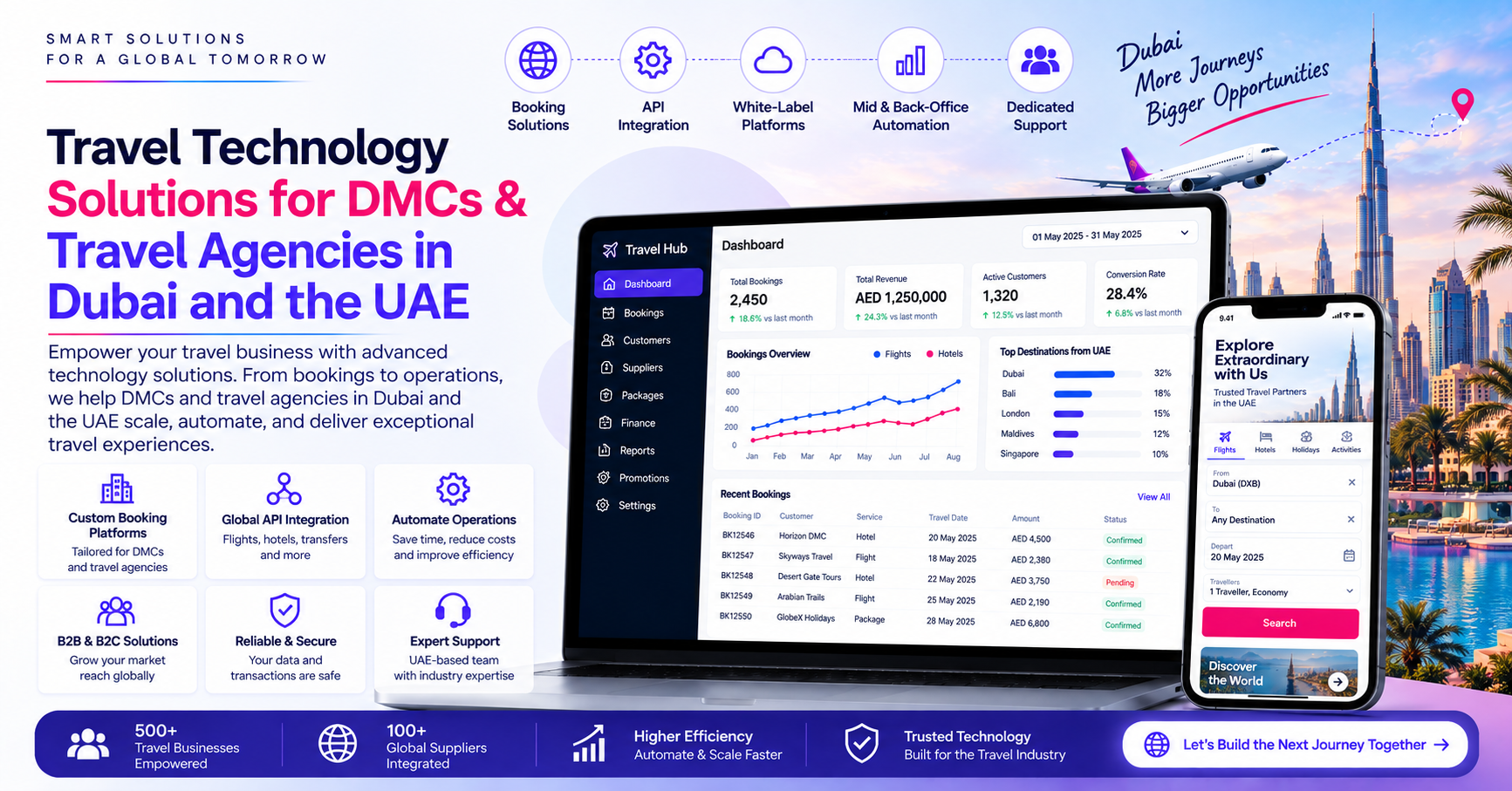
Travel Technology Solutions for DMCs & Travel Agencies in Dubai and the UAE
Dubai is a market where all travel businesses rarely sell just one thing. A DMC might be arranging a hotel stay or airport transfer besides desert safari for the same traveller. A travel agency might be handling flights and hotel activities while a B2B company could be supplying Dubai packages to agents in different countries. For the customer, it is one trip. Behind the scenes it can involve several suppliers, different prices and availability besides bookings and payment confirmations. This is where travel technology solutions come in the picture. The right technology can bring these moving parts into one connected workflow making it easier for your travel business to sell and manage and service bookings without relying on separate spreadsheets or emails. If you are a Dubai based travel business the goal should not be to collect as many software features as possible. It should be to choose technology that fits the way your business actually sells travel and gives it room to grow.
What are travel technology solutions?
Travel technology solutions or digital platforms and systems designed to help your travel business manage activities like supplier connectivity travel inventory bookings pricing payment customer management and distribution. Simply put, they connect different parts of your travel business. The exact setup depends on your business. If you are a DMC, you might need a stronger itinerary and destination service capabilities while OTA might focus more on online search and booking.
The first question for a Dubai travel business is what are you actually selling?
Before choosing a Travel Tech Company in Dubai, you need to understand the basics. Dubai DMC might specialise in hotels, airport transfers and private vehicles. A travel agency could be more focused on flights and hotels while a B2B travel company might not sell directly to travellers at all and instead provide inventory to oversee agencies and tour operators.
| Business Model | Typical Requirements |
| DMC | Hotels, transfers, tours, activities, packages and itinerary management |
| Travel Agency | Flights, hotels, holidays and other travel products |
| B2B Travel Company | Supplier inventory, agent portal, pricing and booking management |
| Tour Operator | Hotels, flights, activities, transfers and package pricing |
| OTA | Online search, booking, payment, supplier connectivity and customer management |
| Corporate Travel Company | Flights, hotels, traveller information, company accounts and reporting |
Where does Dubai DMC lose time without connected travel technology?
Consider how a DMC might handle a simple Dubai holiday inquiry manually. Your agent sends a request for 4 nights in Dubai. Someone checks hotel availability and another person contacts a transfer supplier. Then the team checks the price of a desert safari and attraction ticket. Someone then puts all the rates into one quotation, calculates the markup and sends the itinerary to the travel agent. If your customer changes the hotel or the quotation might need to be recalculated. If a supplier changes its rates the team has to update it again. Once the booking is confirmed payment supplier confirmations and customer communication still have to be managed. That process might be manageable when booking volumes are really low. It becomes much harder when dozens of inquiries and confirmed trips are being handled at the same time. Technology cannot remove every manual task from a DMC nor should it be. But it can centralise information and reduce repetitive work that otherwise takes up a lot of time.
Hotel and flight APIs are only one part of the technology stack
APIs are very important, but they are not the entire travel technology setup. A hotel API can provide hotel availability, room information and booking capabilities. A flight API or TDs connection can provide access to flight schedules or availability. Activity and transfer integrations can bring destination products into the same environment. But someone still needs to bring that information together. Your travel business might therefore have a hotel API for accommodation or activity API for experiences.
Read More: Travel API Integration UAE | Providing Hotel and Flight API in Dubai, UAE
What should a travel technology platform look like for a Dubai DMC?
1. Supplier layer
Hotels, airlines, transfer companies, activity providers and other travel suppliers.
2. Travel connectivity layer
API gds connections and direct supplier integrations.
3. Travel business platform
Search booking quotations pricing itinerary creation and booking management.
4. Business and customer layer
Crm payments B2 b portals and customer communication.
The advantage of this approach is that DMC doesn’t have to treat every supplier as a completely separate process.
Why is B2B connectivity a big opportunity for UAE DMC?
Dubai DMC doesn’t need to depend only on direct customers. You can also work with travel agencies and tour operators in other countries that want to sell Dubai to their own customers. This makes B2B technology especially useful for destination business. An agent portal for example can allow an approved partner to just login and search available products, create bookings and access booking information without sending any email for every request. The commercial setup can also be different from b to C. A DMC might have contracted supplier rate and then apply its own markup before providing the rate to an agent. The agent might subsequently add its own margin before selling with the traveller.
One Dubai itinerary can combine multiple suppliers
Just think about a traveller who wants 4 nights in Dubai with airport pickup or a city tour. The customer just sees one holiday. You see several services that need to be priced and even managed. The hotel would come from one supplier while attracting another. The airport transfer might be operated by the DMC itself while the desert safari could be one of your packages. Technology should combine these services into one itinerary. This is one of the clearest reasons travel technology solutions matter to DMCs. The value is not simply finding inventory it is also helping your business turn different travel products into one manageable booking.
Pricing is different
Travel pricing becomes more complicated when your business operates across B2B & B2C channels. The platform might therefore need to support net rates markups commissions and even agent specific pricing. For Dubai DMC working with oversea agents this is not a minor feature. Pricing rules are part of the business model itself. The system should make it easier to apply those rules consistently rather than just requiring staff to calculate every rate manually.
What changes when a travel agency transitions from manual to digital platform?
Moving online is not just about putting your booking button on a website. The purpose is not to eliminate people from the process. Travel businesses still need people to handle customer requests and supplier issues. The difference is that your team spends minimal time searching various systems for basic booking information.
| Manual Model | Connected Model |
| Supplier emails | API/system connectivity |
| Spreadsheet pricing | Central pricing rules |
| Manual quotations | Digital quotation workflow |
| Separate confirmations | Central booking record |
| Manual agent updates | B2B portal |
| Scattered booking data | Central reporting |
What should a travel agency in Dubai automate first?
You don’t need to automate everything on day one. It makes more sense to start with processes that happen frequently and take a lot of time. Search and booking are usually a logical starting point. Once that workflow is stable you can look at quotation and pricing automation followed by agent management and payment reconciliation. The priority should be simple: automate repetitive work first and keep human attention where it ends well.
What makes a Travel Tech Company in Dubai different from a generic software vendor?
A generic software company might be very good at building websites for CRM systems. Travel as another layer of complexity. A Travel Technology Company in Dubai Should understand how travel inventory and supplier connectivity rates work together. For example, hotel inventory can change quickly. Different hotel suppliers might describe the same property differently. So when evaluating a travel tech company in Dubai you need to look beyond the software interface. You need to ask whether the provider understands the operational side of travel can connect the technology to the way your business actually sells and manages bookings.
Why Traveltekpro For travel technology solutions in Dubai and the UAE?
For a Dubai or UAE travel business the technology partner should be able to work around the realities of travel rather than just offering a generic software package. Traveltekpro can support travel businesses with travel ticket solutions covering areas like booking platforms, travel API and flight integrations. For DMC, this can mean bringing hotels transfers activities and other destinations into a connected booking environment. The important point is that technology can be structured around agents facing booking and commercial workforce.
The right Travel Technology Solutions Should connect more than just a customer facing website. If you are a DMC this could mean combining hotel inventory with your own transfers and experiences. If you are a travel agency it could mean connecting flights and hotels to an online booking experience. When choosing a travel technology company in Dubai you need to look beyond the number of features or the appearance of the platform. See how technology understands travel distribution and supplier connectivity. The best platform is not necessarily the one with the biggest feature list. It is the one that fits the way your travel business operates today.
Read More: How to Start an Online Travel Agency in Dubai With Your Own Booking Platform
FAQ'S
Related Blogs
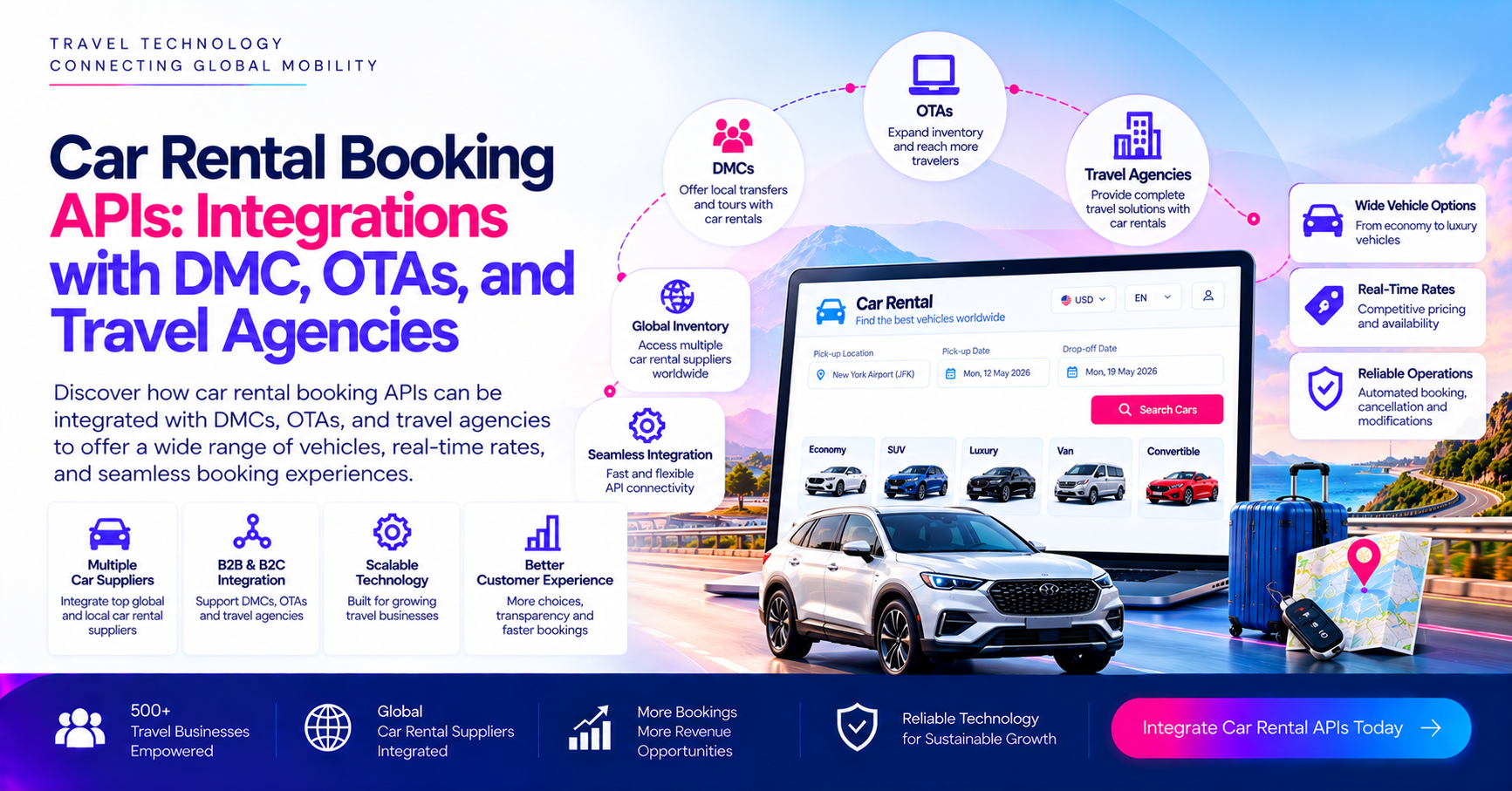
Car Rental Booking APIs: Integrations with DMC, OTAs, and Travel Agencies
Car Rental Booking APIs: Integrations with DMC, OTAs, and Travel Agencies A car rental might look like a simple travel product. Your customer chooses a vehicle enters the travel dates and pays and receives a…
Oct 8, 2026Read More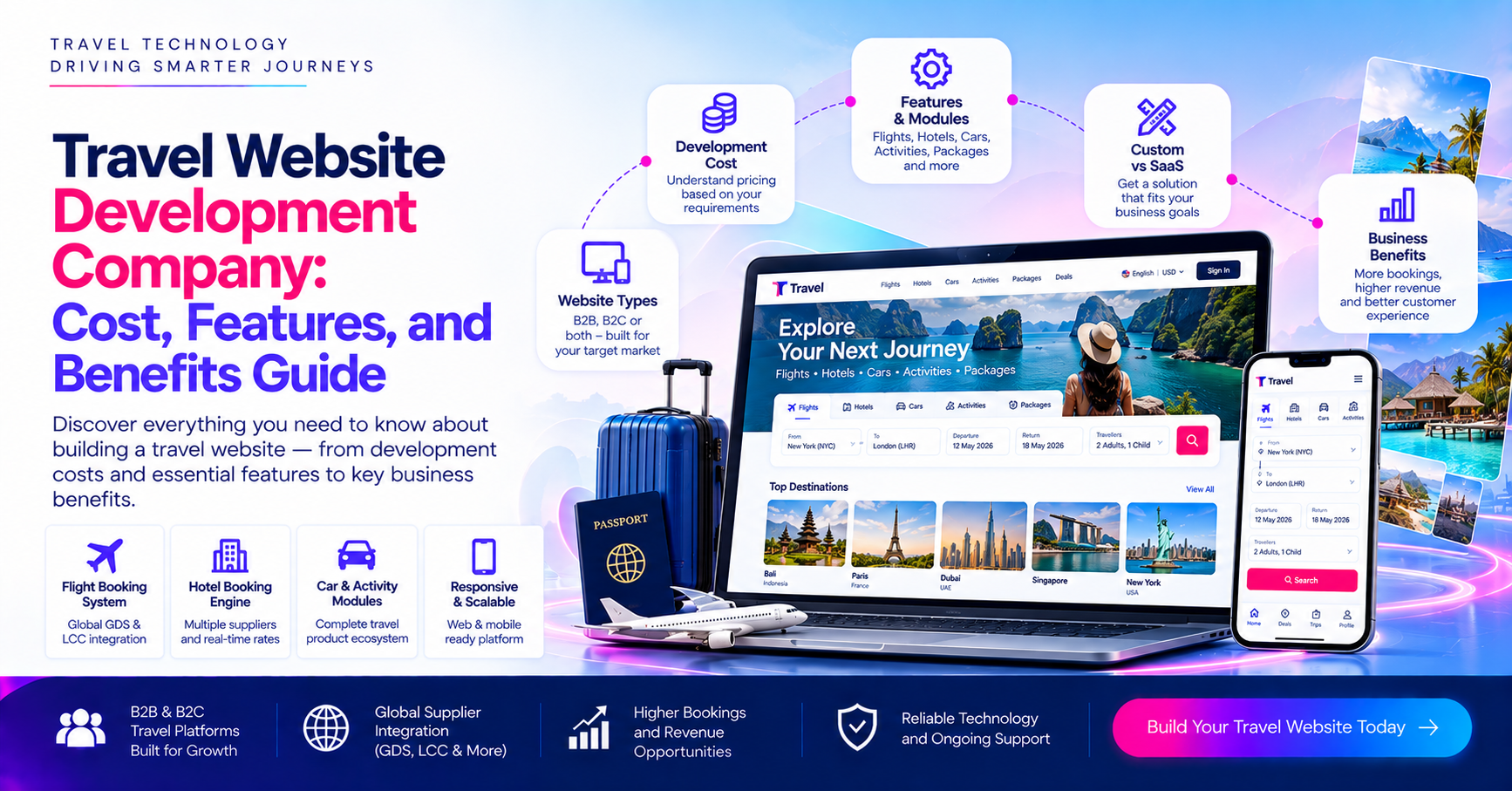
Travel Website Development Company: Cost, Features, and Benefits Guide
Travel Website Development Company: Cost, Features, and Benefits Guide A travel website can look really simple from the outside. Your customer searches for flights, selects hotels, enters all the details, pays and receives confirmation. It…
Oct 6, 2026Read More
Get in touch
Email Us
sales@traveltekprogroup.com“We opted for Traveltekpro to construct and implement our Flight booking system, and I am thoroughly pleased with the outcomes. Their team displays remarkable efficiency, expertise, and utmost professionalism throughout the project.”

Arun Neli
Chief Operating Officer
“I had a fantastic experience with Traveltekpro! Their custom booking system designed for our platform is not only sleek and easy to use,but it has also received excellent feedback rom our customers. Kudos to the Traveltekpro team for their outstanding work!”

Benjamin Smith
Product Manager
“Traveltekpro has been a delight to collaborate with on two distinct occasions, showcasing professionalism and expertise. Their team demonstrates a commitment to surpassing expectations and adheringto deadlines.”

Kevin Brown
CTO
“We partnered with Traveltekpro for our travel booking platform, and the experience was excellent. The team understood our requirements quickly, delivered on time, and provided great support throughout the project. Highly recommended.”

Manish Singh
Director of IT
“Great experience working with Traveltekpro. They were responsive, knowledgeable, and always ready to suggest better solutions. The final product exceeded our expectations, and the after-launch support has been excellent.”

Shubham Rawat
Founder & CEO