
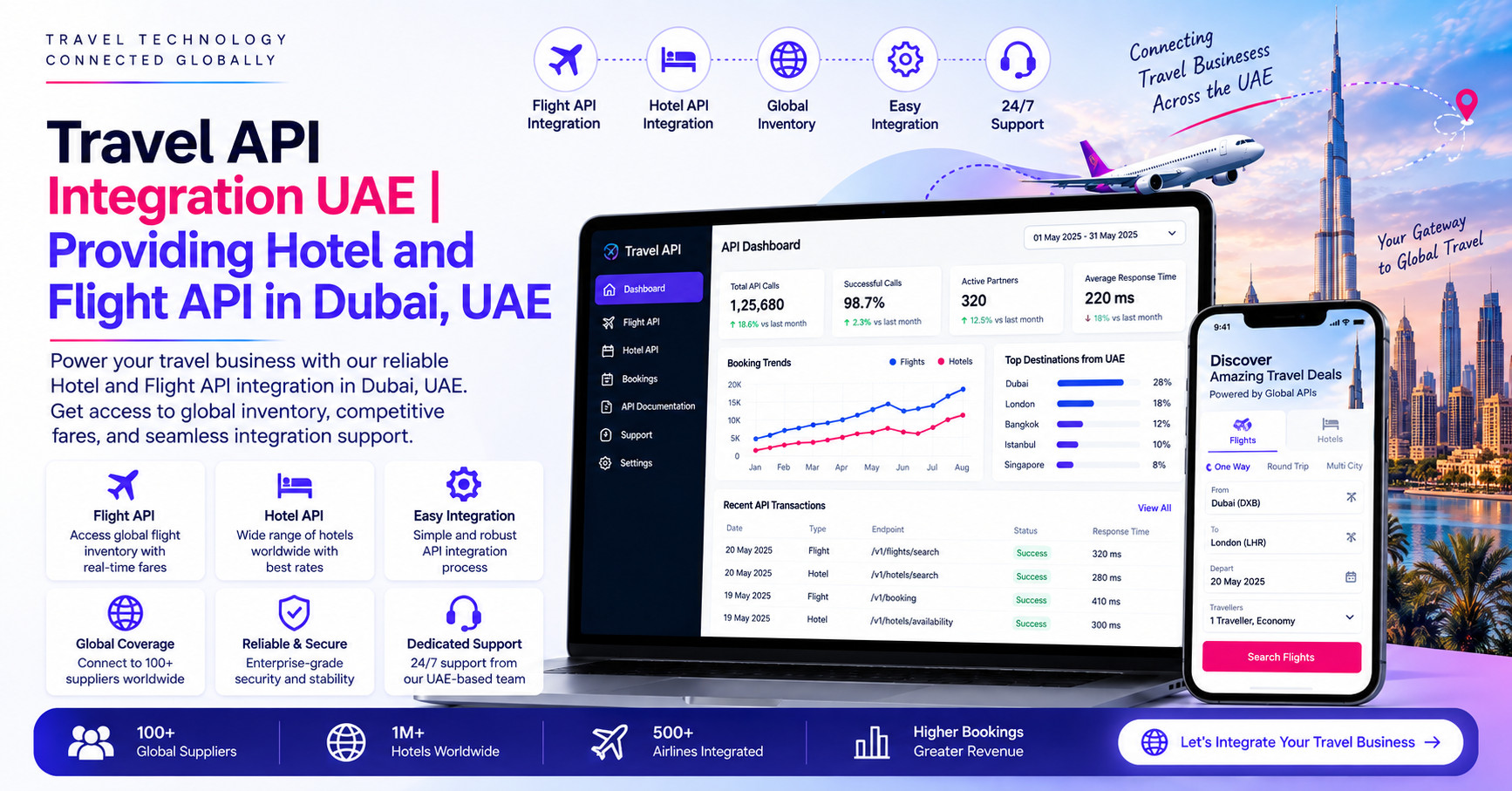
Travel API Integration UAE | Providing Hotel and Flight API in Dubai, UAE
A customer booking a hotel in Dubai sees a fairly central process: search for a property, compare rooms, enter guest details, pay and get a confirmation. But behind that simple booking there can be several systems working together. The opening platform might need to connect with hotel suppliers, flight providers, GDS platforms and payment systems. It might also need to compare rates, check availability again before checking and apply a markup and keep the booking status updated. For a travel agency DMC or tour operator in the UAE the goal is not simply to connect an API. The real goal is to make different travel suppliers work smoothly inside one booking process.
Before integrating an API decide what you want to actually sell?
One of the easiest mistakes is to start by asking which travel API we should integrate? What do we need to sell to our customers? If you are a Dubai hotel specialist you might need hotel connectivity. A UAE OTA might need flights or transfers. A DMC might care more about accommodation transfers and experiences while a corporate travel company might have very different requirements around flights and travellers. So your Hotel API integration in Dubai should follow your product strategy. This is a little value in integrating 5 different travel products if your customers only book hotels. At the same time choosing a single hotel connection when you plan to launch flights and activities 6 months later would leave you rebuilding parts of the platform.
| Business Model | Likely Connectivity |
| Dubai hotel seller | Hotel APIs / bedbanks |
| Flight agency | GDS / airline / flight APIs |
| OTA | Flights + hotels + other suppliers |
| DMC | Hotels + transfers + activities |
| Tour operator | Hotels + flights + tours + transfers |
| B2B wholesaler | Multi-supplier inventory + agent connectivity |
Hotel API integration in Dubai is way more than just hotel inventory
A hotel API might give you access to a large amount of accommodation inventory but getting that inventory into a useful booking experience is another matter. It is especially useful when working with multiple hotel suppliers.
Imagine 3 suppliers offering rates for the same Dubai hotel. One calls a room deluxe king room another calls it king deluxe while the 3rd is a specific room name. Cancellation policies and meal plans might also be presented differently. Your booking platform has to understand that these offers might relate to the same property and then present them clearly to the customer. This is the only reason why Travel API integration UAE Often involves several layers of travel data management.
1. Hotel mapping
Hotel mapping helps match the property IDs used by different suppliers. Without proper mapping the same hotel might appear several times in search results as though they were different properties.
2. Content normalization
Hotel names, room types, amenities images and policies can arrive in different formats. The booking platform must organize this information into a consistent customer experience.
3. Rate comparison
The same hotel might have different rates from different suppliers. One could include breakfast, another could be room only and another could be a refundable rate. Your customers must understand what they are actually getting before choosing.
4. Availability validation
A room being available when the customer starts searching does not always guarantee that it will still be available when they click the final booking button.
5. Booking and cancellation
Integration should also explain what happens after the customer chooses the room. Depending on the supplier the API might support booking confirmation cancellation and other post booking functions. So when comparing hotel APIs, don’t stop at the question: how many hotels do you have?
Dubai hotel search looks simple until you connect multiple suppliers
Consider a customer searching for a Dubai stay from 20 to 23 October for 2 adults.
| Supplier | Hotel | Rate | Meal Plan | Cancellation |
| Supplier A | Hotel X | AED 850 | Room only | Non-refundable |
| Supplier B | Hotel X | AED 890 | Breakfast | Refundable |
| Supplier C | Hotel X | AED 920 | Breakfast | Refundable |
At first glance, this seems like an easy comparison. But the booking system still needs to determine whether all 3 offers refer to the same property, whether the room categories are genuinely comparable and what the cancellation conditions mean. It might also need to apply a business markup before displaying the final selling price. This is the only reason a travel API is not just about moving data from one system to another. It’s also about turning supplier data into something your customer and your booking team can actually use.
Flight API Integration UAE Has different set of challenges
Hotels and flights might sit next to each other on the travel website but their underlying booking processes are quite different. With flight API integration a platform might connect to a GDS, airline API, aggregator or a combination of these. The information returned can include flight schedule availability fares, fare families baggage information seat options and other ancillary services. But booking a flight becomes especially sensitive when the customer is ready to pay. A search result is not always the final fare. Your customer might find a flight at AED 1250 and continue through the booking process. By the time the booking is ready to be confirmed, the supplier might return a different price or availability. This is the only reason why flight booking workflows might require revalidation or repricing before the final reservation, depending on the supplier integration. The platform must also think beyond the initial booking. What if the passenger wants to cancel? Can the booking be retrieved? How are the refunds or exchanges handled?
Should a UAE travel business connect directly to airlines and hotels?
There are several ways to build travel connectivity and each has its own trade-offs.
1. Direct supplier integration
Your business connects directly with individual airlines, hotel companies or other suppliers. This can make sense when a particular supplier is strategically important but maintaining several direct integrations will increase development and maintenance work.
2. GDS Connectivity
Gds platforms can provide access to established airline distribution channels and travel content through a standardized connection. For a business with broad flight booking requirements gds connectivity might form an important part of the technology setup.
3. Aggregator connectivity
An aggregator can bring inventory from multiple suppliers through a single integration. This can simplify the technical side of accessing different sources although the business still needs to understand exactly where the inventory comes from, what booking functions are supported and how supplier servicing works.
4. A hybrid approach
Some travel businesses use a combination of these models. For example you can use one source for flights, several hotel suppliers for accommodation and direct connections for specific products that are particularly important to your customers. The right approach depends on your business.
What happens when the API doesn’t behave as expected?
This is exactly where you can tell the difference between basic Hotel API integration in Dubai and one designed for real travel operations. Travel bookings do not always follow the happy path. A hotel rate can change, a room can be cancelled out or even a supplier can take too long to respond.
-
The hotel rate changes
Your customer sees AED 850 but the supplier returns AED 910 when the rate is checked in. The platform needs a clear way to handle that difference instead of simply creating an incorrect booking.
-
The room sell-outs
The room that appeared during the search but is no longer available at booking time. Your customer should receive a clear response and If appropriate alternate options other than being just left with an unclear booking status.
-
The flight fare changes
The flight needs to be Revalidated or reprised before the booking can proceed.
-
The supplier times out
A system sends a request but doesn’t receive a response within the expected timeline. The platform needs to know whether it is safe to retry or whether the booking might already have been created.
-
Payment succeeds but booking fails
This is one of the most important scenarios. A customer can successfully pay while the supplier booking Encounters an error. The payment system and reservation status must then be reconciled.
-
A customer clicks twice
Your system should have safeguards against accidental duplicate booking or duplicate transaction attempts. Good Travel API integration UAE Therefore needs more than successful search responses. It needs error handling status tracking retries where appropriate and clear operational workflows.
B2B API Integration in the UAE: The Booking Is Only Half the Job
A B2B travel business has another layer to manage.
When a travel agency sells inventory to sub-agents or business partners, the platform may need to support:
- Agent logins
- Agent-specific pricing
- Markups
- Credit limits
- Wallets
- Booking history
- Invoices
- Commission tracking
- Cancellation management
Should a UAE travel business use multiple apis?
There are situations where using multiple vendors makes practical sense. Perhaps one hotel supplier has a strong Dubai inventory while another performs better for a particular international market. A flight source might cover the routes you need while a separate connection gives you access to additional airline content. Multiple APIs can also provide more options as your business expands into transfers activities or other travel products.
Don’t Compare API Providers by Inventory Count Alone
A provider may advertise millions of hotels or numerous airlines.
Ask:
- Are vendors relevant to your customers?
- Are the rates competitive?
- How accurate is availability?
- How quickly do responses arrive?
- How is hotel mapping handled?
- Can you actually complete bookings through the API?
- What cancellation functions are available?
- Is the documentation clear?
- What if the supplier returns an error?
- Who helps when a production booking fails?
How Traveltekpro Can help with API integration for UAE travel business?
Once your business requirements are clear it becomes much easier for a technology partner to evaluate. Traveltekpro can support travel businesses that need to bring supplier connectivity into a wider booking environment rather than just treating each API as an isolated integration.
So you need to know that Hotel API integration in Dubai is way more than just getting hotel inventory on your website. The integration needs to handle property mapping room information and availability. Flight API integration comes with its own challenges, particularly around availability ticketing and fare revalidation. And when a business needs travel API integration across multiple products the challenge becomes connecting those different sources into one booking and operational workflow. This is exactly why the right API integration provider must be selected.
Read More: Top 5 Travel Technology Companies in Dubai You Should Know
FAQ'S
Related Blogs
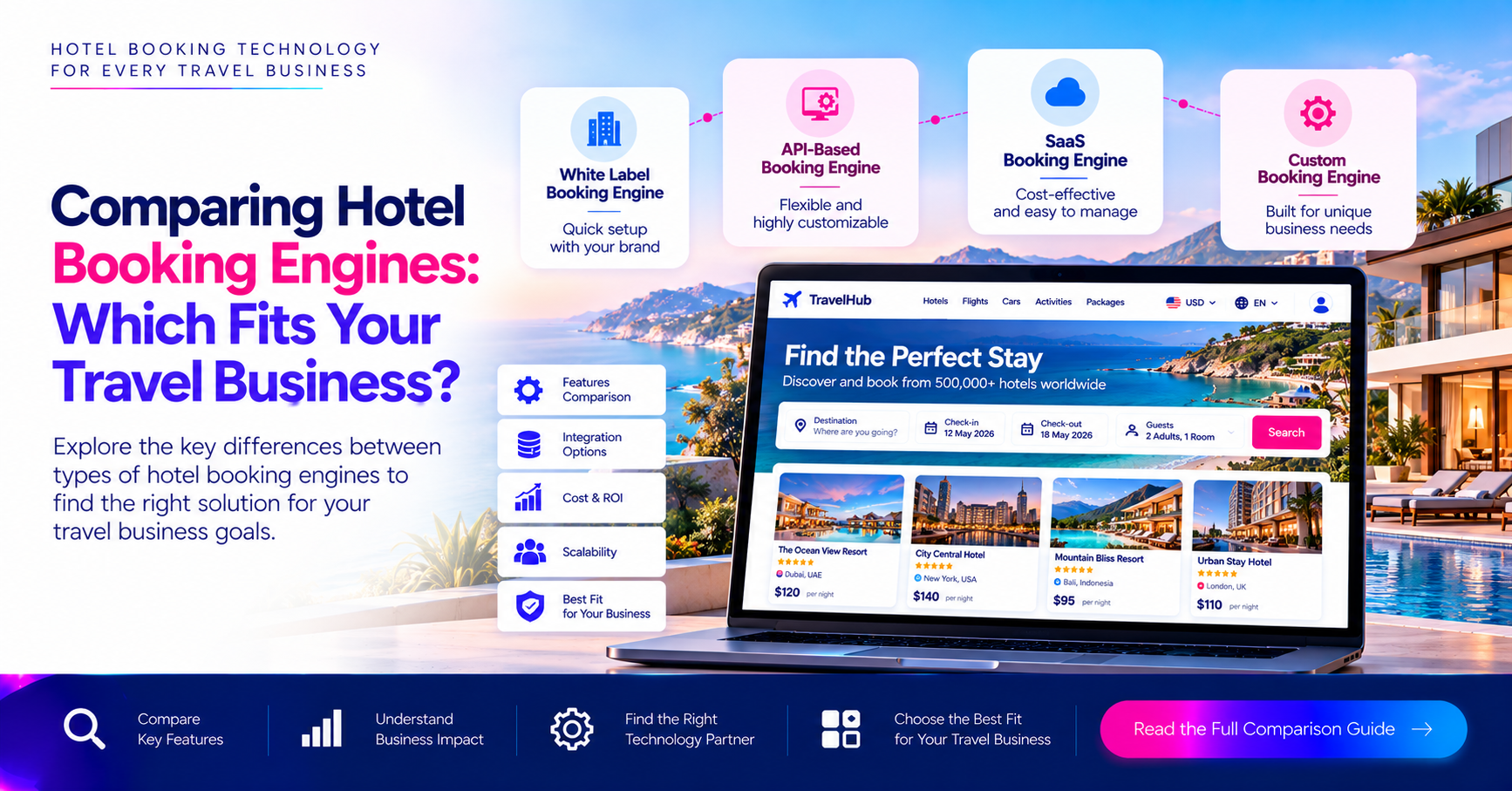
Comparing Hotel Booking Engines: Which Fits Your Travel Agency Best?
Comparing Hotel Booking Engines: Which Fits Your Travel Agency Best? Choosing a Hotel Booking Engine is way more than just finding a system that displays room rates and lets your customers make a reservation. For…
Oct 20, 2026Read More
Get in touch
Email Us
sales@traveltekprogroup.com“We opted for Traveltekpro to construct and implement our Flight booking system, and I am thoroughly pleased with the outcomes. Their team displays remarkable efficiency, expertise, and utmost professionalism throughout the project.”

Arun Neli
Chief Operating Officer
“I had a fantastic experience with Traveltekpro! Their custom booking system designed for our platform is not only sleek and easy to use,but it has also received excellent feedback rom our customers. Kudos to the Traveltekpro team for their outstanding work!”

Benjamin Smith
Product Manager
“Traveltekpro has been a delight to collaborate with on two distinct occasions, showcasing professionalism and expertise. Their team demonstrates a commitment to surpassing expectations and adheringto deadlines.”

Kevin Brown
CTO
“We partnered with Traveltekpro for our travel booking platform, and the experience was excellent. The team understood our requirements quickly, delivered on time, and provided great support throughout the project. Highly recommended.”

Manish Singh
Director of IT
“Great experience working with Traveltekpro. They were responsive, knowledgeable, and always ready to suggest better solutions. The final product exceeded our expectations, and the after-launch support has been excellent.”

Shubham Rawat
Founder & CEO