
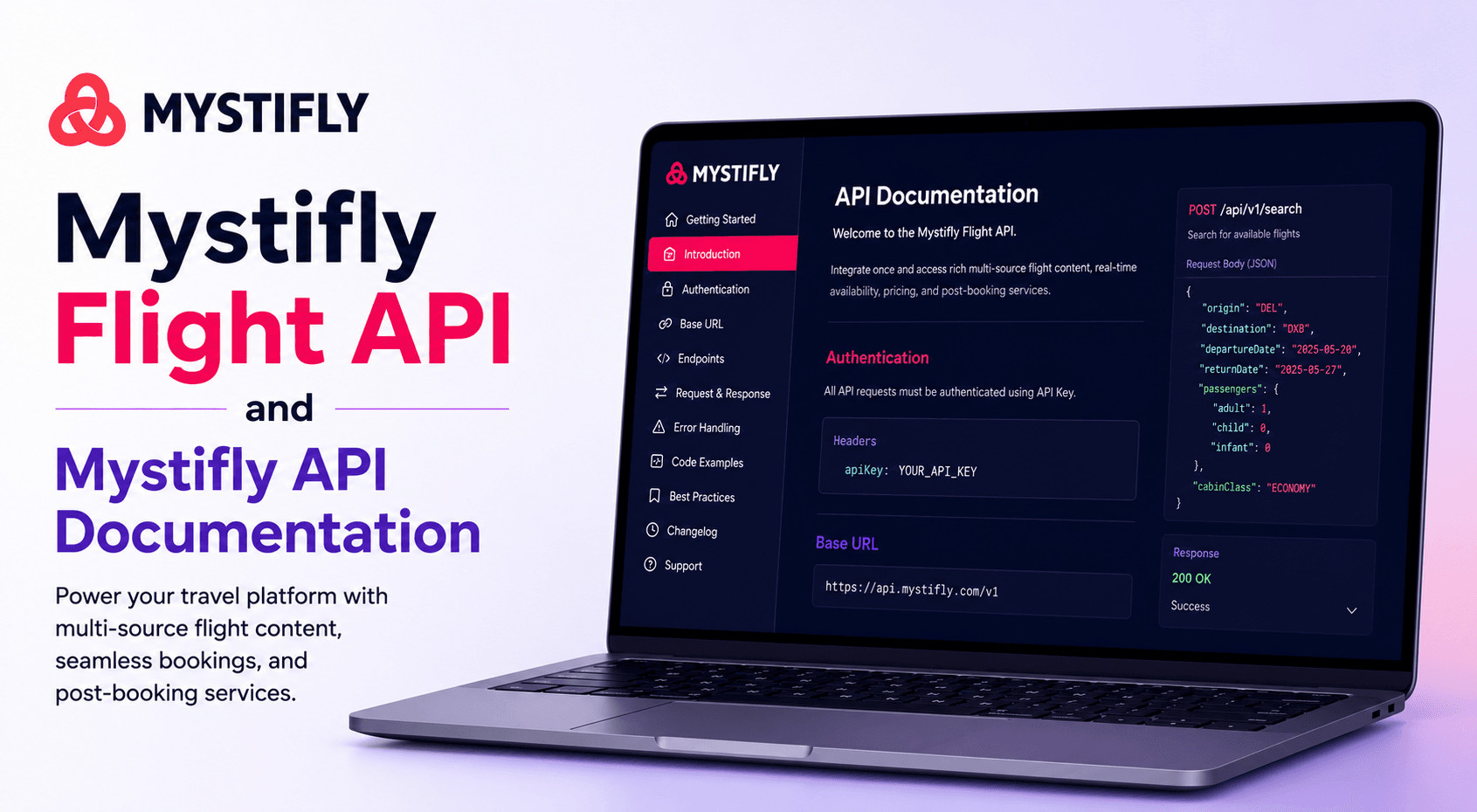
Mystifly Flight API and Mystifly API Documentation: Complete Integration Guide
Modern travel businesses rarely rely on a single airline content source anymore. Online Travel Agencies (OTAs), Corporate Travel Management Companies (TMCs), consolidators, wholesalers, and travel technology providers increasingly require access to multiple airline distribution channels while maintaining a consistent booking experience for customers. This growing demand for flexibility and scalability has made unified airline distribution platforms more important than ever.
This is where the Mystifly Flight API has become an important solution. Instead of connecting separately with every airline, Global Distribution System (GDS), Low-Cost Carrier (LCC), and New Distribution Capability (NDC) provider, businesses can integrate once with Mystifly and access multiple airline inventory sources through a unified platform. This significantly reduces development complexity while improving operational efficiency.
This guide explains everything you need to know about Mystifly API Integration, including how the platform works, available capabilities, integration architecture, booking workflow, documentation, common implementation challenges, and best practices for building scalable airline booking platforms.
What is Mystifly API?
Mystifly is a cloud-based travel technology platform that provides airline distribution services through a unified API. Rather than acting as a traditional Global Distribution System, Mystifly functions as a multi-source airline aggregation platform that combines content from airline NDC connections, Global Distribution Systems (GDS), Low-Cost Carriers (LCC), consolidator inventory, and direct airline connections. This aggregation allows travel businesses to access a wide range of airline content without managing multiple integrations individually.
The platform is designed for travel businesses that want a single integration instead of maintaining dozens of airline-specific connections. Its primary customers include Online Travel Agencies (OTAs), B2B travel portals, corporate travel platforms, travel management companies, airline consolidators, travel startups, and loyalty platforms. By offering a unified interface, Mystifly simplifies airline distribution and enables faster time-to-market for travel solutions.
What is the Mystifly Flight API?
The Mystifly Flight API allows developers to search, compare, book, ticket, manage, and service airline reservations using a unified interface. Instead of integrating with multiple airline APIs individually, developers communicate with one platform while Mystifly handles supplier connectivity behind the scenes. This abstraction layer reduces complexity and ensures consistency across different airline data sources.
Typical capabilities include flight search, fare availability, flight booking, ancillary services, ticket management, refunds, exchanges, cancellations, reissues, and post-booking servicing. These features enable travel platforms to deliver a complete airline booking experience without needing to build separate integrations for each airline or supplier.
Understanding Mystifly API Integration
A typical Mystifly API Integration consists of several stages rather than a single API call. The overall lifecycle begins when a user searches for flights, after which Mystifly collects inventory from multiple airline sources and normalizes the results into a consistent format. The customer then selects a preferred itinerary, and the system performs fare validation to ensure pricing accuracy before proceeding with the booking request.
Once the booking is confirmed, the ticket is issued and a booking reference is generated. Post-booking servicing remains available throughout the lifecycle, allowing users to manage their reservations, request refunds, or make changes. This unified workflow simplifies airline distribution for travel platforms and ensures a seamless user experience.
Integration Flow Overview
| Stage | Description |
| Search | User searches flights |
| Aggregation | Mystifly collects data from multiple sources |
| Normalization | Data is standardized |
| Selection | User selects itinerary |
| Validation | Fare is rechecked |
| Booking | Reservation created |
| Ticketing | Ticket issued |
| Servicing | Post-booking operations |
Mystifly API Documentation Overview
One important observation during technical research is that Mystifly API Documentation is not fully available through a public self-service developer portal. Unlike some API providers that publish complete OpenAPI or Swagger specifications, Mystifly primarily provides documentation during partner onboarding. This approach ensures that integrations are aligned with business agreements and technical requirements.
Public information indicates support for flight search APIs, booking APIs, and post-booking requests. However, detailed endpoint documentation, authentication methods, rate limits, and production credentials are generally shared after commercial onboarding. This makes the implementation process more structured and partner-driven, requiring coordination between technical and business teams.
Documentation Access Model
| Access Type | Availability |
| Public Docs | Limited |
| Partner Docs | Full Access |
| API Credentials | Provided after onboarding |
| Technical Support | Available for partners |
Airline Content Sources Supported
Mystifly aggregates airline content from multiple distribution channels, including NDC for rich airline content, GDS for global airline inventory, LCC for low-cost carriers, consolidators for negotiated fares, and direct airline APIs for airline-specific inventory. This multi-source approach helps travel businesses increase flight availability while reducing the complexity of managing numerous integrations. By combining these sources, Mystifly ensures broader coverage and more competitive pricing options for end users.
Content Source Breakdown
| Source Type | Benefit |
| NDC | Rich content and personalization |
| GDS | Global airline coverage |
| LCC | Budget airline options |
| Consolidators | Discounted fares |
| Direct APIs | Airline-specific inventory |
Typical Flight Booking Workflow
A standard booking flow generally begins with a customer searching for flights, followed by selecting a preferred itinerary from the available options. The system then performs fare validation to verify the latest pricing before creating a reservation. Once the booking request is processed, the airline ticket is generated and a booking reference is returned to the user.
After confirmation, the booking enters the post-booking phase, where users can manage their reservations, request refunds, or make changes such as exchanges or cancellations. This workflow forms the foundation of most airline reservation systems built using Mystifly and ensures a consistent and reliable booking experience.
Booking Workflow Steps
| Step | Action |
| 1 | Flight Search |
| 2 | Select Itinerary |
| 3 | Fare Validation |
| 4 | Booking Creation |
| 5 | Ticket Issuance |
| 6 | Confirmation |
| 7 | Post-booking Management |
Key Features of the Mystifly Flight API
The Mystifly Flight API offers several valuable capabilities that enhance airline booking systems. One of the most important features is multi-source flight search, which allows developers to retrieve flight availability from multiple suppliers using a single API. This is complemented by a unified response format that normalizes different airline responses into a consistent structure, making it easier to process and display data.
The API also supports NDC connectivity, enabling access to richer airline content, as well as GDS connectivity for broader airline coverage. Additionally, it includes support for low-cost carrier inventory, allowing travel platforms to offer budget airline options alongside traditional carriers. Ancillary services such as seat selection, meals, baggage, and special requests are also supported, providing a more comprehensive booking experience.
Post-booking servicing is another key feature, allowing platforms to manage refunds, exchanges, reissues, and cancellations without building separate workflows for each airline. This significantly reduces development effort and improves operational efficiency.
1. Mystifly API Architecture
A simplified architecture of Mystifly integration involves a customer interacting with an OTA website, which communicates with the Mystifly API. The API then connects to multiple airline sources, including NDC, GDS, LCC, and direct airline systems, before returning booking confirmation to the user. This layered architecture ensures that the booking engine only communicates with one integration layer, simplifying development and maintenance.
2. Common Integration Challenges
Despite simplifying airline connectivity, several implementation challenges remain. One of the primary challenges is handling multiple airline response formats, as each supplier returns data in a different structure. Normalization is essential to ensure consistency across the platform.
Another challenge is fare revalidation, as prices can change within seconds. It is crucial to validate fares before final booking to avoid discrepancies. Booking state management is also important, as systems must maintain booking status across search, reservation, ticketing, and servicing stages.
Post-booking operations such as refunds and exchanges often involve supplier-specific business rules, requiring applications to support asynchronous processing. Additionally, retry logic must be carefully implemented to handle temporary API failures without causing duplicate bookings. Logging and monitoring are equally important, as storing identifiers such as booking references, conversation IDs, passenger information, and supplier references helps simplify troubleshooting and improve system reliability.
Best Practices for Mystifly API Integration
Successful implementations of Mystifly API Integration typically involve building a supplier abstraction layer to isolate business logic from supplier-specific details. It is also important to separate search and booking services to improve scalability and maintainability. Caching search responses responsibly can enhance performance, while validating fares before booking ensures pricing accuracy.
Centralized logging should be used to track system activity, and retry mechanisms should be implemented carefully to avoid unintended consequences. Designing scalable booking workflows and continuously monitoring API latency are essential for maintaining performance. Additionally, maintaining supplier-independent data models helps ensure flexibility and future scalability.
1. Security Considerations
A production-grade integration with Mystifly should include robust security measures. These include using HTTPS encryption to protect data in transit, securely storing credentials, and managing access tokens effectively. Audit logging is important for tracking system activity and ensuring accountability.
Compliance with industry standards such as PCI DSS is necessary when processing payments, while GDPR compliance ensures proper handling of traveler data. Secure storage of passenger information is also critical to protect user privacy and maintain trust.
When Should You Choose Mystifly?
Mystifly is generally suitable for organizations that require access to multiple airline connections through a single integration. It is particularly beneficial for businesses that need NDC content, GDS access, low-cost carrier inventory, and enterprise-level travel platforms. Online Travel Agencies, corporate booking engines, and travel startups planning to scale can all benefit from Mystifly’s unified approach to airline distribution.
The Mystifly Flight API provides travel businesses with a practical way to simplify airline connectivity by bringing together NDC, GDS, low-cost carrier, and consolidator content through a single integration layer. This unified approach reduces complexity and enables faster development of airline booking platforms.
Although detailed Mystifly API Documentation is generally shared during partner onboarding rather than through a fully public developer portal, the platform offers comprehensive capabilities for flight search, booking, ticketing, ancillary services, and post-booking management.
For travel technology companies, understanding the complete booking workflow, designing scalable integration architecture, and implementing robust monitoring, validation, and servicing processes are just as important as connecting to the API itself. When implemented with proper planning and engineering practices, Mystifly API Integration can help create reliable airline booking systems that are easier to maintain, scale, and extend as airline distribution continues to evolve, and companies like Traveltekpro can further enhance these implementations by providing advanced travel technology solutions and integration expertise.
Read More: GDS Reservation Systems: The Future of Travel Agency Success
FAQ'S
Related Blogs
Corporate Travel Booking System for Small Business vs. Enterprise: Key Differences
Corporate Travel Booking System for Small Business vs. Enterprise: Key Differences Choosing a corporate travel booking system becomes more complicated as your company grows. A business with 15 employees travelling occasionally might need a simple…
Oct 15, 2026Read More
How to Choose the Best Vacation Rental Management Software
How to Choose the Best Vacation Rental Management Software Choosing the right Vacation Rental Software is not simply about comparing platforms or counting features. A system can have a long list of capabilities and still…
Oct 14, 2026Read More
Get in touch
Email Us
sales@traveltekprogroup.com“We opted for Traveltekpro to construct and implement our Flight booking system, and I am thoroughly pleased with the outcomes. Their team displays remarkable efficiency, expertise, and utmost professionalism throughout the project.”

Arun Neli
Chief Operating Officer
“I had a fantastic experience with Traveltekpro! Their custom booking system designed for our platform is not only sleek and easy to use,but it has also received excellent feedback rom our customers. Kudos to the Traveltekpro team for their outstanding work!”

Benjamin Smith
Product Manager
“Traveltekpro has been a delight to collaborate with on two distinct occasions, showcasing professionalism and expertise. Their team demonstrates a commitment to surpassing expectations and adheringto deadlines.”

Kevin Brown
CTO
“We partnered with Traveltekpro for our travel booking platform, and the experience was excellent. The team understood our requirements quickly, delivered on time, and provided great support throughout the project. Highly recommended.”

Manish Singh
Director of IT
“Great experience working with Traveltekpro. They were responsive, knowledgeable, and always ready to suggest better solutions. The final product exceeded our expectations, and the after-launch support has been excellent.”

Shubham Rawat
Founder & CEO