
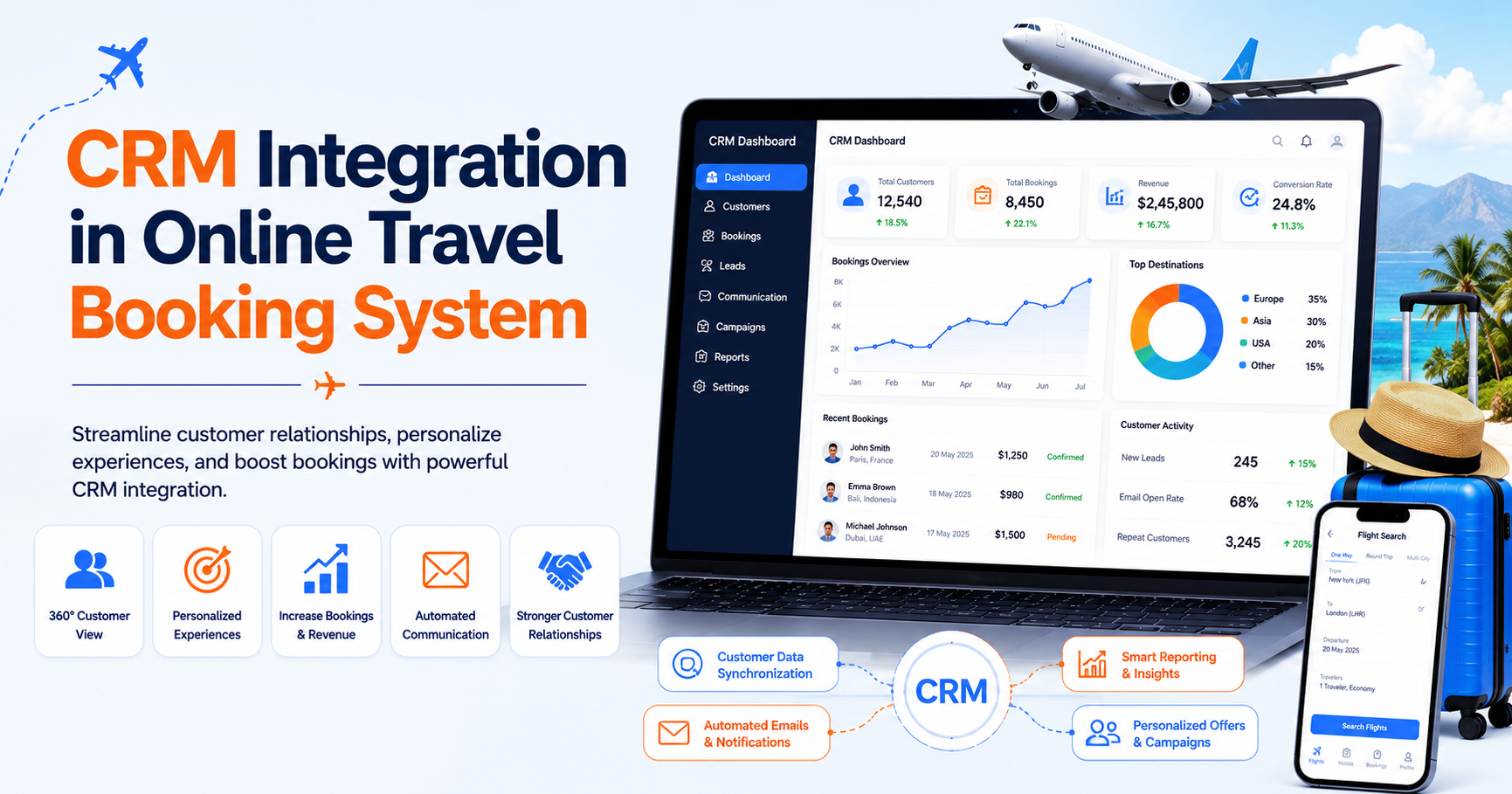
CRM Integration in Online Travel Booking System
Winning a new customer is not easy. As a travel business, you might invest in digital marketing, social media campaigns, referrals and partnerships just to encourage someone to make their first booking. But once the trip is over, you might lose touch with those customers completely. Not because the customer wasn’t satisfied, but because the business does not have a structured way to connect the relationship. Customer details end up scattered across emails, WhatsApp chat, spreadsheets, and even booking platforms. One team member knows about a customer’s travel preferences, while another has no idea that they have booked before. By the time the traveller starts planning their next holiday, the business has missed countless opportunities to reconnect. This is exactly where you might even unknowingly lose revenue. An Online Travel booking system. There’s an amazing job of managing reservations and itineraries. Bookings alone do not create loyal customers.
Without travel CRM integration, valuable customer information often stays disconnected, making it challenging for you to deliver customized service. When your booking system and travel CRM work together, every booking business becomes way more than just a completed transaction. It becomes a source of valuable customer insights. Your team can understand travel preferences and remember previous trips while responding more quickly to inquiries and creating a customized preference that encourages travellers to book again.
Why do bookings alone don’t build a successful travel business?
You might measure success by the number of bookings that you receive every month. No doubt bookings are very important but they are just a part of the story.
1. One time bookings versus long term customers
Just imagine 2 travel agencies. The first constantly spends more money attracting new customers because very few return after the first trip. The second has customers who regularly book holidays recommend the business to friends and trust the agency with every future journey. Both the businesses receive the same number of bookings this month. But with time the second business usually becomes more profitable because repeat customers are easier and less expensive to serve.
2. Customer retention is often more profitable Then customer acquisition
Acquiring new customers requires constant investment in advertising and marketing campaigns. Returning customers already know your brand. They trust your service and often make decisions more quickly. By encouraging repeat bookings you can improve profitability while reducing customer acquisition costs.
3. Fragmented customer information creates poor experiences
Have you ever asked your customer to repeat information they have already shared? Or struggle to find the previous booking details as they were stored in different places? These situations are common when your customer information is spread across multiple systems. Instead of delivering a smooth experience you unintentionally create frustration. Your customers notice these small moments. They expect you to remember the preference and previous steps. Without connected information delivering that level of service becomes much harder.
4. Relationship management has become a competitive advantage
Today’s travellers do not choose business based only on price. They also value convenience trend personalized recommendation and responsive customer experience. When you understand that your customers can offer more relevant travel suggestions, respond faster to inquiries and create experiences that encourage long term loyalty. In a competitive marketplace strong relationships often become the difference between winning your customer once and keeping them for life.
Every customer interaction matters- not just the final booking
You might think customer management begins after a booking is confirmed. In reality it starts much earlier.
-
First inquiry
Everything begins with a question. For example a traveller might ask you about destinations and flight availability. Capturing this information helps you understand customer interest from the very beginning. Even if they do not book immediately these conversations remain valuable.
-
Trip planning
As your customers compare destinations, dates and hotels they often share useful preferences. Maybe they prefer luxury resorts or perhaps they only travel during school holidays. Recording these details makes future conversations much more personal. This is only possible through Travel CRM integration.
-
Booking confirmation
Once the booking is completed your customer journey is only the beginning. Confirmation emails, payment status and travel documents all become part of your customers’ experience. Keeping this information organised helps your customers and your team.
-
Pre departure communication
Before departure travellers often have questions. They might need visa updates and baggage information. A connected Travel CRM allows your team to provide timely information without repeatedly asking customers for the same details.
-
Travel support
Unexpected situations might happen. Lights change and even hotel request updates. Having complete customer information available helps your team respond more confidently and effectively.
-
Future travel opportunities
A customer who booked a honeymoon this year might plan a family holiday. Someone who travels but your business might also need leisure trips. Understanding previous booking helps your team recommend relevant and options
Where travel businesses lose valuable customer data?
Customer information is one of the most valuable assets that a travel business has. Yet many companies unintentionally lose that value because information is scattered.
1. Conversation happen everywhere
Your customer sent an inquiry through your website later they continue the conversation through WhatsApp. Then they sent the passport details and finally they called to change the travel dates. Without a centralised Online Travel booking system important information becomes difficult to track. Your team spends valuable time searching through different portals.
2. Booking history is hard to find
A returning customer contacts or agency. They booked with you last year but no one can quickly locate their previous itinerary. Instead of providing personalized recommendations your staff must start the conversation from the beginning. That slows down the service and reduces the personal touch that customers appreciate.
3. Traveller preferences are easily forgotten
Some customers always choose premium hotels, others prefer direct flights. If these preferences are not stored in one place valuable insights disappear after every booking.
4. Follow up opportunities are missed
A customer celebrates an anniversary every December, another regularly travels during school holidays. Without organised Travel CRM integration, these opportunities remain hidden.
How does Travel CRM change the way your team works?
The biggest advantage of CRM integration is not just storing customer information. Instead of spending time searching for information, your employees can focus on building stronger customer relationships.
-
Bringing customer information into one place
Just imagine opening one customer profile and immediately seeing previous bookings and upcoming trips besides payment status and communication history. Instead of searching across multiple systems everything is available in one location.
-
Helping sales and operations stay connected
Your sales teams promise experience in operation teams. When both departments work from the same customer information, communication becomes much smoother. Everyone understands the customers requirements, reducing misunderstandings and improving coordination.
-
Personalising travel recommendations
CRM HC you understand customer preferences instead of making assumptions. If your traveller regularly works at luxury resorts, recommending budget accommodation is not helpful. Likewise a family that books school holiday vacations has different needs than someone travelling for business. Customized recommendations feel more relevant and improve customer experience
Without CRM Integration vs With Travel CRM Integration
| Business Area | Without Travel CRM Integration | With Travel CRM Integration |
| Customer Information | Stored in different places | Available in one central system |
| Booking History | Difficult to find | Easy to access anytime |
| Customer Response | Slower due to manual searches | Faster with complete customer details |
| Team Collaboration | Teams work with different information | Everyone has access to the same customer data |
| Follow-Up | Often missed or inconsistent | Automated and timely follow-ups |
| Travel Recommendations | General offers for everyone | Personalized offers based on customer preferences |
| Repeat Bookings | Hard to track and encourage | Easier to build long-term customer relationships |
| Business Insights | Limited visibility into customer behaviour | Clear reports and insights for better decisions |
Connecting your Online Travel booking system with the rest of your business
Many travel businesses think of CRM as a separate tool. But in reality its biggest strength comes from working alongside your online travel booking system and other systems your business uses everyday.
1. Booking platform
The booking platform is where every customer journey begins. When someone searches for a flight or books a hotel that information should automatically become part of your customer profile. Instead of manually updating records the CRM receives booking details instantly.
2. CRM
Crm works like the central hub for your customer information. It combines booking history inquiries and communication records. This gives every department a clear understanding of the customer without searching for multiple systems.
3. Payment systems
Payments are an important part of every booking. When payment information connects with CRM your team can quickly see whether invoices have been paid or refunds are pending. This improves communication while reducing unnecessary follow up.
4. Customer communication
Confirmation emails and travel reminders besides visa updates and post follow ups all become much easier when your customer data is centralised. Instead of sending generic messages you can communicate with your travellers based on your booking status.
5. Sales team
Sales representatives can immediately view previous bookings and recent inquiries. This helps them recommend relevant travel options instead of restarting every conversation from scratch.
Signs your travel business is ready for Travel CRM integration
-
Customer inquiries on increasing
As your business grows so do customer questions. Without a structured system following every conversation becomes very difficult. Important conversation might be delayed.
-
Repeat bookings are becoming hard to manage
Returning customers expect you to remember that. If your team struggles to locate previous bookings or customer preferences, delivering customized service becomes really difficult.
-
Staff spend too much time searching for information
Employees should not spend valuable time looking through emails and spreadsheets just to answer one customer question. A centralised Travel CRM reduces unnecessary work.
-
Follow ups are inconsistent
Some customers receive reminders and promotional offers while others earn nothing after that trip. Without automation follow up depends on individual employees remembering to connect customers.
-
Customer service depends on who answers the phone
If one employee knows everything about a customer while another knows very little quality becomes inconsistent. Every team member should have access to the same customer information.
-
Growth is creating operational complexity
Growth is very exciting, but it also creates challenges. More customers, more suppliers, and more bookings increase the amount of information that your business needs to manage.
The most successful travel businesses treat customer data as a growth asset
Customer data is way more than this collection of names and booking records. It is one of the most valuable assets that your business owns. Successful travel companies use this information to make smarter decisions every day.
1. Data supports better decisions
Understanding which destinations perform well when customers book and which marketing campaigns generate the highest conversions that help businesses invest more wisely.
2. Customer behaviour reveals new opportunities
Patterns are often likely to emerge with. Families might travel during school holidays or corporate clients might book regularly throughout the year. Recognizing these patterns help you create more relevant offers.
3. Marketing becomes more effective
Instead of sending broad campaigns to every customer, you can now communicate based on travel interest, previous bookings or seasonal preference.
Choose a travel technology partner that understands CRM integration
Integrating a CRM is not just about connecting to software systems. It is all about creating a smoother way for your entire business to operate. That’s why choosing the right technology partner matters. You need to look for a team that understands how travel businesses actually work. They should know the relationship between bookings, supplier management and customer service payments. Experience with travel technology is equally important. A knowledgeable partner like Traveltekpro understands how booking system APIs and payment gateways work together to support day to day operations.
So you must know that the travel industry has become more competitive than ever and competing on price alone is rarely enough. Travellers remember your business if you understand their needs and respond quickly. An online travel booking system is very important for managing reservations payments and itineraries. But when it’s combined with travel CRM integration it becomes much more than just a booking tool.
Read More: What is CRM in the Travel Industry? A Complete Guide
FAQ'S
Related Blogs
How to Find the Best Hotel Booking Website Development Company
How to Find the Best Hotel Booking Website Development Company Choosing a company for hotel booking website development is not completely the same as hiring someone to build a regular business website. A normal website…
Oct 12, 2026Read More
How an Online Hotel Booking System Can Enhance Guest Experience and Increase Revenue
How an Online Hotel Booking System Can Enhance Guest Experience and Increase Revenue Your guest does not start experiencing a hotel when they walk through the lobby doors. The experience often starts several days or…
Oct 9, 2026Read More
Get in touch
Email Us
sales@traveltekprogroup.com“We opted for Traveltekpro to construct and implement our Flight booking system, and I am thoroughly pleased with the outcomes. Their team displays remarkable efficiency, expertise, and utmost professionalism throughout the project.”

Arun Neli
Chief Operating Officer
“I had a fantastic experience with Traveltekpro! Their custom booking system designed for our platform is not only sleek and easy to use,but it has also received excellent feedback rom our customers. Kudos to the Traveltekpro team for their outstanding work!”

Benjamin Smith
Product Manager
“Traveltekpro has been a delight to collaborate with on two distinct occasions, showcasing professionalism and expertise. Their team demonstrates a commitment to surpassing expectations and adheringto deadlines.”

Kevin Brown
CTO
“We partnered with Traveltekpro for our travel booking platform, and the experience was excellent. The team understood our requirements quickly, delivered on time, and provided great support throughout the project. Highly recommended.”

Manish Singh
Director of IT
“Great experience working with Traveltekpro. They were responsive, knowledgeable, and always ready to suggest better solutions. The final product exceeded our expectations, and the after-launch support has been excellent.”

Shubham Rawat
Founder & CEO