
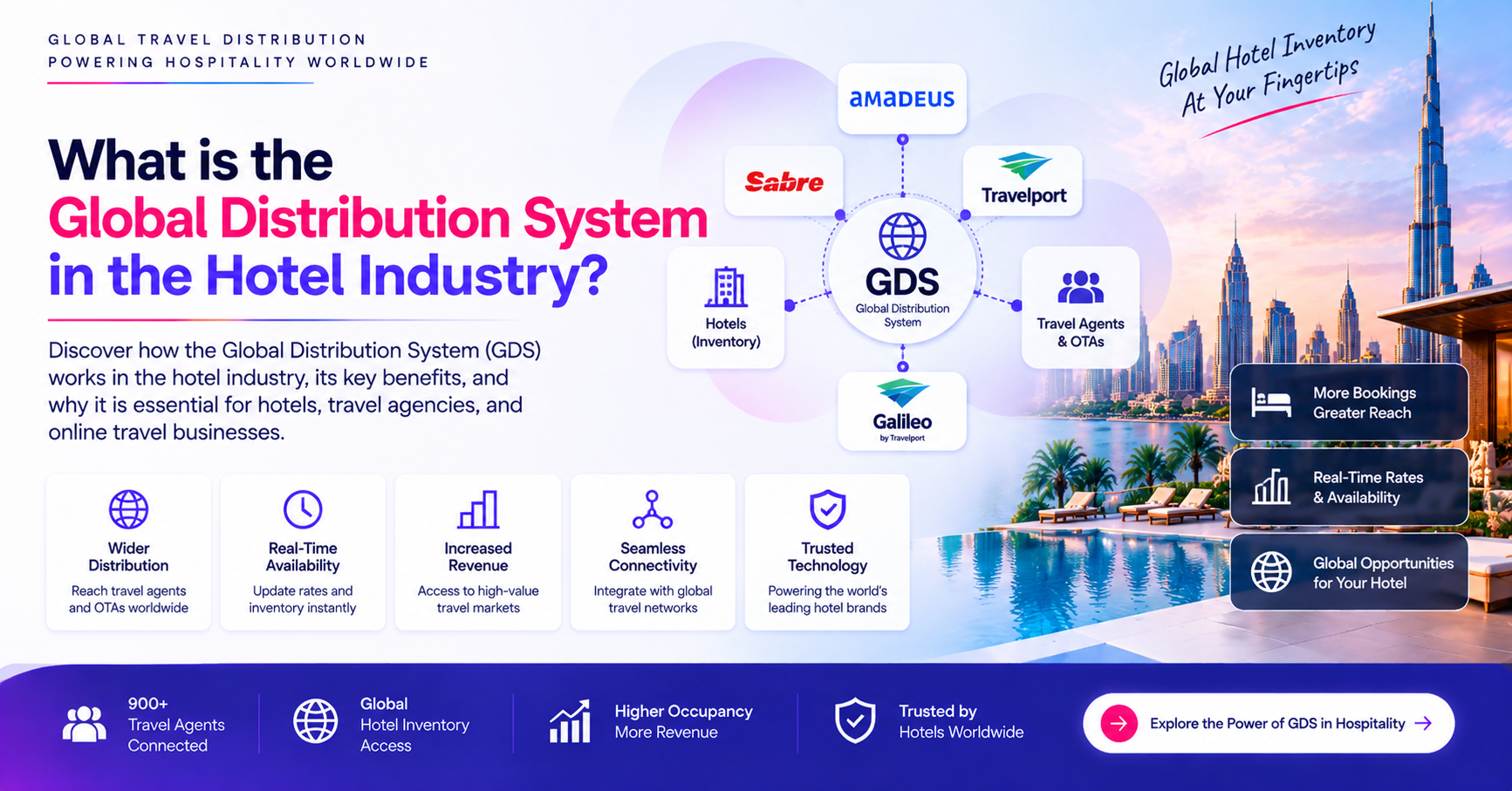
What is the global distribution system in the hotel industry
Your hotel might have hundreds of rooms to sell but its own website is only one place where those rooms can be booked. A business traveller might book through a corporate travel company. A customer travelling for a conference might ask a travel agent to arrange the stay, while a company might have negotiated hotel rates that are booked through a travel management platform rather than directly with the hotel. So how does the hotel make its room dates and availability visible to all the professional travel sellers without building a separate connection for every one of them? This is where the global distribution system enters the picture.
A hotel distribution system works like a distribution channel between travel suppliers and travels. In the hotel industry, it can distribute information like room availability and booking details to connected travel agencies, corporate travel companies and other professional travel platforms. For hotels, the value of GDS is not simply about putting rooms online. It’s also about reaching the right distribution channels and making the inventory bookable through the systems travel professionals already use.
GDS is a distribution layer, not the hotel’s booking site
It’s very easy for you to confuse the GDS hotel reservation system with a hotel booking engine because both can be involved in making a hotel room available for booking. But they perform very different jobs. A hotel booking engine is basically designed for direct bookings. Your customer visits the hotel’s website, searches for a date , selects a room and completes a reservation directly with the property. GDS works differently. The hotel makes its inventory available through the GDS and connected travel sellers can access that information through their own system. This means gds hotel booking Does not necessarily replace the website or hotel booking engine.
A customer already knows the hotel might go directly to its website and make a reservation. Another customer might ask a travel agent to find a suitable hotel in which case the agent might search hotel inventory through GDS. So GDS does not replace or direct bookings it gives you another route to reach customers through the professional travel distribution network.
Where does a GDS sit in the hotel distribution system?
The easiest way to understand the GDS hotel reservation system is to follow the information from the property to the traveller . The hotel is a source of the room inventory. Its systems include information on room rates availability and booking conditions. GDS works like the distribution network that provides the information to connected travel sellers. The travel agency or the corporate travel platform can then search that inventory, select an appropriate rate and make the reservation for the customer. That means gds is not where the hotel lives. It is the connection that helps the hotel’s inventory reach another part of the travel market.
What information does the GDS reservation system distribute?
A GDS hotel Reservation system needs to carry much more than the hotel’s name and room price. When your agent searches for a property the information returned can include details:
- Room types
- Availability
- Rates
- Rate plans
- Meal plans
- Occupancy rules
- Cancellation policies
- Booking restrictions
- Hotel policies
- Other relevant property information
For example, an agent searching for a hotel in Dubai may see two rates for the same room:
| Rate | Price | Meal Plan | Cancellation |
| Room Only | AED 500 | No breakfast | Non-refundable |
| Flexible Rate | AED 560 | Breakfast included | Free cancellation until specified date |
The agent is not comparing prices. They are just comparing what the customer actually gets for their price. This is why the quality of the information being distributed matters. If room names, policies or cancellation conditions are unclear the booking process becomes harder for both the agent and the traveller.
What if a travel agent searches a hotel through a GDS?
Your customer asks a travel agent to find a hotel in Dubai for 3 nights. The agent enters the destination dates and number of guests into the booking system.
1. The agent searches for the hotel
The agent enters details like destination check in date and checkout date.
2. The GDS process is the request
GDS searches the connected hotel inventory based on the requirements of gds hotel booking.
3. Hotel results are returned
The agent receives available properties and their relevant rates or room information.
4. The agent then selects a suitable rate
The agent compares options and chooses the room and rate that fits your customers requirements.
5. The booking request is sent
Customer details and selected reservation information are submitted through the distribution system.
6. Confirmation is returned
Once the reservation is successfully processed, the booking confirmation and relevant destination details are returned to the selling side.
That is the hotel distribution system in practical terms. The technologies working behind the scenes mean the travel professional does not have to separately contact every hotel to check availability and make each reservation.
GDS hotel reservation system is particularly relevant to corporate travel
Corporate travel has different booking requirements from a typical leisure booking. You might not simply search for the cheapest room available. The company might have preferred hotels, negotiated rates, and specific spending policies or approved booking channels. The booking might go through a travel management company, corporate travel agencies, business travel platforms, and even managed travel programs. These businesses also need information like corporate rates, booking preferences, traveller details and reporting information. This is one reason GDS connectivity continues to matter in professional hotel distribution. For a corporate travel company, the ability to search and book hotel inventory through an established distribution network can be a part of a much larger workflow.
GDS hotel booking vs hotel booking engine vs API
| Requirement | GDS | Hotel Aggregator/API |
| Professional travel distribution | Strong fit | Can also be relevant |
| Corporate travel | Particularly relevant | Depends on the inventory |
| Multiple hotel suppliers | Possible through connected distribution | Core use case |
| OTA connectivity | Possible | Common use case |
| Direct supplier relationships | Not necessarily required | May vary |
| Technology integration | Required | Required |
How does GDS connectivity affect your hotel availability and rates?
Hotel inventory is not static. A room available at 10:00 AM might be sold by 2:00 PM. A hotel can also change its rates close to the rate plan user restriction. A refundable rate might also have different conditions from a non-refundable rate. This creates an important relationship. A travel agent might search for a hotel and see an attractive rate; by the time the booking is submitted, the underlying inventory might have changed. This is the only reason why technology needs to handle availability and booking responses carefully.
What happens after GDS hotel booking?
The booking does not stop when the confirmation number appears. Your customers might later ask to change their stay or they might even cancel the reservation. Depending on the GDS and the connected hotel workflow, post-booking functions can include reservation retrieval, confirmation details, cancellation, booking status, and hotel information. This is the only reason why evaluating GDS connectivity only in the initial booking can give you an incomplete picture. For a travel agency or an OTA, servicing the booking after the sale is just as important as creating it.
Why might GDS integration alone not be enough for an OTA?
If you are an OTA you might have a broader inventory requirement than a traditional corporate travel workflow. It might want access to GDS hotel APIs or even direct suppliers. Why use more than one source? Because different suppliers might have different properties, market rates and commercial terms. One supplier might have better coverage while another might provide better availability or pricing in another. That does not mean that you should connect to as many suppliers as possible. Every additional connection brings more work around mapping, monitoring and error handling. So the objective is not maximum activity.
How Traveltekpro can support GDS and hotel booking connectivity.
For travel technology Business connecting a GDS is only one part of the project. The bigger task is making that inventory usable inside the booking environment where customers and travel agents actually search and book. The practical role of technology is to connect travel inventory with the systems used by agencies and other travel businesses.
Traveltekpro can support travel businesses with areas such as:
- GDS integration
- Hotel API integration
- Travel API integration
- Booking engine connectivity
- B2B travel portals
- B2C booking platforms
- Multi-supplier travel inventory
The practical role is to connect travel inventory with the booking environment used by agencies, OTAs and other travel businesses.
So you need to know that a hotel distribution system is way more than just a technical connection. It is the network of channels and systems that help a hotel make its rooms available to different types of buyers. GDS hotel reservation system allows hotel inventory rates and availability to reach connected travel sellers while GDS hotel booking supports the reservation process through the professional travel channels. But GDS does not exist in isolation. A modern hotel or travel business might work with GDS and travel APIs or direct booking channels at the same time. The right combination depends on who you sell to what inventory you need and which markets you serve and how your booking platform is built.
Read More: What Is a GDS Flight Booking System Essential for Travel Agents?
FAQ'S
Related Blogs
How an Online Hotel Booking System Can Enhance Guest Experience and Increase Revenue
How an Online Hotel Booking System Can Enhance Guest Experience and Increase Revenue Your guest does not start experiencing a hotel when they walk through the lobby doors. The experience often starts several days or…
Oct 9, 2026Read More
Car Rental Booking APIs: Integrations with DMC, OTAs, and Travel Agencies
Car Rental Booking APIs: Integrations with DMC, OTAs, and Travel Agencies A car rental might look like a simple travel product. Your customer chooses a vehicle enters the travel dates and pays and receives a…
Oct 8, 2026Read More
Get in touch
Email Us
sales@traveltekprogroup.com“We opted for Traveltekpro to construct and implement our Flight booking system, and I am thoroughly pleased with the outcomes. Their team displays remarkable efficiency, expertise, and utmost professionalism throughout the project.”

Arun Neli
Chief Operating Officer
“I had a fantastic experience with Traveltekpro! Their custom booking system designed for our platform is not only sleek and easy to use,but it has also received excellent feedback rom our customers. Kudos to the Traveltekpro team for their outstanding work!”

Benjamin Smith
Product Manager
“Traveltekpro has been a delight to collaborate with on two distinct occasions, showcasing professionalism and expertise. Their team demonstrates a commitment to surpassing expectations and adheringto deadlines.”

Kevin Brown
CTO
“We partnered with Traveltekpro for our travel booking platform, and the experience was excellent. The team understood our requirements quickly, delivered on time, and provided great support throughout the project. Highly recommended.”

Manish Singh
Director of IT
“Great experience working with Traveltekpro. They were responsive, knowledgeable, and always ready to suggest better solutions. The final product exceeded our expectations, and the after-launch support has been excellent.”

Shubham Rawat
Founder & CEO