
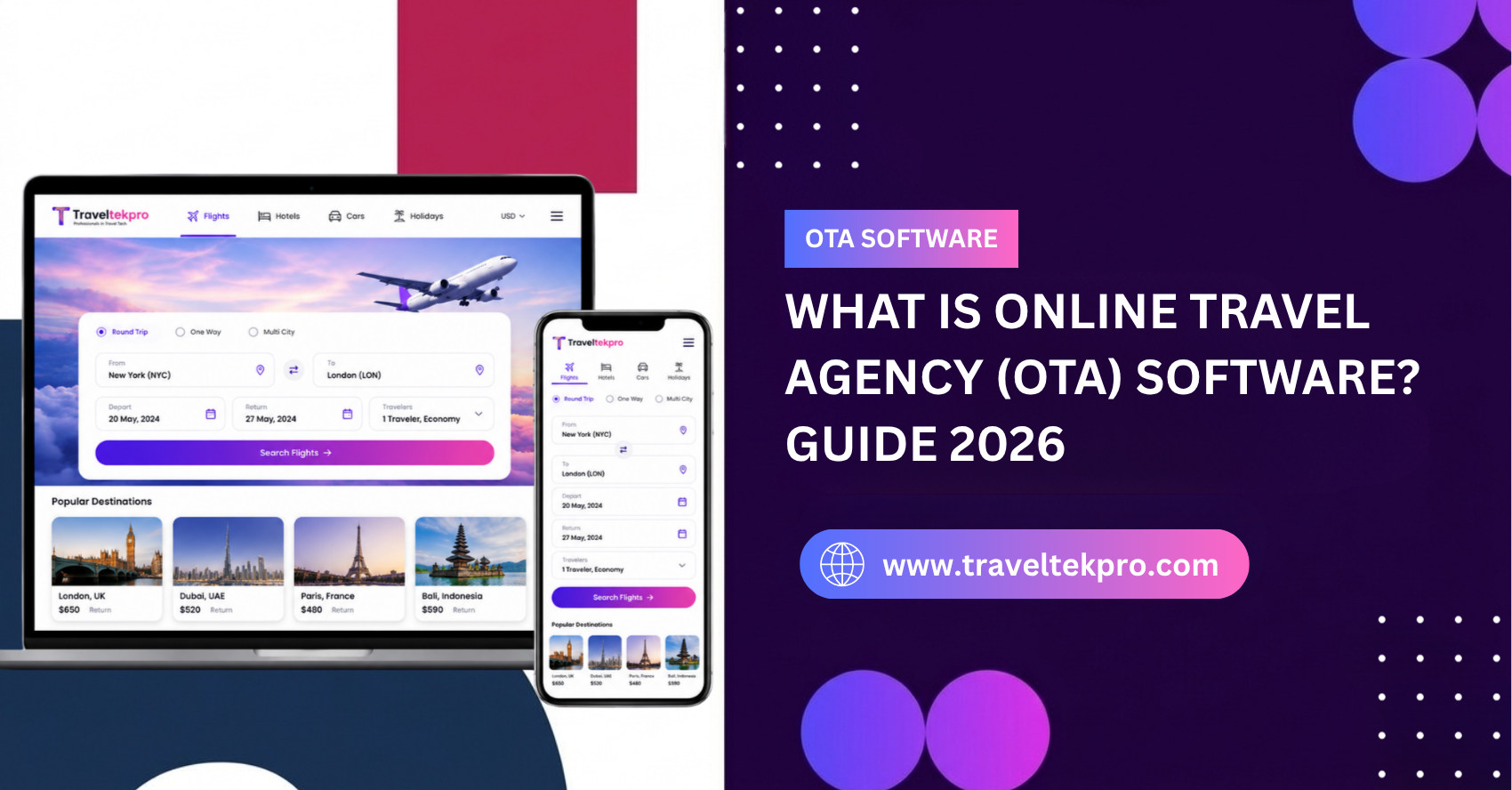
What is Online Travel Agency (OTA) Software? Complete Guide for Travel Agents in 2026
We’ve spent years working hands-on with travel agencies, OTAs, and tour operators integrating booking technology from large multi-vertical platforms connecting to Amadeus and Sabre, to boutique agencies launching their first IBE on a white-label stack. The question we hear most consistently from agency owners and product leads is still the same: what exactly is OTA software, and what do I actually need?
This guide answers that question from first principles. We cover what OTA software is, how it works under the hood, what components you’ll need, and what the key decision points are in 2026. We don’t cover hotel PMS or airline PSS those are separate systems upstream of the OTA layer. This is specifically for agencies and OTA operators building or evaluating the customer-facing booking experience.
What is OTA Software?
OTA software — Online Travel Agency software is the integrated technology stack that enables a travel business to search, display, price, book, and manage travel products (flights, hotels, car rentals, transfers, packages) through a digital storefront, without the customer needing to contact a human agent.
The term covers both the customer-facing layer (the Internet Booking Engine, or IBE) and the back-office systems that power it: inventory aggregation, pricing engines, booking management, payments, and supplier connectivity.
In practice, no single piece of software covers everything. What most people call OTA software is actually a set of integrated components that work together. Understanding each component and which ones you actually need is the central challenge of OTA platform selection.
As of 2026, the global OTA market handles over $800 billion in gross travel bookings annually, with the top platforms Booking Holdings, Expedia Group, Trip.com accounting for roughly 55% of online leisure travel transactions globally. For independent OTAs and travel agencies, the software infrastructure that powers those platforms is now increasingly accessible as modular, API-first SaaS products.
How OTA Software Works: The Core Architecture
Understanding OTA software starts with understanding the booking flow. Every travel transaction, regardless of platform, follows the same fundamental sequence:
Search → Price → Book → (Post-booking: Modify / Cancel / Refund)
Each stage maps to a distinct layer of the OTA software stack.
-
The Search Layer: Inventory Aggregation
When a customer searches for a flight from Mumbai to London, your OTA software sends that query simultaneously to multiple inventory sources — GDS feeds, airline direct APIs, NDC connections, and low-cost carrier (LCC) aggregators — and stitches the results into a unified response. This is called multi-source aggregation, and it’s the most technically complex part of operating an OTA.
The three primary inventory channels are:
GDS (Global Distribution Systems): Amadeus, Sabre, and Travelport aggregate content from hundreds of full-service carriers and most hotel chains. GDS connectivity provides the broadest air content coverage but comes with per-segment booking fees, typically in the range of $3–$7 per segment depending on volume and negotiation.
NDC (New Distribution Capability): IATA’s NDC (New Distribution Capability) standard, now at schema version 21.3, enables airlines to distribute rich content — including branded fares, ancillaries, and seat maps — directly to agents and OTAs without GDS intermediation. As of 2026, over 80 airlines have active NDC programs, including British Airways, Lufthansa Group, and Air India. NDC integration requires a separate certified connection, either directly or through an NDC aggregator like Verteil, Duffel, or Travelfusion.
Direct Supplier APIs: LCCs like IndiGo, SpiceJet, and Ryanair generally don’t distribute through GDS and require direct API integration. Similarly, hotel chains like Marriott and IHG offer direct API connectivity that may offer rate advantages over GDS hotel content.
The single biggest mistake independent OTAs make is assuming GDS content is sufficient, says one platform architect we work with regularly. You need a strategy for NDC and LCC coverage from day one, or you’re showing customers an incomplete picture.
The Pricing Engine
Once results are returned, the pricing engine applies your agency’s markup rules, commission logic, and any promotional pricing before surfacing fares and rates to the customer. Sophisticated pricing engines also handle fare combination logic — building the cheapest itinerary from a mix of inventory sources — and dynamic packaging (bundling air + hotel into a single price).
The IBE (Internet Booking Engine)
The Internet Booking Engine (IBE) is the customer-facing front end: the search forms, results pages, seat maps, extras selection, and checkout flow. IBE quality directly drives conversion rates. In 2026, leading OTA platforms report checkout conversion rates in the 3–8% range for cold traffic, with loyalty members converting at 2–3x that rate.
The Booking Management Layer
After payment is captured, the booking management layer handles PNR (Passenger Name Record) creation in the GDS or supplier system, ticket issuance, and voucher generation. It also manages the post-booking lifecycle: modifications, cancellations, refunds, and the associated supplier communications.
The Payments Layer
OTA payment infrastructure typically involves a payment gateway (Stripe, Adyen, or Checkout.com are common in 2026), fraud screening, virtual card issuance for B2B payables, and settlement reconciliation. For agencies operating under BSP (Billing and Settlement Plan) or ARC, the payment layer must also interface with IATA’s settlement infrastructure for airline ticket proceeds.
Key Components of OTA Software — What You Actually Need
Not every OTA needs every component. Here’s a breakdown by business model.
|
Component |
B2C OTA | B2B Aggregator | White-Label/Franchise |
Corporate OBT |
|
Multi-source flight aggregation |
✓ | ✓ | ✓ | ✓ |
|
Hotel channel manager connectivity |
✓ | ✓ | ✓ |
Optional |
|
IBE (customer-facing UI) |
✓ | — | ✓ (branded) |
✓ |
|
Mid-office / agent desktop |
Optional | ✓ |
✓ |
✓ |
|
Dynamic packaging engine |
✓ | Optional | ✓ |
— |
|
Corporate policy engine |
— | — | — |
✓ |
|
White-label reseller portal |
— | ✓ | ✓ |
— |
| BSP/ARC settlement | ✓ | ✓ | ✓ |
✓ |
Types of OTA Software Platforms in 2026
The market has consolidated around four delivery models. Each has trade-offs that matter at different scales.
1. Full-Stack OTA Platforms (SaaS)
Full-stack SaaS platforms like Travelomatix, Phptravels, and OTRAMS bundle IBE, mid-office, inventory connectivity, and payment processing into a single licensed product. They’re the fastest path to market for new OTAs typical go-live timelines run 8–16 weeks but customization is limited by the platform’s architecture.
Pricing models vary: most charge a setup fee ($5,000–$50,000), a monthly SaaS license ($500–$5,000), and a per-booking transaction fee (0.5–2% of GTV). At early volumes, the economics are favorable. At scale, the transaction fee becomes a significant cost driver.
2. API-First / Headless OTA Infrastructure
Platforms like Duffel (air), Hotelbeds (hotel), and Viator (activities) provide API-first inventory and booking infrastructure that you connect to your own front end. This model gives you full control over the customer experience and pricing logic, but requires meaningful engineering capacity to build and maintain.
This is the preferred approach for OTAs with in-house engineering teams building differentiated products. It’s also the right model for NDC-first strategies, since API-first platforms tend to have better NDC coverage than legacy full-stack products.
3. White-Label / Franchise OTA Platforms
White-label platforms let you brand and operate an OTA on top of another company’s inventory and booking infrastructure. You own the customer relationship and front-end experience; the platform handles supplier connectivity, payments, and back-office operations. Travelstart, MakeMyTrip’s B2B platform, and several regional players offer this model.
The trade-off: margins are compressed because the platform takes a cut of every booking, and you’re competing on the same inventory and pricing as every other operator on the same platform.
4. Enterprise Custom Build
Large OTAs typically those exceeding $100M in annual GTV often reach a point where commercial platforms introduce more constraints than benefits. At this scale, building proprietary infrastructure (often on top of Amadeus or Sabre’s enterprise APIs) becomes economically rational. This path requires 18–36 months of build time, substantial engineering investment, and ongoing GDS contract negotiation.
OTA Software vs. Related Systems: Clearing Up the Confusion
Several terms are frequently confused with OTA software. Here’s how they relate:
OTA software vs. CRS (Central Reservation System): A CRS is a supplier-side system used by hotels and airlines to manage their own inventory. An OTA consumes inventory from a CRS via a distribution channel. They’re at opposite ends of the supply chain.
OTA software vs. GDS: A GDS (Global Distribution System) is an inventory aggregation network — a B2B marketplace that sits between suppliers and agents. OTA software connects to a GDS to access that inventory. You can’t confuse a GDS subscription for OTA software any more than you’d confuse a wholesale food market for a restaurant.
OTA software vs. IBE: The IBE is one component of OTA software — specifically the customer-facing booking interface. OTA software includes the IBE plus all the back-office infrastructure behind it.
OTA software vs. OBT (Online Booking Tool): An OBT is a corporate travel-specific booking tool that enforces company travel policies (maximum fare rules, preferred vendors, approval workflows). OTAs and OBTs often share underlying technology but serve fundamentally different use cases.
What to Look for When Evaluating OTA Software in 2026
Choosing OTA software is less about features and more about fit — your inventory strategy, customer segment, technical capacity, and growth trajectory all shape which platform makes sense. From hands-on evaluation work across multiple projects, here’s what actually matters:
1. Inventory Coverage
Start with the inventory question: which suppliers do you need to connect to, and does the platform already have those connections live? Confirm GDS connectivity (which of the three Amadeus, Sabre, Travelport?), NDC partnerships, LCC direct connections, and hotel content sources. A platform that claims “1 million+ hotels” may be sourcing them all from a single bed bank with thin coverage in your core markets.
2. Fare Combination and Interline Logic
For air-focused OTAs, the sophistication of fare combination logic the ability to build the cheapest itinerary by mixing carriers and booking classes is a key competitive differentiator. Some platforms only return single-carrier options; others can construct complex multi-carrier, multi-PNR itineraries. Ask to see live demos on actual routes.
3. Booking Management and Post-Booking Automation
Cancellations and modifications are where OTA operations either scale or break. Evaluate how the platform handles involuntary schedule changes (IROPS), refund processing timelines, and customer communications. Platforms with high manual touch in post-booking workflows will cap your growth unless you’re planning to grow your operations team in parallel.
4. Payment and Settlement Infrastructure
Confirm BSP and ARC compatibility if you’re issuing airline tickets. For hotel, verify the virtual card issuance model for supplier payables. Ask specifically about 3D Secure 2 (3DS2) compliance and chargeback handling in our experience, chargebacks are consistently underestimated in OTA planning.
5. Technical Integration and API Quality
If you’re planning any custom development your own front end, CRM integrations, loyalty programs the quality of the platform’s API matters enormously. Review the documentation before signing any contract. Poorly documented APIs with rate limits and undisclosed deprecation schedules are among the most common sources of integration pain in OTA projects.
We spent three months on a GDS integration that should have taken six weeks because the platform’s API documentation hadn’t been updated to reflect a breaking change from the previous year, notes a senior travel tech engineer we’ve worked with on multiple implementations. Always test in sandbox before you commit.
The Cost of OTA Software: What to Budget in 2026
OTA software costs sit across several categories that are easy to underestimate if you only look at the headline license fee.
Platform license and setup: For SaaS full-stack platforms, expect $5,000–$80,000 in setup fees and $1,000–$8,000/month in license costs depending on the vendor and feature set. Enterprise platforms operate on custom pricing.
GDS subscription and booking fees: GDS access requires either a direct contract with Amadeus, Sabre, or Travelport (minimum volume commitments typically apply, often $50,000–$200,000/year in booking fees to get competitive segment pricing) or indirect access through a sub-licensed aggregator at slightly higher per-booking rates.
NDC aggregator fees: NDC aggregators typically charge per-booking fees in the $1–$4 range, similar to or slightly below GDS segment fees, depending on volume.
Payment processing: Stripe and Adyen charge 1.5–2.9% + fixed fee per transaction for card processing in most markets. For a business doing $10M in GTV at an average 80% card payment rate, that’s $120,000–$232,000/year in payment fees alone.
Development and integration: Unless you’re using a fully managed platform, budget for development. API integrations, UI customization, and back-office configuration typically run $50,000–$300,000 for an initial build, with ongoing maintenance costs.
Total first-year cost for a lean B2C OTA launch: Realistically, $150,000–$500,000 including platform, GDS access, development, and working capital for operations. This range assumes a focused single-vertical approach (air-only or hotel-only) rather than a multi-vertical launch.
Common Pitfalls in OTA Software Implementation
Having worked through a range of OTA launches and re-platforming projects, these are the mistakes that cost agencies the most time and money.
Underestimating NDC complexity. NDC integration is not a simple API call. Each airline’s NDC implementation is subtly different, error handling is inconsistent across implementations, and the certification process for direct NDC connections involves months of testing. If NDC content is important to your strategy, factor this into your timeline honestly.
Choosing a platform based on the demo, not the documentation. Every platform looks good in a controlled demo. The real test is what happens when a booking fails at 2am, when an airline cancels a schedule, or when a customer demands a refund for a non-refundable fare they misread. Ask vendors for their incident response SLA and post-booking automation capabilities specifically.
Ignoring the IATA/non-IATA question early. If you plan to issue airline tickets, you need IATA accreditation or to operate under an IATA-accredited consolidator. The IATA accreditation process takes 3–6 months and requires financial guarantees. Not accounting for this timeline has derailed multiple agency launch projects we’ve been involved in.
Over-building at launch. The temptation to launch with flights + hotels + cars + packages + transfers is understandable but expensive. The most successful OTA launches we’ve seen focus on one vertical deeply usually flights and expand from there once the core booking flow is stable and the unit economics are understood.
OTA Software and AI in 2026: What’s Actually Useful
AI has entered the OTA software conversation in full force. The realistic picture is more measured than the marketing suggests.
What’s genuinely working in production today:
- Automated fare alert and price drop notifications using ML-based price prediction models
- AI-powered customer support chatbots handling tier-1 queries (booking status, refund timelines, check-in information) with 60–75% deflection rates on straightforward queries
- Personalized search ranking — surfacing results based on past booking behavior and stated preferences
- Fraud scoring in real time at checkout
What’s promising but not yet production-ready at scale:
- Full conversational booking (natural language to confirmed booking without human fallback)
- Autonomous post-booking management for complex disruption scenarios
- Dynamic packaging built entirely by AI from unstructured preferences
The agencies gaining practical advantage from AI in 2026 are those using it for operational efficiency support deflection and fraud reduction rather than those trying to replace core booking infrastructure with generative experiences.
Choosing OTA Software: A Decision Framework
If you’re evaluating platforms today, use this sequence:
Step 1: Define your inventory strategy first. Which suppliers are non-negotiable? Which markets are you targeting? Which inventory channels (GDS, NDC, LCC direct) do you need live at launch?
Step 2: Define your business model. B2C storefront? B2B white-label? Corporate OBT? The right platform architecture differs significantly across these models.
Step 3: Assess your technical capacity honestly. If you have no in-house developers, a full-stack SaaS platform is the right starting point regardless of its limitations. If you have a team capable of API integration and front-end development, an API-first approach gives you more control.
Step 4: Build a shortlist of 3–4 platforms and test in sandbox. Don’t evaluate platforms purely on demos and sales calls. Get sandbox credentials, run actual test bookings on your highest-priority routes, and test a cancellation flow end-to-end.
Step 5: Model the unit economics at your target volume. Platform fees look very different at $1M GTV versus $20M GTV. Model the all-in cost per booking platform fees, GDS/NDC fees, payment processing at your 12-month and 36-month projected volumes before signing.
Read More: Travel Booking Engine Development Guide for Travel Businesses
FAQ’S
1. What is OTA software used for?
OTA software enables travel agencies and online travel companies to search, price, book, and manage travel products flights, hotels, car rentals, and packages through a digital platform. It connects to inventory sources like GDS networks, NDC feeds, and direct supplier APIs, and handles the full booking lifecycle from search through post-booking management.
2. How long does it take to launch an OTA platform?
With a full-stack SaaS platform and focused single-vertical scope, a lean OTA can go live in 8–16 weeks. Multi-vertical launches with custom front-end development typically take 6–12 months. Enterprise custom builds require 18–36 months. IATA accreditation required to issue airline tickets adds 3–6 months if pursued from scratch.
3.What is the difference between a GDS and OTA software?
A GDS (Global Distribution System) like Amadeus, Sabre, or Travelport is an inventory network a B2B marketplace where airlines and hotels distribute their content. OTA software connects to a GDS to access that inventory. The GDS is the supplier; the OTA software is the retail platform that packages and sells the content to end customers.
4. Do I need IATA accreditation to use OTA software?
Not necessarily. You need IATA accreditation (or a sub-agency agreement with an IATA-accredited consolidator) to issue airline tickets directly. Many OTAs, particularly those focused on hotel or package products, operate without IATA accreditation. For air-focused agencies, the most common path is to operate under an accredited consolidator while pursuing direct accreditation in parallel.
5. What does OTA software cost?
Costs vary widely by platform type and scale. A full-stack SaaS OTA platform typically runs $5,000–$80,000 in setup fees and $1,000–$8,000/month in license costs, plus GDS booking fees ($3–$7 per air segment), payment processing (1.5–2.9% of transaction value), and development costs if customization is required. All-in, a lean first-year budget for a focused OTA launch realistically ranges from $150,000 to $500,000.
6. What is the difference between an OTA and an IBE?
An IBE (Internet Booking Engine) is the customer-facing search and booking interface the front end your customers interact with. OTA software is the broader technology stack that includes the IBE plus inventory aggregation, pricing engine, booking management, payment processing, and back-office systems. The IBE is one component of OTA software.
Related Blogs
Comparing Hotel Booking Engines: Which Fits Your Travel Agency Best?
Comparing Hotel Booking Engines: Which Fits Your Travel Agency Best? Choosing a Hotel Booking Engine is way more than just finding a system that displays room rates and lets your customers make a reservation. For…
Oct 20, 2026Read More
Get in touch
Email Us
sales@traveltekprogroup.com“We opted for Traveltekpro to construct and implement our Flight booking system, and I am thoroughly pleased with the outcomes. Their team displays remarkable efficiency, expertise, and utmost professionalism throughout the project.”

Arun Neli
Chief Operating Officer
“I had a fantastic experience with Traveltekpro! Their custom booking system designed for our platform is not only sleek and easy to use,but it has also received excellent feedback rom our customers. Kudos to the Traveltekpro team for their outstanding work!”

Benjamin Smith
Product Manager
“Traveltekpro has been a delight to collaborate with on two distinct occasions, showcasing professionalism and expertise. Their team demonstrates a commitment to surpassing expectations and adheringto deadlines.”

Kevin Brown
CTO
“We partnered with Traveltekpro for our travel booking platform, and the experience was excellent. The team understood our requirements quickly, delivered on time, and provided great support throughout the project. Highly recommended.”

Manish Singh
Director of IT
“Great experience working with Traveltekpro. They were responsive, knowledgeable, and always ready to suggest better solutions. The final product exceeded our expectations, and the after-launch support has been excellent.”

Shubham Rawat
Founder & CEO