
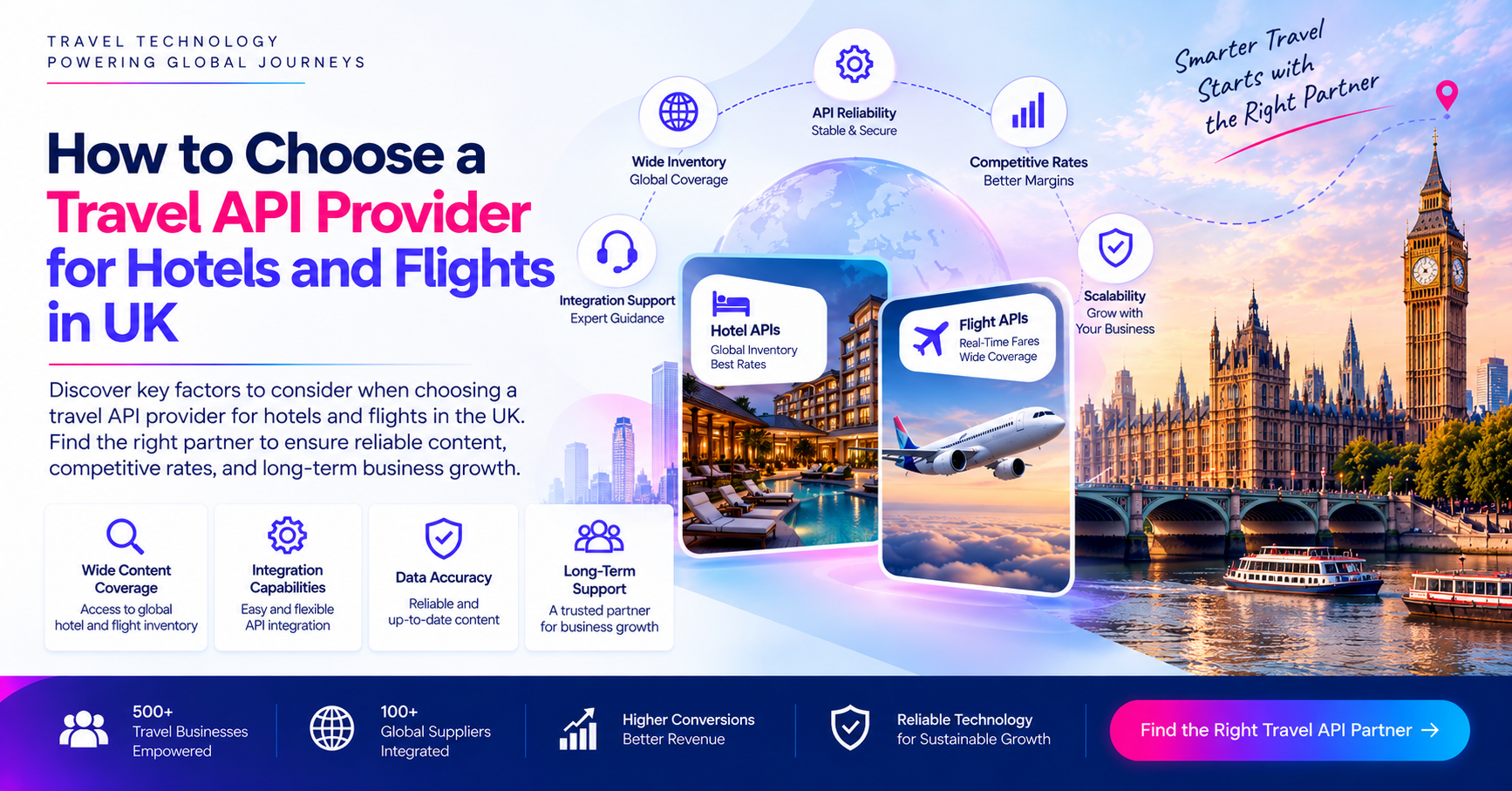
How to Choose a Travel API Provider for Hotels and Flights in UK
A customer types in London to Dubai selects a hotel, enters details and clicks Book. From their side it looks like a simple online transaction. Behind that search through your platform might be talking to an airline system, hotel supplier, payment gateway and other services before the booking is actually confirmed. This is the only reason why choosing a travel API provider in the UK is not simply about finding the company with the largest inventory list. The API needs to provide the right content, handle bookings properly and fit into the way your travel business already operates. If you are a travel agency or a travel technology company, the wrong API can create problems that are difficult to see during a sales demo. Search results might look impressive but booking failures, outdated rates, and weak documentation can become expensive once the integration goes live. So how should you compare providers? The best place is to start with the API itself. You need to start with what you actually need to sell and how you expect your customers or agents to book it. How do you choose the right travel or Hotel API in the UK? You need to choose a provider based on your travel inventory. You need supplier coverage and the markets you serve besides API reliability and documentation.
First understand what kind of travel API you need
Travel API sounds like one type of product but it can mean several different things. A hotel API can connect your platform with accommodation and inventory rates besides booking capabilities while Flight API in the UK can provide access to airline content through sources like GDS and airline connections. Then there are broader travel APIs that bring together several products like hotels, flight transfers and activities. An API aggregator can also sit between your platform and multiple suppliers, giving you access to several sources through a more unified integration. These approaches are not interchangeable. You might be just selling hotels you have no reason to introduce complex flight connectivity. While a flight focused agency might need access to specific airline content. Meanwhile an OTA selling hotels and flights needs a wider connectivity strategy. So before speaking to providers we need to decide what you are actually trying to connect.
Start with the travel products you sell
The easiest way to narrow your options is to map your travel products first. Are you selling flights? Hotels? Are transfers activities and car rentals also part of your offering? This simple exercise can prevent a common mistake of choosing a Travel API in the UK because it offers an impressive range of products when most of those products are irrelevant to your business. The right connectivity is the connectivity you can actually use.
Choosing a Hotel API in the UK , what should you check?
A hotel API can give your booking platform access to a large amount of accommodation inventory. But property count alone tells you very little about whether the connection will work for your customers.
1. Hotel Coverage
You can start with destinations your customers actually booked. If your business focuses heavily on the UK, Europe and the Middle East are specific long haul destinations you need to check whether the provider has useful coverage in those markets. A provider might advertise millions of properties but if your key destinations have limited availability or poor rate coverage that headline number does not help much.
2. Rate types
Your commercial model also matters. You might need net rates for commissionable rates for certain partnerships or legal rates for direct customers. If you operate differently, sales tax might be more than one pricing approach. You must ask if the API delivers rates and whether those rates which is model
3. Hotel Content Matters
Good hotel connectivity is more than room rates.
Your platform may need:
- Room types
- Property descriptions
- Images
- Amenities
- Meal plans
- Cancellation policies
- Check-in information
- Rate conditions
Choosing Flight API in UK : look beyond search
Flight connectivity can be even more complicated because different sources provide different types of airline content.
-
Check the airline and routes you need
Ask only how many airlines you support. You must ask airlines about their customers. If your business specialises in particular international routes, regional markets or specific carriers those relationships and content sources might be far more important than the providers total Airline count.
-
Look at the fare content
A flight search is only useful when it gives your customers the information they need to make up in the schedules and also needs to check what fare options are available and whether API provides ancillary related information to your business.
-
Availability needs to be reliable
Airline inventory can change quickly. Your customer might see fare during search and then find that it has been changed when they try to book. Your platform therefore needs a sensible validation process before the final booking post office is one of the reasons a good flight integration cannot be judged simply by how fast it returns search results.
What if you need both hotels and flights?
If your business sells both it is worth thinking about connectivity strategy as one ecosystem. You can have hotel API and flight API or you could even build a broader setup where several travel products are connected through one integration layer. For a multi product OTA for example your customer might search for a flight add hotel or select an airport transfer and complete the transaction through one platform. That does not necessarily mean one provider has to supply everything. You might use separate specialist suppliers where they make commercial or operational sense. The important part is that your booking platform can work with those different sources without creating a disconnected experience. You just need to connect with experts offering a Travel API in the UK.
What makes a Travel API Provider in the UK reliable?
This is where you should look beyond vendor sales presentation.
1. Inventory quality
Look at the inventory that is relevant to your market, not just a total number advertised.
2. API Performance
Response time matters especially when your customers are searching across multiple dates or destinations. You should also understand how much the API performs during periods of high traffic.
3. Availability accuracy
Search results need to translate into bookable inventory and consistency.
4. Booking reliability
Ask how failed bookings and supplier errors are handled.
5. Documentation
Good API documentation can make a huge difference in development time. Your technical team should be able to understand authentication and request or responses and errors without having to ask the sales team about every step.
6. Technical support
Even a well designed API can encounter issues in production. You need to find out to your developers when something breaks and how technical issues arise.
Read the API Documentation Before You Sign
A provider’s documentation can tell you a surprising amount about the maturity of its technology.
Before committing, ask to see the documentation and, where possible, access a sandbox environment.
Look for:
- Authentication details
- Sample requests and responses
- Booking workflows
- Cancellation processes
- Error codes
- Rate limits
- Webhooks
- Version information
- Testing environment
- Change notifications
One practical question is worth asking your development team:
Compare the real cost of travel api
Api pricing is rarely as simple as finding one monthly subscription number. Depending on the provider and commercial model you need to consider setup fees and commissions besides minimum commitments and currency conversions. There is another cost buyers sometimes ignore, like development and maintenance. For example Hotel API in the UK that takes weeks of additional development to integrate can cost more than a slightly more expensive API that your team can implement clearly. The same applies after launch. If the integration frequently requires manual intervention or troubleshooting, those operational costs also add up.
Questions to Ask a Travel API Provider
| Area | Questions to ask |
| Inventory | Which destinations, airlines, hotels and suppliers do you cover? |
| Connectivity | Do you support GDS, NDC, direct APIs or aggregation? |
| Availability | How is availability updated and validated? |
| Booking | What booking and ticketing functions are supported? |
| Servicing | Can bookings be cancelled, changed or refunded through the API? |
| Technology | Is there a sandbox and complete API documentation? |
| Performance | What response times and uptime can we expect? |
| Support | What technical support and SLA are provided? |
| Commercials | Are there setup fees, transaction charges or minimum commitments? |
| Scalability | Can the platform support higher search and booking volumes? |
| Expansion | Can we add suppliers or travel products later? |
GDS, direct supplier or aggregator which is better?
There is no universal answer. A GBS can make sense when broad airline distribution and established travel booking workflows are important to your business. A direct supplier API can be useful when you specifically want content from a particular airline or travel supplier. Aggregators can be useful when you want access to multiple suppliers through a more unified integration. The right choice depends on your content requirements and technical resources. In some cases a travel business might use more than one approach.
Why choose Traveltekpro as your Travel API Provider in the UK?
Once you understand what to look for, the next step is finding a technology partner that can connect those requirements to your actual booking platform. Traveltekpro can support travel businesses looking at flights, hotels and broader travel API connectivity as a part of the technology setup.
So you need to know that there is no single travel API that is automatically the best choice for every UK travel business. The right provider depends on what you sell, where your customers book and with suppliers matter to you and how your booking operation works. The best API is ultimately not the one that looks good on paper. It is the one that fits your travel business, works reliably in real booking situations and gives you more room to grow.
Read More: Top Travel Technology Companies in the United Kingdom
FAQ'S
Related Blogs
Corporate Travel Booking System for Small Business vs. Enterprise: Key Differences
Corporate Travel Booking System for Small Business vs. Enterprise: Key Differences Choosing a corporate travel booking system becomes more complicated as your company grows. A business with 15 employees travelling occasionally might need a simple…
Oct 15, 2026Read More
How to Choose the Best Vacation Rental Management Software
How to Choose the Best Vacation Rental Management Software Choosing the right Vacation Rental Software is not simply about comparing platforms or counting features. A system can have a long list of capabilities and still…
Oct 14, 2026Read More
Get in touch
Email Us
sales@traveltekprogroup.com“We opted for Traveltekpro to construct and implement our Flight booking system, and I am thoroughly pleased with the outcomes. Their team displays remarkable efficiency, expertise, and utmost professionalism throughout the project.”

Arun Neli
Chief Operating Officer
“I had a fantastic experience with Traveltekpro! Their custom booking system designed for our platform is not only sleek and easy to use,but it has also received excellent feedback rom our customers. Kudos to the Traveltekpro team for their outstanding work!”

Benjamin Smith
Product Manager
“Traveltekpro has been a delight to collaborate with on two distinct occasions, showcasing professionalism and expertise. Their team demonstrates a commitment to surpassing expectations and adheringto deadlines.”

Kevin Brown
CTO
“We partnered with Traveltekpro for our travel booking platform, and the experience was excellent. The team understood our requirements quickly, delivered on time, and provided great support throughout the project. Highly recommended.”

Manish Singh
Director of IT
“Great experience working with Traveltekpro. They were responsive, knowledgeable, and always ready to suggest better solutions. The final product exceeded our expectations, and the after-launch support has been excellent.”

Shubham Rawat
Founder & CEO