
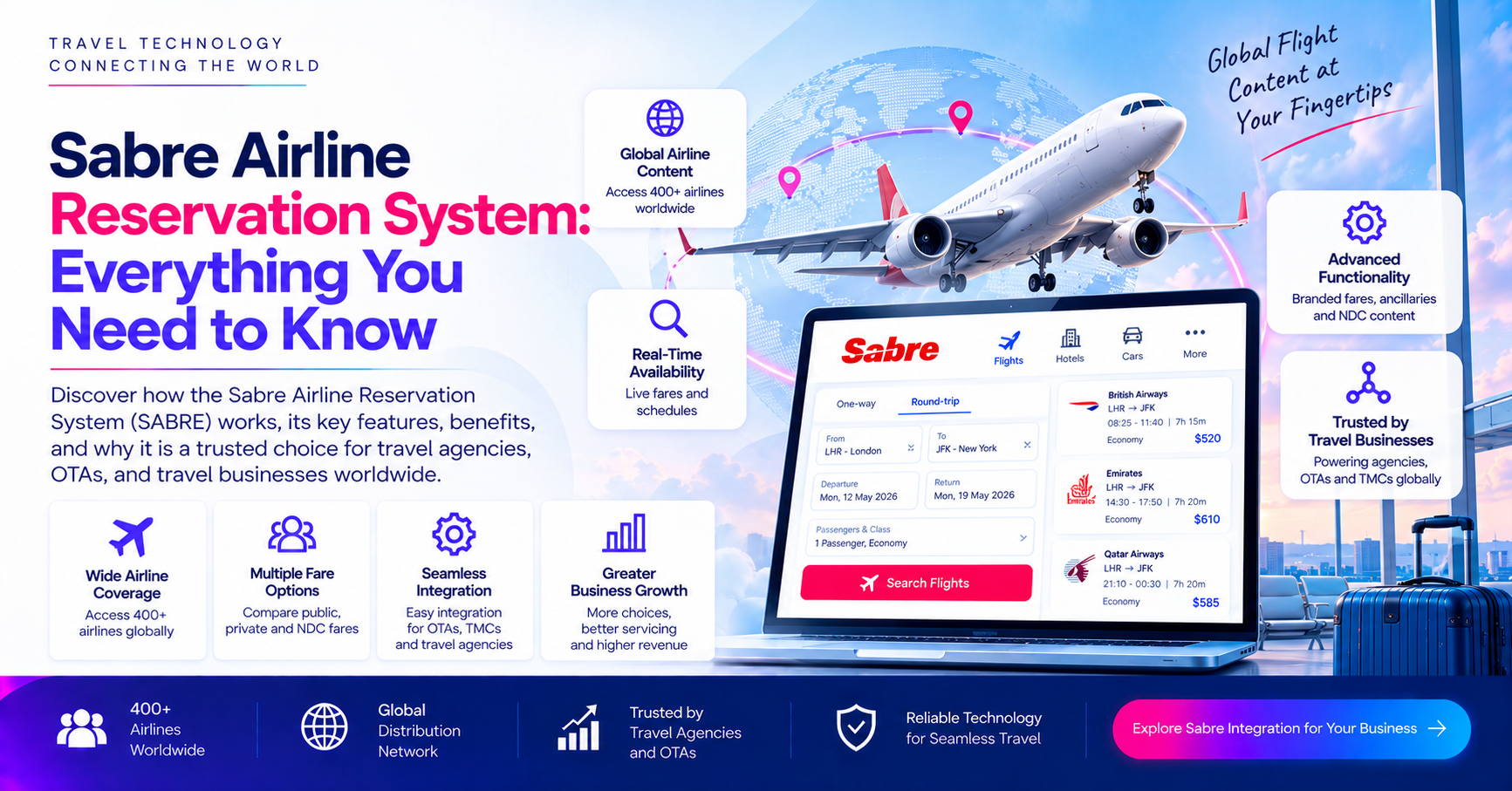
Sabre Airline Reservation System: Everything You Need to Know
A traveller searching for a Dubai to London flight does not see everything happening behind the booking screen. They just enter the dates, choose the number of passengers, compare flight options and select a fare. From their perspective it feels like one simple process. Behind that journey however the travel platform has to request flight availability, retrieve fare information, display the results, create the reservation, complete ticketing and provide complete confirmation. If the traveller later wants to change or cancel the booking another set of processes come into play. This is where the saber flight booking system comes in. If you are a travel agency or an OTA , Sabre connectivity can form part of the infrastructure used to access and manage the airline content. But connecting Sabre is not as same as building a complete flight booking operation. The booking platform still needs to manage search pricing, reservation ticketing payment and post booking servicing around that connectivity.
What happens behind Sabre flight booking?
Consider a traveller searching for a Dubai to London flight for a specific date. The customer enters the search details on your website or booking platform. Your system sends the request via connected travel technology later. Flight options availability and fare information are returned and displayed to the customer. The traveller then selects the itinerary and provides the required passenger information. Depending on the booking workflow the selected fare might need to be revalidated or repriced before the reservation is even created. The reservation is then created followed by ticketing issuance where applicable. Once the relevant process is completed the booking and ticket information can be returned to the customer. Your travel platform needs to know what happens when the selected fare changes when inventory becomes unavailable or when reservation is created but ticketing does not complete. That is why the Sabre airline reservation system should be viewed as a complete workflow rather than just a flight search.
What is Sabre in airline distribution?
Sabre is part of a global travel distribution and technology ecosystem including GDS-based airline and content distribution. Airlines provide content and availability through applicable distribution arrangements. You can access that content True Sabre connectivity and then build your own booking experience around it. For your travel business, this can support activities like flight search and availability retrieval besides reservation workflows and certain post-booking servicing processes depending on the applicable setup and capabilities. It is not important for you to think of Sabre as simply a booking website that a travel agency sends customers to. You can build your own website, mobile application or agent portal while using Sabre connectivity as one part of the underlying technology. Your customer sees the travel company’s booking experience. The connectivity behind the experience handles communication with the relevant travel content system.
Read More: What is the Sabre Global Distribution System | Sabre GDS
How can an airline booking system fit into a travel system?
1. Customer layer
This is basically the website or mobile application where your customer or travel professional searches and books flights.
2. Booking layer
This is your own booking engine or reservation platform. It controls how search results are displayed or how pricing rules are applied.
3. Connectivity layer
This is where Sabre APIs and other travel content connections are set. The connectivity layer allows the booking platform to communicate with external travel content sources.
4. Airline content
This includes flight availability and booking information returned via relevant connectivity.
5. Transaction layer
This covers reservation creation, ticketing and payment workflows.
6. Post booking layer
Once the booking has been made your platform might need to support cancellation changes, reissues or other servicing requirements depending on the booking and applicable airline rules.
What can you do through Sabre flight booking integration?
The capabilities available to a travel business depend on the specific Sabre setup and commercial arrangements.
-
Flight search
Your booking platform can send search parameters like origin destination or travel dates. For example, a customer might search for a round trip from Dubai to London for 2 adults in economy class. The platform turns the details into requests and processes the response for presentation to the customer.
-
Fare and availability.
The returned information can include flight options and relevant fare information. The booking platform then needs to organize that information so that your customers can compare options without being overwhelmed by cross supplier data.
-
Itinerary selection
Your customer selects the flight combination that suits their requirements. At this point your system should retain the relevant itinerary and fare information needed for the next stage of booking.
-
Booking
Passenger information is submitted and the reservation is created according to the applicable booking workflow. The stage needs careful handling of vehicles. Reservation creation and ticket issuance are not necessarily the same event.
-
Ticketing
Ticket issuance is a separate stage that needs to be handled correctly by the booking platform. A reservation being created does not automatically mean the ticketing process has completed successfully.
-
Post booking
After ticketing your platform might need to support changes, refunds or the issues where those services are available and permitted by the applicable fare and airline rules.
Sabre flight booking is more than just showing a list of flights.
A common mistake is to think of flight API integration as simple as retrieving a list of flights and putting them on a website. For example, your customer seeks a flight from Dubai to London. They might receive nonstop flights connecting itineraries and combinations involving different airlines. Your platform needs to present information like departure and arrival times besides baggage conditions and price differences in a way that the customer can understand. The API provides the underlying data, but your booking platform decides how that data is presented.
What does your travel business need before integrating Sabre?
Before starting sabre airline reservation system integration, you need to define your business requirements.
1. Business requirements
Start by deciding which markets you serve. Are you selling domestic flights and international flights? Consider whether the platform will support B2B or B2C. You should also consider the types of travelers you serve and whether agent level access or sub agent functionalities are required.
2. Commercial requirements
Pricing must be defined before integration goes live. You need to consider how commissions markups and service fees will work. Currency requirements and payment arrangements must also be cleared.
3. Technical requirements
Your technical team needs proper API access credentials and documentation. It should also plan for error handling and logging from the beginning. Your booking platform needs to know not only how an API request failed but also what failed when it failed and what happened to the booking or payment around the request.
What happens when Sabre flight booking goes wrong?
Successful bookings are very easy to demonstrate. The difficult cases tell you much more about the quality of the booking operation.
-
The fare changes
A customer sees a fare during the search stage but the price changes before the booking is completed. Your sabre airline booking system needs to handle the new price clearly rather than just silently charging a different amount.
-
Seat or inventory becomes unavailable.
The selected itinerary might no longer be available by the time the customer reaches the booking stage. Your customer needs a clear response and, where appropriate, alternative options.
-
Booking is created, but ticketing fails.
This is an important distinction. Your platform needs to know that the reservation exists, but ticket issuance did not complete. The customer should not simply receive a generic booking successful message.
-
Payment succeeds, but booking fails
Payment status and booking status must be tracked separately. If your customer has paid but the reservation was not successfully created, the system needs a defined reconciliation and refund process.
Sabre vs Direct Airline Connections: What Should a Travel Business Consider?
| Factor | Sabre Connectivity | Direct Airline Connection |
| Access model | GDS-based | Airline-specific |
| Airline coverage | Depends on available Sabre content | Depends on airline connections |
| Integration approach | One GDS relationship can provide access to multiple airline contents | Separate integration requirements may apply |
| Commercial model | Depends on agreement and market | Airline-specific |
| Technical maintenance | Centralised connection for Sabre content | Can increase as more airline connections are added |
| Best fit | Businesses needing broad travel distribution through GDS connectivity | Businesses with specific direct airline requirements |
Common mistakes businesses make with Sabre flight booking integration
One of the biggest mistakes is treating API integration as the entire booking system. The API provides connectivity but the travel business still needs its own booking logic, customer experience, payment process and operational workflows. Another mistake is focusing only on flight search while ignoring ticketing. Search results can work perfectly while the actual reservation and ticketing workflow still has gaps. Post booking servicing is another area that is often ignored. Your customers do not stop needing support once the ticket is issued. Finally, choosing an airline integration partner purely on development price can create problems later if the provider does not understand the operational side of the sabre airline reservation system.
Sabre airline booking system Integration with Traveltekpro
For your travel business Sabre connection needs to fit into a larger booking operation. Traveltekpro can be positioned around connecting airline inventory with travel booking engines. The important question is not simply whether Sabre can be connected. It is how the connection will work inside your existing travel ecosystem. The technology around Sabre connection therefore needs to be designed around your business workflow and not treated as an isolated integration project.
Read More: Sabre API Integration Guide | Setup & Best Practices
FAQ'S
Related Blogs
Comparing Hotel Booking Engines: Which Fits Your Travel Agency Best?
Comparing Hotel Booking Engines: Which Fits Your Travel Agency Best? Choosing a Hotel Booking Engine is way more than just finding a system that displays room rates and lets your customers make a reservation. For…
Oct 20, 2026Read More
Get in touch
Email Us
sales@traveltekprogroup.com“We opted for Traveltekpro to construct and implement our Flight booking system, and I am thoroughly pleased with the outcomes. Their team displays remarkable efficiency, expertise, and utmost professionalism throughout the project.”

Arun Neli
Chief Operating Officer
“I had a fantastic experience with Traveltekpro! Their custom booking system designed for our platform is not only sleek and easy to use,but it has also received excellent feedback rom our customers. Kudos to the Traveltekpro team for their outstanding work!”

Benjamin Smith
Product Manager
“Traveltekpro has been a delight to collaborate with on two distinct occasions, showcasing professionalism and expertise. Their team demonstrates a commitment to surpassing expectations and adheringto deadlines.”

Kevin Brown
CTO
“We partnered with Traveltekpro for our travel booking platform, and the experience was excellent. The team understood our requirements quickly, delivered on time, and provided great support throughout the project. Highly recommended.”

Manish Singh
Director of IT
“Great experience working with Traveltekpro. They were responsive, knowledgeable, and always ready to suggest better solutions. The final product exceeded our expectations, and the after-launch support has been excellent.”

Shubham Rawat
Founder & CEO