
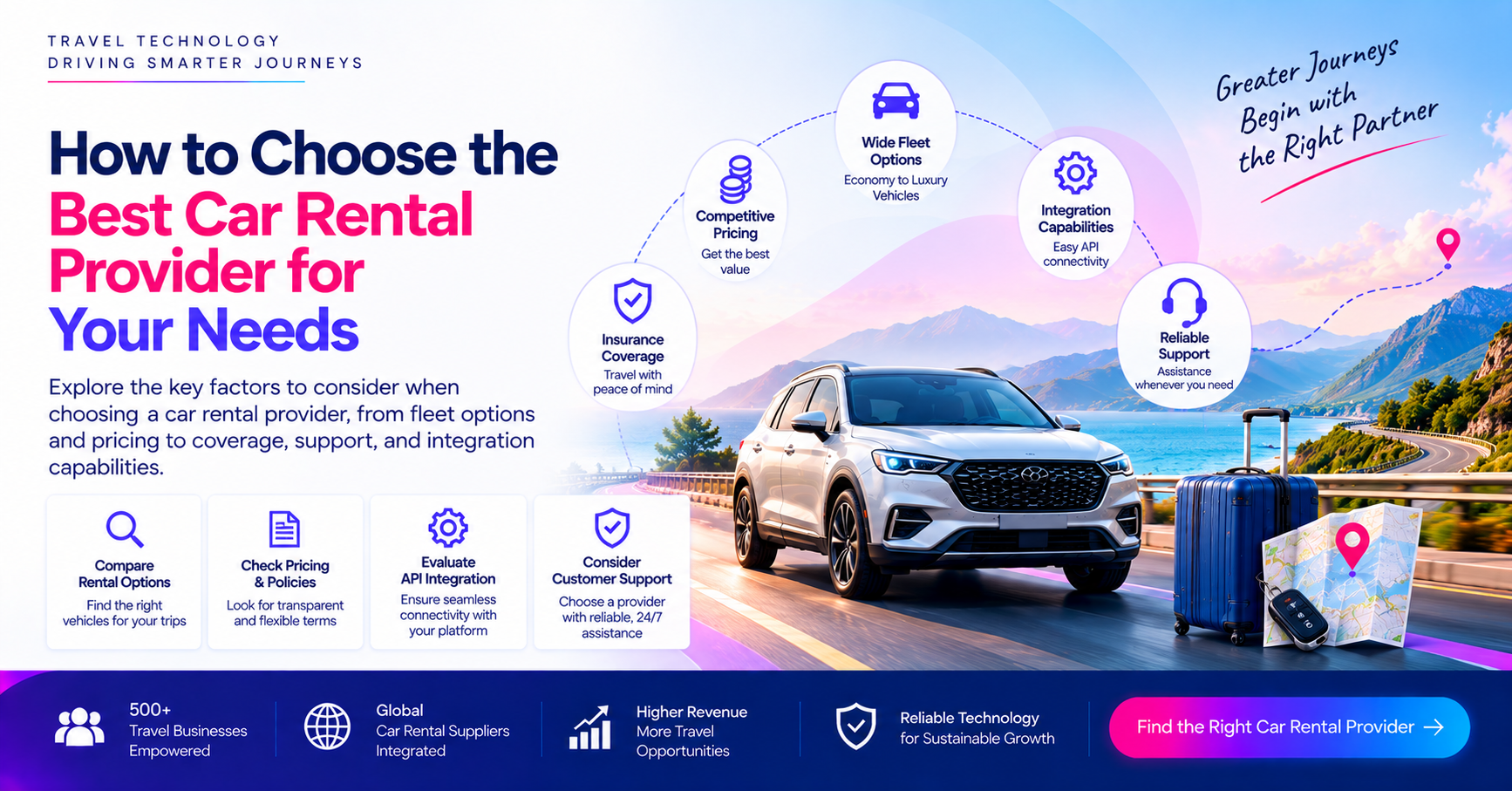
How to Choose the Best Car Rental Provider for Your Needs
When your customer books a holiday through a travel agency or OTA the journey often does not end with a flight or a hotel. They might also need a rental car at the destination. From a customer’s perspective, the process seems simple. They choose a vehicle, enter the dates, pay and receive confirmation. For your travel business there is much more happening behind that booking. Your business has to find a suitable rental inventory, understand the rental conditions, send the booking to the supplier and also deal with any changes or cancellations later. That is the only reason why choosing a car rental supplier is not just about finding the company with the largest fleet or the most destinations. You also need to know whether the supplier fits the way your travel business actually sells and manages car rentals.
First decide what role a car rental provider will actually play?
Before comparing car rental wholesalers you need to understand what type of relationship you actually need. As a travel agency you might work with a rental company and access the vehicles and rates. Another agency might prefer to work with a wholesaler that brings together inventory from several rental companies. OTA might choose an aggregator or API provider because it wants multiple suppliers through one technical connection. These approaches can all work but they solve slightly different problems. A direct supplier can give you a c in the rental company. A wholesaler or aggregator can make it easier to access a broader selection without maintaining a separate integration with every rental company.
Car Rental Supplier, Provider and Wholesaler: What’s the Difference?
| Model | Main Role |
| Car Rental Supplier | Provides the actual rental vehicles and rental service |
| Car Rental Provider | General term for a company providing rental vehicles or rental services |
| Car Rental Wholesaler | Aggregates or distributes rental inventory to travel businesses |
| Car Rental API/Aggregator | Provides technology connectivity to one or multiple rental sources |
Start with destinations your customers actually rent in
A car rental provider might advertise thousands of locations but that number doesn’t tell you whether it is useful for your business. Consider where your customers actually travel. If your agency mainly serves customers travelling to Europe, strong coverage in London, Rome , Paris and other relevant cities might matter more than a huge global location count. You should also look at the type of pickup locations your customers use. Airport rentals might be important for holiday travellers while city center branches might matter more for business customers. One way rentals can also change your requirements. A customer might want to collect a vehicle at one point and return it elsewhere. Depending on your market Rental options.
Compare the inventory not just the number of cars
The size of a rental company’s fleet does not tell you much about whether the vehicles are suitable for your customers. A family travelling with several suitcases might need a larger vehicle. A business traveller might prefer a compact automatic car. A group might need a van while a luxury traveller might be looking for a premium vehicle. So when comparing inventory you need to look at the range of categories available. You might need economy and compact cars, luxury vehicles or vans. Transmission can also matter especially in markets where customers specifically search for automatic vehicles. The content shown with the vehicle is equally important. Customers might want to know the number of passengers, luggage capacity, fuel type and pickup location before they make a decision.
Rental price is only the beginning
Prices are obviously important but the first price you see is not always the final cost of the rental. A customer might see an attractive daily rate and assume that they have found the best option. Later they might discover additional charges related to taxes or airport fees. That is why you should understand what is included in the rate before presenting it to your customers. The complete cost is basically the base rental rate including services, additional charges and applicable fees. Other details might include the mileage allowance fuel policy security deposit and child seat charges. The cheapest displayed rate can become the least attractive option if important costs appear later in the booking process. If you are a travel agency, unclear pricing can also create customer support problems. If the traveller believes everything was included and discovers additional charges at pickup you might end up handling the complaint even though car rental wholesalers provide the vehicle.
Cancellation rules can make or break the booking experience
Two rental cars can have the most identical prices but very different cancellation conditions. One might allow free cancellation until a particular time while another might become fully non refundable shortly after booking. These differences matter to your customers. A traveller might choose a slightly more expensive rental because it offers greater flexibility. If your platform only displays the price and hides the important conditions. Your car rental provider should therefore make rental conditions accessible during the working process. Look at free c cancellations deadlines and nonrefundable rates. The booking platform should also clarify what happens after the customer confirms the rental.
For many travel businesses API connectivity can matter more than the suppliers website
A rental company’s consumer website might be perfectly good for someone booking directly. That does not necessarily mean it is the right technology partner for your travel agency. If you want to sell rental cars through your own website, mobile application or travel booking engine you might even need API connectivity. The API needs to provide information like vehicle availability pricing vehicle details and rental conditions. It might also need to support booking cancellation, booking retrieval and confirmation. Exact features will vary by vendor and integration. This leads to an important distinction: good rental inventory does not automatically mean good travel technology. A supplier might have amazing vehicles but limited API functionality. Another might have slightly different inventory but a much easier integration and more reliable booking workflow.
Why car rental wholesalers can be useful for OTS and travel agencies
Imagine you want to offer rental cars from several companies. Without a car rental supplier you need to manage a lot of things. Each relationship can include several contacts systems booking purposes and technical requirements. With a wholesaler supplier the structure might look really easy. But the word wholesaler should not automatically mean treated as a guarantee of better inventory or pricing. You still need to investigate where the inventory comes from, whether the rates are competitive, how the suppliers are selected and how cancellation rules are handled.
The right car rental provider depends on your business model
A travel agency might primarily care about reliable inventory competitive rates and a simple booking process. If your customers often call the agency for support, responsive vendor service can be as important as the initial price. And OTA has another set of priorities. It might need API connectivity, high search capacity and accurate availability. A DMC might just care more about local rental partners and destination specific inventory. A tour operator might need rental cars to work alongside packages and contracted travel products. The best supplier therefore depends on the job you need it to do.
Evaluate the car rental wholesalers commercial model
Business agreement deserves the same attention as technology. You should not ask only what the rental rate is. You also need to look at how your business will actually make money and what it will pay to access the inventory. Depending on the arrangement you might even encounter net rates Commission models markups and minimum commitments. You should also understand how refunds are handled and whether there are additional charges also associated with cancellations or amendments. Suppliers with a slightly higher base rate might still make more commercial sense if it offers better inventory and fewer booking problems. That is the only reason why it is useful to look at total commercial value rather than just comparing one price on a spreadsheet.
Test the supplier with real booking scenarios
A supplier presentation will usually show the booking process when everything works perfectly. Your evaluation should do the opposite. You need to ask the provider to demonstrate realistic situations. Start with a normal airport booking search for a vehicle and complete the reservation. Then you need to test the situation where the vehicle becomes unavailable before confirmation. Ask what happens when a customer cancels refundable bookings. Then test one of the most important situations that is payment succeeds but the supplier does not confirm the booking. You should also understand what happens when your platform sends a large number of searches at the same time. These tests tell you far more about the provider than a standard demonstration.
So you need to know that choosing a car rental supplier is not simply a matter of finding the company with the largest fleet or the most rental locations. You also need to look at the destinations your customers actually see, the vehicle categories they need and the quality of the rates. To get the best car rental provider you can connect with experts at Traveltekpro.
Read More: Why Choose a Custom Car Rental Reservation System?
FAQ'S
Related Blogs
Get in touch
Email Us
sales@traveltekprogroup.com“We opted for Traveltekpro to construct and implement our Flight booking system, and I am thoroughly pleased with the outcomes. Their team displays remarkable efficiency, expertise, and utmost professionalism throughout the project.”

Arun Neli
Chief Operating Officer
“I had a fantastic experience with Traveltekpro! Their custom booking system designed for our platform is not only sleek and easy to use,but it has also received excellent feedback rom our customers. Kudos to the Traveltekpro team for their outstanding work!”

Benjamin Smith
Product Manager
“Traveltekpro has been a delight to collaborate with on two distinct occasions, showcasing professionalism and expertise. Their team demonstrates a commitment to surpassing expectations and adheringto deadlines.”

Kevin Brown
CTO
“We partnered with Traveltekpro for our travel booking platform, and the experience was excellent. The team understood our requirements quickly, delivered on time, and provided great support throughout the project. Highly recommended.”

Manish Singh
Director of IT
“Great experience working with Traveltekpro. They were responsive, knowledgeable, and always ready to suggest better solutions. The final product exceeded our expectations, and the after-launch support has been excellent.”

Shubham Rawat
Founder & CEO