
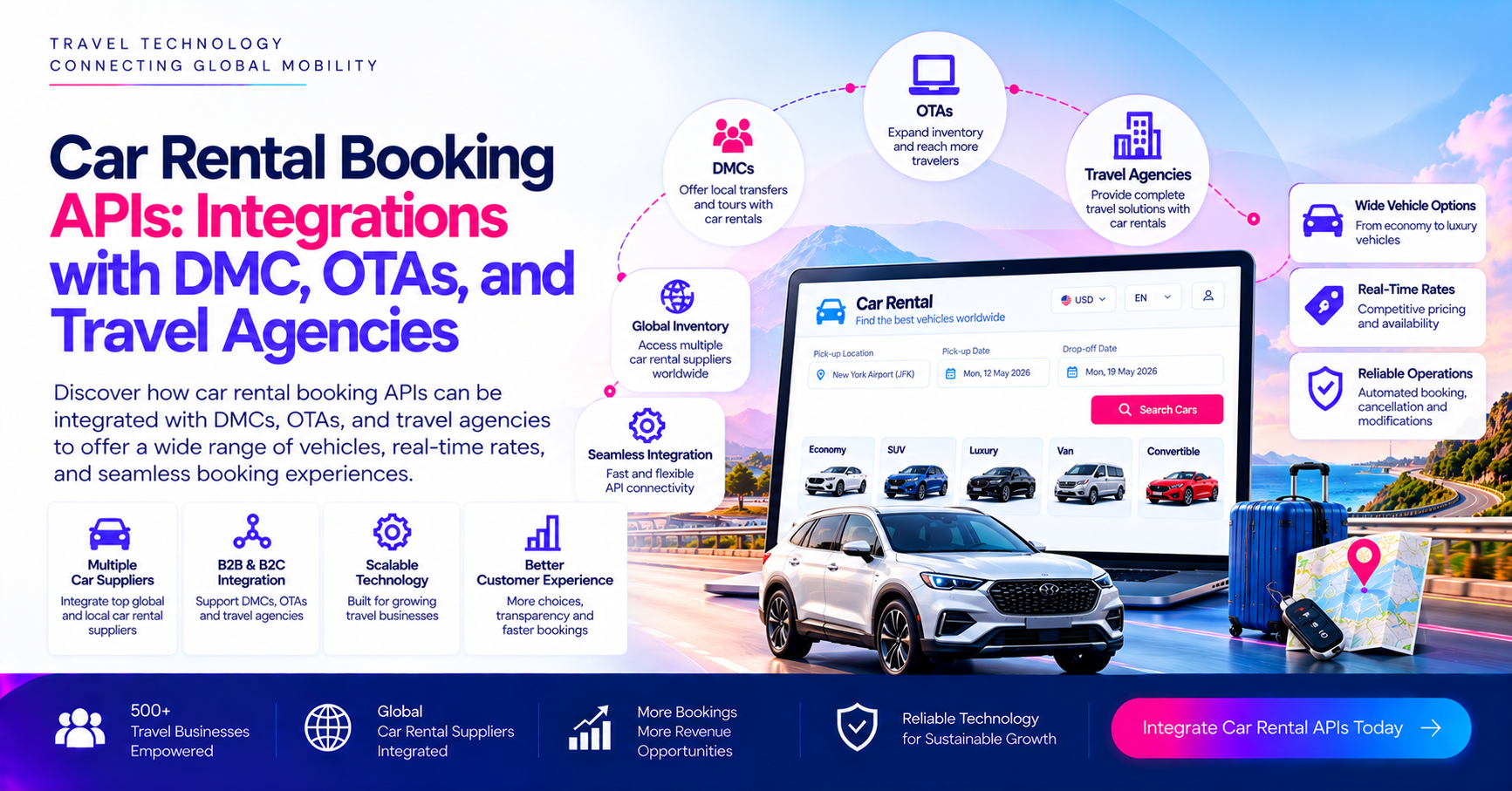
Car Rental Booking APIs: Integrations with DMC, OTAs, and Travel Agencies
A car rental might look like a simple travel product. Your customer chooses a vehicle enters the travel dates and pays and receives a confirmation. Behind that simple booking there can be several systems working together. Your travel platform needs to find available vehicles, understand supplier policies, show the right information, and then keep the reservation available for cancellation or modification. The process becomes even more interesting when the same car inventory needs to serve different types of travel businesses. A DMC might need a private vehicle as a part of a complete destination itinerary while OTA might want to offer rental car after a customer books. A travel agency might need an agent portal where staff can search supplier inventory and confirm booking for customers. All 3 businesses can use Car Rental Booking API but they might have to use it in different ways.
What is a car rental booking API?
A Car Booking API There is a connection that allows you to communicate with external car rental suppliers. Instead of manually entering supplier information into your website the API allows your platform to request and receive data electronically. Depending on the supplier and integration this information can include vehicle availability rental locations and dates besides cancellations and booking details. The important distinction is that the car booking API is not the booking website itself. The booking website or the portal is what the customer or agent interacts with. The API works behind the interface connecting the platform to the suppliers inventory and booking systems. So when your customer searches for a rental car on travel website they are not necessarily searching inventory stored by that website. The platform might be sending the request to one or more external suppliers through a car rental API and then presenting the returned results in its own interface.
Where do Car Rental APIs come from?
Before choosing the Car Rental Booking API you need to understand where the inventory is actually coming from. Not every travel company needs a direct relationship with individual rental companies.
1. Direct car rental supply
Your travel platform can connect directly with a particular rental company. This approach can be useful when your business already has a supply relationship or specifically wants that company’s inventory. The challenge comes when the business wants to add several suppliers.
2. Wholesaler
A wholesaler can provide access to inventory from multiple rental suppliers through a single collection. This can reduce the number of individual integrations a travel company needs to maintain. For your travel business that wants wider coverage without managing numerous connections this model can be practical.
3. Car rental aggregator
An aggregator gathers inventory from different sources and presents it through a common API structure. The advantage is broader access through a consolidated connection. The trade off is that the travel platform still needs to understand how the return inventory pricing policies and booking connections should be handled.
How does a Car Booking API work from search to confirmation?
Your customer sees a search form and a list of vehicles. The platform behind the touch screen is handling much more. For example, your customer wants to rent a car in London for 7 days. They enter the pickup and drop off locations, rental dates, times and other information required by the booking system. The platform then sends those details to the connected supplier aggregator through Car Rental APIs. So the API is involved throughout the booking journey but the travel platform still has responsibility for turning that connectivity into a usable booking experience.
Car rental API for DMC more than just a rental booking
A DMC car is rarely a rental car. If you are a destination management company you might receive request for airport pickup private transportation during sightseeing or hotel transfers. The final service might look something like airport transfer private vehicle plus sightseeing and hotel booking. That means you need to combine car rental or transportation inventory with your own destination services. The booking workflow therefore might involve way more than just simply searching for available rental car. Your platform needs to handle destination specific inventory multiple passengers or supplier coordination.
Car rental APIs for OTA
An OTA has a different challenge. Your customer is usually completing the booking independently so the rental car needs to fit naturally into your online journey. Your customer might already be booking a complete trip. If you can offer a rental car during that journey the customer does not have to leave the platform and visit another site. For this model the platform might need live availability, fast search features and price comparisons besides booking history confirmation and cancellation functionality. A car rental booking API provides the supplier connectivity needed to make this possible while the OTA controls how that product appears within its own customer journey stop
Car rental APIs for travel agencies
Travel agencies often work differently because an agent is involved in the booking. Your customer might call your agency and say I need a car in London for a week. If you are the agent you need to find suitable vehicles compare rates and apply your commercial rules and confirm the reservation. Instead of visiting multiple supplier websites you can connect your supplier inventory the booking platform. You can even search available vehicles from one interface compare options select a suitable rate and apply the required markup or consumption structure.
Why the Same Car Can Have Different Prices
One of the easiest mistakes in car rental integration is if the lowest displayed price is automatically the best comparison.
Two offers may have different conditions even when the vehicle category appears similar.
Price can be affected by:
- Supplier rates
- Commission
- Markup
- Taxes
- Airport fees
- Insurance
- Mileage
- Fuel policy
- Deposit
- Cancellation conditions
- Optional extras
- Currency conversion
Vehicle mapping is a bigger challenge than it looks
Supplier data does not always arrive exactly in the format your website needs. One supplier might classify vehicles as economy, others might use a different category for a similar vehicle. Common categories include economy compact full size and premium. But category names are only part of the problem. Their platform also needs to standardize proper passenger capacity, luggage capacity, transmission transmission and vehicle type. This matters because your customers do not want to compare raw supplier data, they want to understand what they are actually getting. This is the only reason why a Car Rental Booking API is not just about receiving data.
What happens when car rental booking fails?
Real bookings do not always follow the ideal path. Your vehicle can be available when the customer searches an unavailable when the booking is submitted. A supplier return a different price or the Supplier API itself can become temporarily unavailable. A duplicate booking can also happen if the system does not properly control repetitive requests. One particularly important example is payment success with booking failure. The platform should be able to distinguish between the payment status and the reservation status. A successful payment does not automatically mean that the supplier has successfully confirmed the car. The system needs a defined process for handling that situation and communicating the correct status.
What Data Should a Car Rental Booking API Provide?
When evaluating a Car Rental API, look beyond the number of vehicles available.
| Data | Why It Matters |
| Vehicle type | Helps customers understand what they are booking |
| Supplier | Identifies the rental provider |
| Pickup location | Shows where the vehicle is collected |
| Drop-off location | Important for one-way rentals |
| Rental price | Provides the main cost |
| Currency | Important for international bookings |
| Mileage | Can affect the actual rental cost |
| Fuel policy | Helps customers understand refuelling requirements |
| Insurance/excess | Sets expectations around coverage and liability |
| Deposit | Shows additional payment requirements |
| Cancellation policy | Explains booking flexibility |
| Pickup instructions | Helps customers complete the rental |
Integrating car rental APIs with Traveltekpro
For a travel technology platform the goal should be to make car inventory part of the existing booking operation. Traveltekpro Can support the integration of car rental APIs with travel booking engines B2 b portals and travel agency software besides booking management and cancellation workflows. The technical approach therefore is based on existing platform supply structure and business rules. The experts can help you with unique integration model for your company. So the search needs the right inventory and well planned integration should take the booking beyond simply displaying available cars.
Read More: What Is Car Rental Management Software and How Does It Work?
FAQ'S
Related Blogs
Travel Website Development Company: Cost, Features, and Benefits Guide
Travel Website Development Company: Cost, Features, and Benefits Guide A travel website can look really simple from the outside. Your customer searches for flights, selects hotels, enters all the details, pays and receives confirmation. It…
Oct 6, 2026Read More
Get in touch
Email Us
sales@traveltekprogroup.com“We opted for Traveltekpro to construct and implement our Flight booking system, and I am thoroughly pleased with the outcomes. Their team displays remarkable efficiency, expertise, and utmost professionalism throughout the project.”

Arun Neli
Chief Operating Officer
“I had a fantastic experience with Traveltekpro! Their custom booking system designed for our platform is not only sleek and easy to use,but it has also received excellent feedback rom our customers. Kudos to the Traveltekpro team for their outstanding work!”

Benjamin Smith
Product Manager
“Traveltekpro has been a delight to collaborate with on two distinct occasions, showcasing professionalism and expertise. Their team demonstrates a commitment to surpassing expectations and adheringto deadlines.”

Kevin Brown
CTO
“We partnered with Traveltekpro for our travel booking platform, and the experience was excellent. The team understood our requirements quickly, delivered on time, and provided great support throughout the project. Highly recommended.”

Manish Singh
Director of IT
“Great experience working with Traveltekpro. They were responsive, knowledgeable, and always ready to suggest better solutions. The final product exceeded our expectations, and the after-launch support has been excellent.”

Shubham Rawat
Founder & CEO