
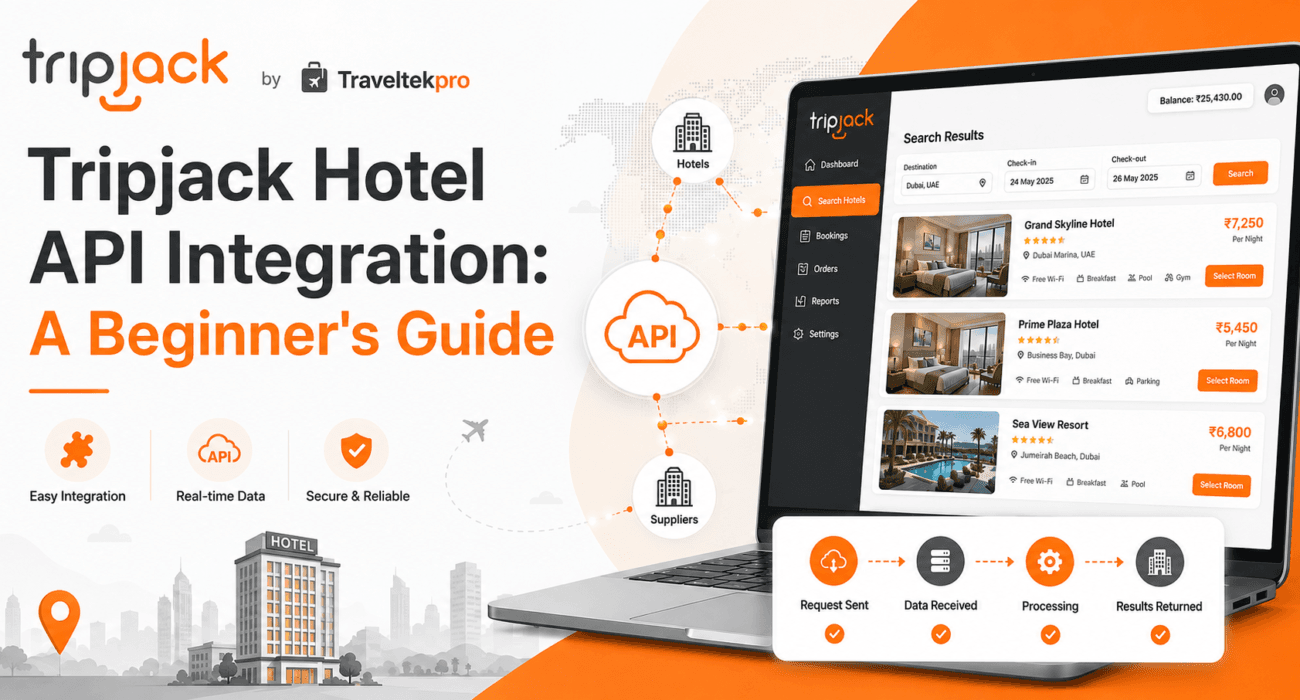
Tripjack Hotel API Integration: A Beginner’s Guide
The hotel booking industry depends on speed, accurate pricing, live availability, and reliable supplier connectivity. Travel agencies, online travel agencies, tour operators, destination management companies, and travel startups need access to hotel inventory without manually checking multiple supplier portals. This is where Tripjack Hotel API Integration can help.
Tripjack Hotel API Integration connects a travel booking platform with Tripjack’s hotel inventory and booking services. Through this connection, a travel business can search hotels, retrieve live rates, display room options, check cancellation policies, confirm reservations, generate vouchers, and manage bookings through its own website, B2B agent portal, or mobile application.
For beginners, the integration may appear complex because it involves supplier credentials, API requests, hotel content, pricing, booking references, mapping, testing, and certification. This guide explains how the Tripjack Hotel API works, what the integration process includes, and how Traveltekpro helps travel businesses build a scalable hotel booking solution.
What Is Tripjack Hotel API Integration?
Tripjack Hotel API Integration is a system-to-system connection between Tripjack and a third-party travel platform. Instead of signing into a supplier panel and processing each hotel search manually, the travel platform sends requests directly to the Tripjack system and receives hotel information automatically.
The integration can allow a travel website or portal to display hotel availability, room categories, meal plans, prices, cancellation conditions, hotel descriptions, images, amenities, and booking status. Once a traveler or agent confirms a room, the platform can send the reservation request to Tripjack and capture the booking reference or confirmation details.
In simple terms, the Tripjack API integration brings Tripjack hotel supply into the travel company’s own booking environment.
Tripjack’s public positioning is primarily focused on B2B travel distribution, agency operations, wallet-based workflows, booking servicing, amendments, cancellations, and access to travel inventory through one platform.
How Does the Tripjack Hotel API Work?
The Tripjack Hotel API generally follows a standard hotel-booking workflow. The travel platform first authenticates with supplier credentials. It then sends a hotel search request containing information such as destination, check-in date, check-out date, number of rooms, adults, children, nationality, and preferred currency.
The API returns available hotels and rate options. The user can then open a hotel detail page, compare room categories, review meal plans, check pricing, and read cancellation conditions.
Before final booking, the system should perform a price and availability recheck. This is important because hotel rates and room availability can change between the initial search and the final confirmation.
After the traveler or agent accepts the rate, the booking request is sent through the API. The platform then stores the supplier reference, confirmation status, pricing details, cancellation rules, and voucher information.
The expected workflow includes authentication, search, availability, hotel details, pre-booking, booking, cancellation, voucher capture, webhook processing, and sandbox testing.
Is Tripjack API Documentation Publicly Available?
Tripjack does not appear to provide a completely open developer portal with publicly accessible Swagger files, OpenAPI specifications, SDKs, or Postman collections in the same way as some global hotel API providers.
The complete technical documentation, test credentials, endpoints, and certification requirements are generally obtained through the commercial onboarding process. A travel business must normally establish a relationship with Tripjack, receive approval, collect sandbox credentials, and then begin development.
This makes Tripjack a commercially controlled hotel supplier integration rather than a fully self-service API product. Travel businesses should request current documentation, commercial terms, test access, support contacts, settlement details, and production requirements before development begins.
What Information Can the Tripjack Hotel API Provide?
The exact response fields depend on the documentation and credentials supplied by Tripjack. However, a typical hotel API response may contain the hotel name, supplier hotel code, address, geographic coordinates, star rating, descriptions, images, amenities, room categories, meal plans, occupancy limits, total price, taxes, cancellation charges, booking tokens, and supplier terms.
Travel companies may also receive agent net rates that can be passed through a configurable markup engine. This allows a B2B portal or OTA to apply different margins for direct customers, retail agents, preferred partners, branches, or sub-agents.
A professionally developed integration should keep the original supplier identifiers while converting Tripjack data into a standard structure used by the travel platform. This becomes especially important when the business connects Tripjack alongside other suppliers.
Main Benefits of Tripjack Hotel API Integration
The biggest advantage of Tripjack Hotel API Integration is automation. Travel agents no longer need to search for every hotel manually through the supplier dashboard. Hotel inventory, rates, policies, and booking responses can flow directly into their own platform.
The integration can increase hotel options by adding another supply source to the travel company’s inventory. A wider range of rates may improve conversion because customers can compare more rooms and pricing choices.
The system can also reduce booking errors by transferring data directly between platforms. Room details, passenger information, cancellation conditions, and confirmation references can be stored consistently within the booking system.
For B2B travel companies, the Tripjack Hotel API can support agent markups, net-rate distribution, credit or wallet workflows, booking reports, vouchers, and post-booking servicing.
For OTAs, it can support a complete customer journey from hotel search to checkout, confirmation, cancellation, and refund management.
Who Should Use the Tripjack Hotel API?
Tripjack API integration can be suitable for online travel agencies that need live hotel inventory on their websites or mobile applications. It can also support B2B travel portals distributing hotel content to registered agents and sub-agents.
Tour operators can use the hotel API to combine accommodation with flights, transfers, activities, insurance, and other services. This makes it easier to create static or dynamic travel packages.
Destination management companies may use Tripjack as an additional hotel source when their direct contracts do not cover every destination or travel date.
Travel startups can use the integration to launch hotel-booking functionality without building individual contracts with thousands of properties. However, the startup must still complete supplier onboarding and meet the required commercial and technical conditions.
The Tripjack Hotel API Integration Process
1. First Step
The first stage is requirement analysis. The technology provider must understand whether the platform is B2C, B2B, B2B2C, corporate, or a combination of different models. It must also define currencies, languages, target destinations, markup rules, payment flow, cancellation handling, and reporting requirements.
2. Second Step
The second stage is supplier onboarding. The travel company must obtain Tripjack credentials, documentation, sandbox access, commercial terms, and technical contacts.
3. Third Step
The third stage is architecture and data mapping. The development team creates a supplier adapter that translates Tripjack requests and responses into the platform’s standard hotel format.
4. Fourth Step
The fourth stage covers hotel search, availability, and static content. Developers connect destination search, occupancy details, room rates, hotel descriptions, amenities, images, and cancellation policies.
5. Fifth Step
The fifth stage covers pre-booking and rate verification. The platform checks whether the selected room is still available and whether the final rate has changed.
6. Six Step
The sixth stage connects the final booking process. The system sends guest information, confirms the reservation, stores the supplier booking reference, and creates a customer or agent voucher.
7. Seven Step
The seventh stage handles cancellation, amendments, booking retrieval, and refund workflows.
The final stage includes sandbox testing, certification, production credentials, monitoring, and post-launch support. The recommended onboarding sequence begins with documentation and credentials, followed by integration, mapping, testing, and live deployment.
Why Hotel Mapping Is Important
Hotel mapping is one of the most important parts of a multi-supplier booking platform. The same hotel may be provided by Tripjack and several other hotel suppliers. Each supplier may use a different hotel code, property name, address format, image set, or description. Without mapping, the website could display the same hotel multiple times. A mapping service connects different supplier hotel codes to one master hotel record. The platform can then compare rates from all connected suppliers and present a cleaner result.
Mapping should consider hotel name, address, coordinates, chain, brand, contact details, and destination. Uncertain properties should be sent for manual review. Room mapping requires additional care because suppliers may describe similar rooms differently. A “Deluxe King Room” from one supplier may not always match a “Deluxe Double Room” from another. Traveltekpro therefore recommends controlled room normalization rather than automatically combining every room with a similar name.
Rate Rechecking and Live Availability
Hotel prices are dynamic. They may change due to demand, room availability, supplier rules, currency conversion, promotions, or cancellation conditions.
A platform should never assume that an initial search price will remain valid until checkout. It should perform a pre-book or rate-recheck request before collecting final confirmation from the traveler.
When the rate changes, the system should clearly show the updated amount and ask the user to accept it. When the room becomes unavailable, the platform should provide alternative options rather than displaying a technical error.
Static hotel content can be cached for better performance, but dynamic prices and availability should be cached only briefly and revalidated before booking.
Authentication and API Security
The Tripjack Hotel API is expected to require supplier credentials and secure endpoint authorization. The platform may also need to manage sessions or access tokens, including token expiry and renewal.
The exact authentication headers, token duration, signing requirements, and endpoint URLs should be confirmed through Tripjack’s official documentation. These details should not be guessed or hard-coded before the supplier provides the approved integration guide.
Credentials must be stored securely and never exposed in front-end code, mobile applications, browser requests, or public repositories.
Traveltekpro generally places supplier connectivity behind a secure middleware layer. The website or mobile application communicates with Traveltekpro’s hotel engine, while the hotel engine communicates with Tripjack. This protects supplier credentials and simplifies error management, logging, caching, and monitoring.
Understanding Net Rates and Markups
Tripjack’s B2B model may provide hotel rates intended for travel agents or distribution partners. The travel company can use a markup engine to calculate its selling price.
For example, a hotel room may be received at a supplier net rate. The platform can add a fixed markup, percentage markup, destination-based margin, agent-specific markup, or promotional adjustment.
The final selling price should clearly account for taxes, fees, currency conversion, payment charges, discounts, and the business margin.
A configurable markup system allows travel companies to use different commercial rules for B2C customers, B2B agents, corporate accounts, or international markets.
Booking Status, Webhooks, and Reconciliation
A booking request may return an immediate confirmation, but travel platforms should also prepare for pending or asynchronous booking statuses.
Webhooks or callbacks can notify the platform when the supplier booking status changes. However, the booking engine should not depend entirely on callbacks because notifications can occasionally be delayed or missed.
Traveltekpro recommends combining webhook processing with scheduled booking-status checks. Pending bookings should be reconciled until they reach a final status.
The platform should maintain both the internal booking ID and the Tripjack supplier reference. It should also track the original cost, selling price, payment status, cancellation amount, refund status, and voucher details.
Booking confirmation, voucher capture, callbacks, error handling, session expiry, and fallback logic should all form part of production testing.
Common Challenges During Tripjack API Integration
One common challenge is receiving access to the latest documentation and sandbox credentials. Development planning should begin only after the business has confirmed its supplier account and access conditions.
Another challenge is mapping hotel and room data. Weak mapping can create duplicate hotels, incorrect images, mismatched rooms, and confusing search results.
Rate changes are also common in hotel distribution. The booking engine must manage price differences between search and confirmation without damaging the customer experience.
Timeouts and session expiry must be handled through retry controls, token renewal, meaningful errors, and circuit-breaker logic.
Cancellation policies can be complex because charges may depend on dates, time zones, room types, market rules, and supplier conditions. The platform must display these policies accurately before payment.
Post-booking reconciliation is equally important. Every successful booking, cancellation, refund, wallet debit, supplier reference, and customer payment should be recorded and reviewed.
Why Integrate Tripjack Through Traveltekpro?
Traveltekpro provides end-to-end Tripjack Hotel API Integration for OTAs, travel agencies, B2B portals, tour operators, destination management companies, and travel startups.
Instead of connecting Tripjack directly to a front-end interface, Traveltekpro builds a structured hotel aggregation layer. This layer manages supplier authentication, hotel search, content normalization, mapping, pricing, markups, booking orchestration, vouchers, cancellations, error handling, reconciliation, and reporting.
Traveltekpro can also connect the Tripjack Hotel API with other hotel suppliers. A multi-supplier search engine can compare inventory and rates while presenting mapped hotel results through one booking experience.
The solution can include a B2C website, B2B agent portal, admin dashboard, mobile application, wallet, credit limits, payment gateway, CRM, supplier controls, promotions, reporting, and customer notifications.
Tripjack Hotel API Integration for B2B Portals
A B2B portal allows registered travel agents to search hotels and complete bookings through one platform.
Tripjack inventory can be combined with agent-specific pricing, markup, wallet balance, credit limits, booking history, invoice generation, voucher downloads, cancellation requests, and sub-agent management.
The administrator can control which suppliers are available to each agent and apply different commercial rules according to sales volume, location, or partnership level.
This model is useful for wholesalers, consolidators, host agencies, travel networks, and regional distributors.
Tripjack Hotel API Integration for B2C OTAs
For a B2C OTA, the Tripjack API can power hotel search and booking within a customer-facing website or application.
The platform can offer destination search, filters, maps, property details, room selection, checkout, payment, booking confirmation, vouchers, and cancellation management.
Traveltekpro can add customer accounts, loyalty points, coupons, wish lists, reviews, abandoned-search automation, recommendation tools, and AI-powered trip planning.
The most important requirement is to keep the customer experience controlled by the OTA while the supplier integration operates securely in the background.
Final Thoughts and Key Takeaways
Tripjack Hotel API Integration can help travel businesses automate hotel search, pricing, booking, confirmation, servicing, and distribution through their own platforms. It is particularly relevant for OTAs, B2B travel portals, tour operators, DMCs, wholesalers, and travel startups that need scalable hotel connectivity.
A successful integration requires more than connecting a few endpoints. It needs secure authentication, normalized hotel data, mapping, markup controls, price rechecking, booking orchestration, cancellation management, reconciliation, monitoring, and reliable customer-facing workflows.
Traveltekpro develops complete Tripjack API integration solutions designed around the travel company’s business model. From the first supplier connection to a complete B2B or B2C booking ecosystem, Traveltekpro helps businesses build reliable and scalable hotel technology.
Connect with Traveltekpro to discuss Tripjack Hotel API integration, hotel aggregation, B2B travel portals, OTA development, mobile applications, dynamic packages, and multi-supplier booking solutions.
Read More: Tripjack Flight API Integration for Your Travel Business
Frequently Asked Questions About Tripjack Hotel API Integration
1. What is Tripjack Hotel API Integration?
Tripjack Hotel API Integration connects a travel platform with Tripjack’s hotel services so that the platform can retrieve hotel availability, rates, room details, policies, and booking responses automatically.
2. Is the Tripjack Hotel API suitable for beginners?
The business concept is easy to understand, but the technical implementation requires experience with supplier APIs, hotel data, booking workflows, security, mapping, testing, and reconciliation. A specialized travel technology company can simplify the process.
3. Does Tripjack provide public API documentation?
Tripjack’s full technical hotel API documentation does not appear to be openly available through a public developer portal. Documentation and credentials are generally provided during commercial onboarding.
4. Can Tripjack be integrated with an existing travel portal?
Yes. The integration can be added to an existing travel portal if its architecture supports supplier APIs, hotel normalization, pricing, booking management, and secure middleware connectivity.
5. Can I use Tripjack with other hotel suppliers?
Yes. Tripjack can be connected as one supplier within a multi-supplier hotel aggregation platform. Hotel mapping and deduplication should be used to avoid displaying repeated properties.
6. Does the hotel rate need to be checked again before booking?
Yes. Hotel availability and prices can change after the initial search. The system should revalidate the selected rate before final booking.
7. Can the platform apply its own markup?
A travel platform can include a configurable markup engine to calculate selling prices based on the supplier rate and the company’s commercial rules.
8. How long does Tripjack API integration take?
The timeline depends on documentation access, credential availability, portal architecture, modules, testing requirements, and certification. A basic supplier integration may be completed faster than a complete OTA or B2B platform containing payments, mapping, mobile applications, and multiple suppliers.
9. Who should manage Tripjack API integration?
The integration should be handled by developers or a travel technology company experienced in hotel APIs, supplier systems, booking workflows, data mapping, payment handling, and production monitoring.
Let's Start Your Project
Let us help you achieve your goals, by creating the best solution for you!