

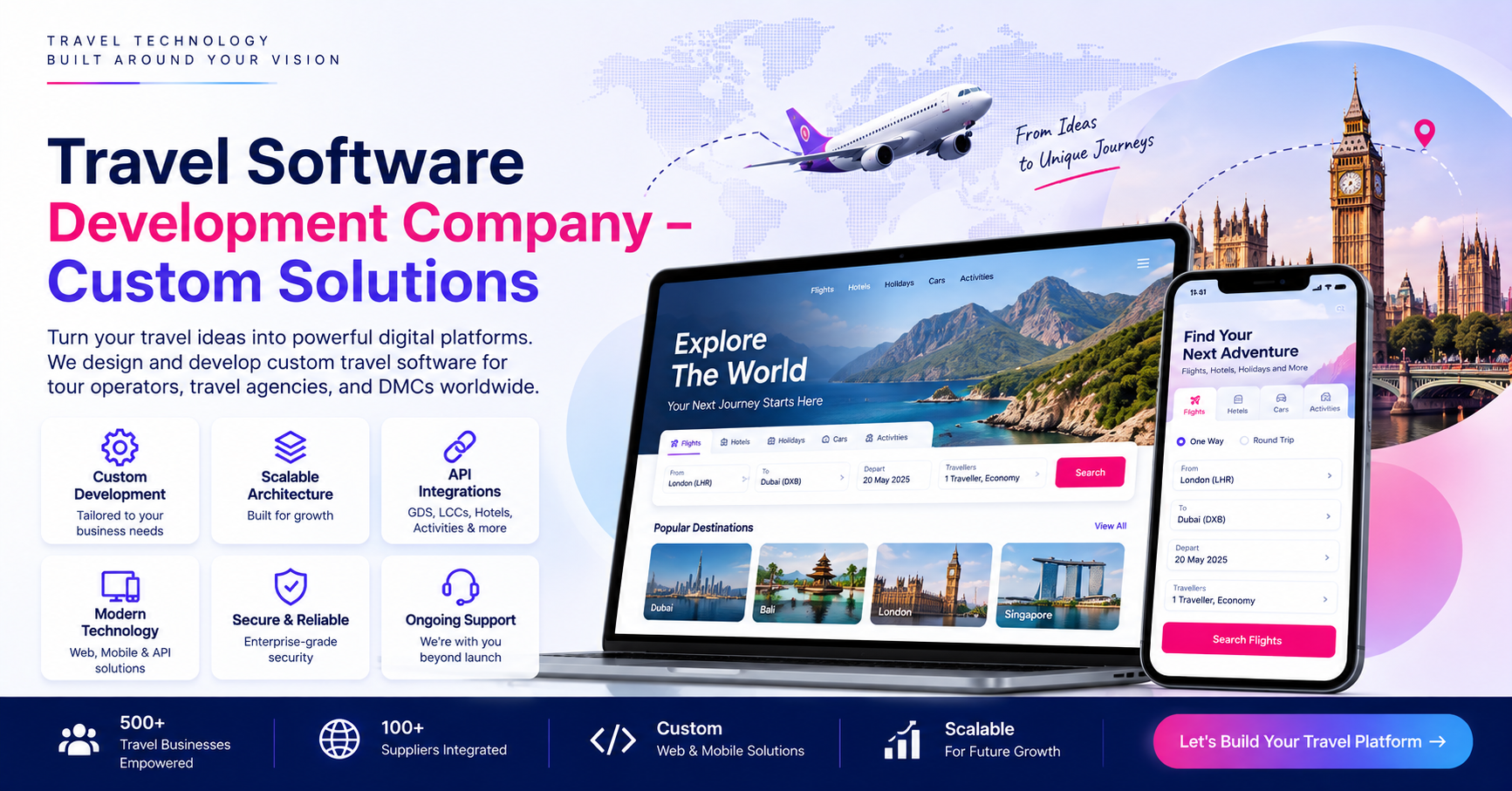
Travel Software Development Company – Custom Solutions | TravelTech Innovations
The travel business rarely relies on just one thing to manage. A simple booking can involve a customer agent or government supplier APIs and pricing rules. As your business grows, keeping all these moving parts connected becomes much harder. That is the only reason why you need way more than just a website with the book now button you need a technology that supports the way your business actually sells and manages. A travel booking engine Development company can help you build the technology. Instead of forcing every business into the same platform the right development partner can create or connect systems around specific booking workflows and inventory sources.
What does a travel software development company do?
A travel software company builds and integrates technology that helps you manage bookings inventory supplier connectivity payments agents and day to day operations. This can include travel booking engines, agency software reservation systems and travel apis.
What does a Travel Agency Booking Software development company actually build?
There is no single software that works for every travel business. A tour operator, travel agency and B2B wholesaler can have completely different processes.
1. Travel booking engines
A travel booking engine handles the customer facing booking journey. Users can search for travel products, compare available options and enter travel details.
2. Travel agency booking software
Travel agencies need more than online reservations. The software might also need to handle customer needs, supplier bookings, pricing and markups.
3. B2B Travel portals
The portals are designed for agents sub agents And business partners. They can include agent accounts, negotiated rates, markups and credit limits besides booking history and other controls that would normally be required in a direct journey.
4. B2C Travel portals
These portals focus on direct customers. The priority is usually a smooth search and booking experience online payments confirmations and self service options.
5. Reservation and management systems
The systems handle the operational side of bookings. They can aggregate reservations, customer suppliers and payments.
Start with the travel business not the technology
One of the biggest mistakes that you might make is choosing software first and then trying to adjust your process around it. The better approach is the opposite. Before deciding what needs to be built, a development partner understands what the business sells, who it sells, where the inventory comes from and how a booking moves to the organization. For example a wholeseller might need strong agent management markups and commissions. An OTA might care more about supplier aggregation search speed.
Where does a travel booking engine fit?
Think of the booking engine as a part of the travel platform that the customer or agent interacts with during a booking. The user searches for a flight or Hotel or other travel products. The system retrieves available inventory, presents options and prices, collects traveler details and processes the booking. Once the transaction is completed the system generates the relevant ticket voucher. But the journey does not end here. Your customers want to cancel or modify a booking. Prices might change between search and confirmation. So the booking engine is the customer facing part of the journey. The surrounding technology determines how effectively the travel business can manage everything that happens before and after working.
Travel booking engine should go beyond reservation
a travel agency does not become more efficient simply because your customers can book online. Someone still needs to manage those bookings. Good travel agency booking software should support the operational work around each reservation including your customer management and supply and management that leads to a much better question for agencies to ask for evaluated software: what happens up to the customer clicks book? Can the team find the booking easily or can the agent modify it? These details might not look very impressive in a software demonstration, but they have a major effect on everyday operations.
The financial side of travel software matters
Travel software is also a financial system. Pricing is rarely as simple as showing the supplier’s rate. You might need to apply markup commissions, service fees or customer specific pricing before displaying the final amount. If you are running a B2B business there might also be agent wallets or credit limits. A connected platform can bring together dynamic pricing Commission management service fees and agent wallets besides payment gateway integration. This matters because a booking that cannot be financially tracked properly can create just as much operational trouble as booking that was never confirmed.
Automation is changing how travel teams work
Automation does not always mean complicated AI features. Some of travel’s most useful automation is surprisingly practical. Assisting then automates quotations or booking confirmations. It can also help with supplier data processing and hotel mapping besides workflows and repetitive administrative tasks. For a growing travel company that can make a big difference. Instead of increasing headcount every time booking volume rises you can use technology to remove some of the repetitive work.
What should a travel software development process look like?
Custom travel software should not begin with developers immediately writing code.
-
Business discovery
The development team studies the existing business model users booking workflow and operational challenges.
-
Requirement mapping
Booking inventory payment and customer operational requirements are mapped to propose solutions.
-
Architecture and integration planning
The team determines which APIs and vendor systems must communicate.
-
Product and UX Design
Booking interfaces and internal workflows are designed around the actual users.
-
Development and integration
The platform is built and connected with required travel suppliers and services.
-
Testing
The system is tested against fuel booking payment and cancellation.
-
Launch
The platform is deployed and users or internal teams are onboarded.
-
Ongoing improvement
New suppliers, sales channels and business requirements can be added as the company evolves.
When does a travel business need more than off the shelf software
Custom development is not automatically the right choice for every travel company. Off-the-shelf software can make sense when you have a simple requirement and you want to deploy quickly. But problems arise when standard workflows no longer match how your business operates.
Connect the Software to the Travel Inventory You Actually Sell
A travel software development company may need to connect a business with several types of travel sources, such as:
- GDS platforms
- Airline APIs
- NDC connections
- Hotel APIs
- Bedbanks
- Tour and activity suppliers
- Transfer providers
- Travel aggregators
Why Traveltekpro For travel software development?
Once the business requirements are cleared the next step is finding a technology partner that can translate those requirements into a workable travel platform. Traveltekpro can support your travel business across different areas of the technology system including travel booking technology, travel agency solutions API and gds connectivity besides travel management systems.
The focus should not be on how many features a platform contains. What matters more is whether those capabilities solve the problems the travel business is actually facing. For one company that could mean connecting multiple suppliers for another, it could mean improving agent management onto a connected platform.
What to Look for in a Travel Software Development Company
| Evaluation Area | What to Look For |
| Travel industry experience | Understanding of real travel booking workflows |
| Integration capability | APIs, GDS, NDC and supplier connections |
| Product understanding | Booking engines, portals and management systems |
| Scalability | Ability to support more users, bookings and suppliers |
| Security | Protection of customer and payment-related data |
| Testing | Real-world booking and failure scenarios |
| Support | Implementation and post-launch assistance |
| Product roadmap | Ability to adapt as the business grows |
So you must know that travel software is more than just a booking interface. Behind every successful booking platform is a wider ecosystem of inventory suppliers, payment customers, agents and pricing rules. That is the only reason why you should not choose technology simply because it has a long feature list. You should first understand how they sell travel and then select or build technology that supports the process.
Read More: How to Choose Customizable Travel Agency Booking Software
FAQ'S
Related Blogs
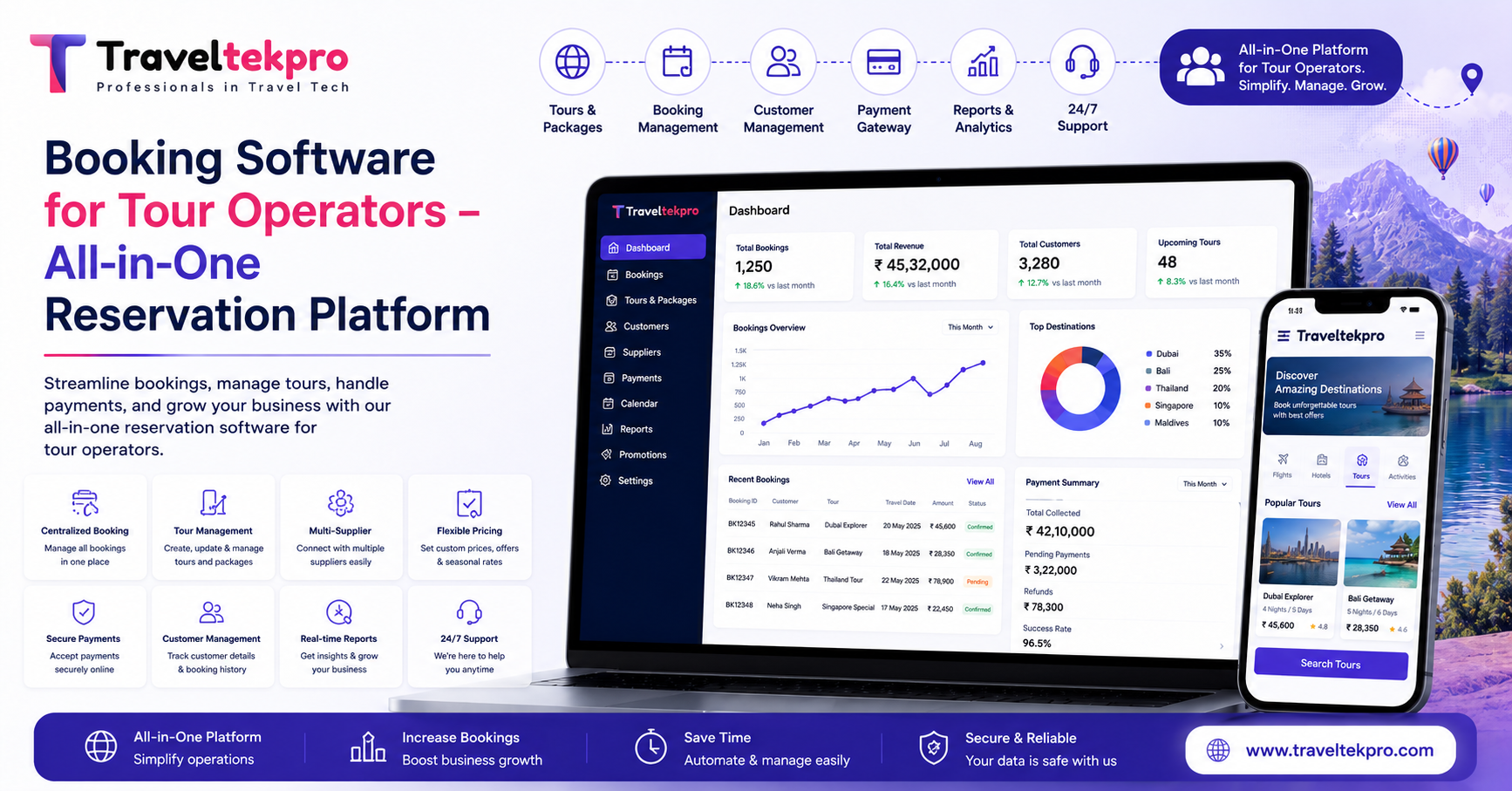
Booking Software for Tour Operators – All-in-One Reservation Platform
Booking Software for Tour Operators – All-in-One Reservation Platform Running a tour business sounds really exciting from the outside. You create itineraries, work with suppliers, plan departures and help people experience new places. But behind…
Sep 2, 2026Read More
Get in touch
Email Us
sales@traveltekprogroup.com“We opted for Traveltekpro to construct and implement our Flight booking system, and I am thoroughly pleased with the outcomes. Their team displays remarkable efficiency, expertise, and utmost professionalism throughout the project.”

Arun Neli
Chief Operating Officer
“I had a fantastic experience with Traveltekpro! Their custom booking system designed for our platform is not only sleek and easy to use,but it has also received excellent feedback rom our customers. Kudos to the Traveltekpro team for their outstanding work!”

Benjamin Smith
Product Manager
“Traveltekpro has been a delight to collaborate with on two distinct occasions, showcasing professionalism and expertise. Their team demonstrates a commitment to surpassing expectations and adheringto deadlines.”

Kevin Brown
CTO
“We partnered with Traveltekpro for our travel booking platform, and the experience was excellent. The team understood our requirements quickly, delivered on time, and provided great support throughout the project. Highly recommended.”

Manish Singh
Director of IT
“Great experience working with Traveltekpro. They were responsive, knowledgeable, and always ready to suggest better solutions. The final product exceeded our expectations, and the after-launch support has been excellent.”

Shubham Rawat
Founder & CEO