
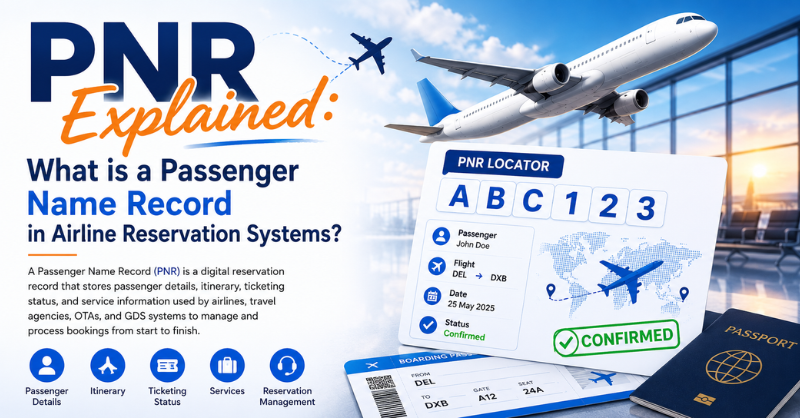
PNR Explained: What is a Passenger Name Record in Airline Reservation Systems?
A Passenger Name Record (PNR) is a digital reservation record created when a traveler books a flight. It contains passenger details, itinerary information, contact details, ticketing status, seat assignments, and other booking-related data. Every airline reservation generates a unique PNR that allows airlines, travel agencies, OTAs, and Global Distribution Systems (GDS) to manage and track the booking throughout its lifecycle.
What is a Passenger Name Record (PNR)?
If you’ve ever booked a flight online, you’ve likely received a six-character booking reference after completing your reservation. This reference is commonly called a PNR, but the actual Passenger Name Record is much more than a simple booking code.
A Passenger Name Record (PNR) is the core reservation record used by airlines, Online Travel Agencies (OTAs), Global Distribution Systems (GDS), and travel management companies to store and manage passenger bookings.
The PNR acts as the central source of information for a journey, containing everything required to process, ticket, modify, service, and complete a reservation.
Simply put, if you’re asking “What is PNR?”, it is the digital record that makes modern airline reservations possible.
PNR Explained: Why It Matters
To fully understand PNR Explained, it’s important to recognize that airlines handle millions of reservations every day.
Without a centralized reservation record, airlines would struggle to:
- Store passenger information
- Issue tickets
- Manage seat assignments
- Process cancellations
- Handle flight changes
- Coordinate code-share flights
- Support airport check-in
The Passenger Name Record serves as the operational backbone of airline reservation systems.
Every action performed after booking whether it’s ticket issuance, seat selection, baggage purchase, or flight modification is connected to the PNR.
How Does a PNR Work?
When a traveler books a flight through an airline website, OTA, or travel agency, the booking system creates a Passenger Name Record.
The typical workflow looks like this:
Step 1: Flight Search
The traveler searches for available flights.
Step 2: Flight Selection
The traveler selects a preferred itinerary.
Step 3: Passenger Information
Personal details such as name, email, and phone number are entered.
Step 4: PNR Creation
The airline reservation system creates a unique Passenger Name Record.
Step 5: Ticket Issuance
After payment is completed, the airline issues the electronic ticket.
Step 6: Reservation Management
The PNR is used for:
- Check-in
- Schedule changes
- Seat selection
- Baggage purchases
- Cancellations
- Refunds
What Information is Stored in a Passenger Name Record?
A Passenger Name Record contains multiple data elements required for reservation management.
Typical PNR Data Includes:
| PNR Element | Purpose |
| Passenger Name | Traveler identification |
| Booking Reference | Reservation lookup |
| Flight Itinerary | Flight segments and routes |
| Contact Information | Notifications and updates |
| Ticket Number | Ticket issuance tracking |
| Seat Assignment | Selected seat details |
| Baggage Information | Ancillary services |
| Frequent Flyer Number | Loyalty program integration |
| Payment Details | Reservation processing |
| Special Service Requests (SSR) | Meal preferences, wheelchair assistance, etc. |
| Booking Status | Confirmed, Cancelled, Waitlisted |
These elements collectively form the Passenger Name Record used throughout the journey.
PNR vs Airline Ticket
One of the most common misconceptions is that a PNR and an airline ticket are the same thing.
They are not.
1. Passenger Name Record (PNR)
- Reservation record
- Stores booking information
- Created before ticket issuance
- Used to manage the booking
2. E-Ticket
- Travel document
- Issued after payment
- Required for travel
- Linked to the PNR
A booking can have a PNR without an issued ticket, but an airline ticket cannot exist without an associated reservation.
How Airlines, OTAs, and GDS Use PNRs
Modern travel technology relies heavily on Passenger Name Records.
1. Airlines
Airlines use PNRs to:
- Manage reservations
- Issue tickets
- Process check-ins
- Handle flight disruptions
2. Online Travel Agencies (OTAs)
OTAs use PNRs to:
- Retrieve bookings
- Process cancellations
- Manage itinerary changes
- Provide customer support
3. Global Distribution Systems (GDS)
Platforms such as Amadeus, Travelport, and Sabre use PNRs to distribute flight inventory and synchronize booking information across multiple travel channels.
The Lifecycle of a Passenger Name Record
A Passenger Name Record follows a complete lifecycle from booking to travel completion.
-
Booking Created
Passenger details are entered.
-
PNR Generated
A reservation record is created.
-
Ticket Issued
The booking is financially confirmed.
-
Servicing
Changes, upgrades, and ancillary purchases are processed.
-
Check-In
Airport systems access the PNR.
-
Travel Completed
Journey is completed.
-
Archiving
The PNR is archived for reporting, compliance, and historical purposes.
Why PNRs Are Critical for Travel Technology Platforms
Travel technology companies, OTAs, and booking engines rely on Passenger Name Records as the foundation of reservation management.
Without PNRs, platforms would be unable to:
- Retrieve bookings
- Issue tickets
- Synchronize supplier data
- Support post-booking modifications
- Manage customer service requests
For travel technology providers building airline reservation systems, understanding What is PNR is essential for successful airline and GDS integrations.
Security and Compliance Considerations
Since a Passenger Name Record contains personal information, airlines and travel companies must implement strict security controls.
Key compliance areas include:
- Data protection regulations
- GDPR compliance
- PCI DSS requirements
- Secure payment handling
- Data retention policies
- Access controls
Organizations must ensure that passenger data is securely stored and processed throughout the reservation lifecycle.
Future of Passenger Name Records
The airline industry is evolving toward modern standards such as:
- NDC (New Distribution Capability)
- ONE Order
- API-based reservations
- AI-powered travel servicing
While new technologies continue to emerge, the concept behind the Passenger Name Record remains fundamental to airline operations.
As travel distribution becomes increasingly digital, PNRs will continue to serve as the bridge between booking, ticketing, servicing, and fulfillment.
Final Thoughts on Passenger Name Records (PNRs)
Understanding what a Passenger Name Record (PNR) is essential for anyone involved in airline reservations, travel technology, or OTA development. A PNR is much more than a simple booking reference it serves as the central reservation record that stores passenger details, itinerary information, ticketing data, and other operational information needed to manage a traveler’s journey from booking through completion. Whether you are an airline, travel agency, OTA, or travel technology provider, having a strong understanding of Passenger Name Records is crucial for building efficient, reliable, and scalable travel booking systems. Companies like Traveltekpro leverage advanced travel technology solutions and seamless airline integrations to help businesses effectively manage PNRs and deliver a smooth booking experience for travelers.
Read More: IATA Ticket Booking Software: Features, Benefits, and Integration
FAQ’S
1. What is a PNR in airline booking?
A Passenger Name Record (PNR) is a reservation record that stores passenger details, itinerary information, contact information, ticketing status, and other booking-related data used throughout the travel lifecycle. Airlines, OTAs, and travel agencies use the PNR to manage reservations, process changes, and support passenger services.
2. Is a PNR the same as a ticket?
No. A PNR and an airline ticket are different. A PNR is the reservation record that contains booking information, while an e-ticket is the travel document issued after payment and ticketing. A booking can have a PNR before a ticket is issued, but every ticket is linked to a PNR.
3. How many characters are in a PNR?
Most airlines use a six-character alphanumeric booking reference as the PNR locator. However, the format may vary slightly depending on the airline, reservation system, or Global Distribution System (GDS) being used.
4. What information does a Passenger Name Record contain?
A Passenger Name Record typically contains passenger names, flight itinerary details, contact information, ticket numbers, seat assignments, baggage information, payment-related details, frequent flyer numbers, booking status, and Special Service Requests (SSRs) such as meal preferences or wheelchair assistance.
5. Why is a PNR important?
A PNR is important because it serves as the central record for managing an airline reservation. It allows airlines, OTAs, travel agencies, airport systems, and GDS platforms to access booking information, issue tickets, process modifications, handle disruptions, and support passengers throughout their journey.
6. How can I find my PNR number?
Your PNR number is usually included in the booking confirmation email sent by the airline or travel agency after a reservation is made. It can also be found on your e-ticket receipt, itinerary document, or within the airline’s “Manage Booking” section on its website or mobile app.
Related Blogs
How an Online Flight Reservation System Streamlines Your Travel Planning
How an Online Flight Reservation System Streamlines Your Travel Planning Booking a flight might look very simple from the outside. A traveller searches for a destination, compares a few options and makes the payment. But…
Aug 21, 2026Read More
Understanding Razorpay Payment Gateway Integration: Key Steps and Benefits
Understanding Razorpay Payment Gateway Integration: Key Steps and Benefits A customer can spend 10 minutes comparing flights, checking hotel rooms or building a holiday package and still walk away at the final step. Not because…
Aug 20, 2026Read More
Get in touch
Email Us
sales@traveltekprogroup.com“We opted for Traveltekpro to construct and implement our Flight booking system, and I am thoroughly pleased with the outcomes. Their team displays remarkable efficiency, expertise, and utmost professionalism throughout the project.”

Arun Neli
Chief Operating Officer
“I had a fantastic experience with Traveltekpro! Their custom booking system designed for our platform is not only sleek and easy to use,but it has also received excellent feedback rom our customers. Kudos to the Traveltekpro team for their outstanding work!”

Benjamin Smith
Product Manager
“Traveltekpro has been a delight to collaborate with on two distinct occasions, showcasing professionalism and expertise. Their team demonstrates a commitment to surpassing expectations and adheringto deadlines.”

Kevin Brown
CTO
“We partnered with Traveltekpro for our travel booking platform, and the experience was excellent. The team understood our requirements quickly, delivered on time, and provided great support throughout the project. Highly recommended.”

Manish Singh
Director of IT
“Great experience working with Traveltekpro. They were responsive, knowledgeable, and always ready to suggest better solutions. The final product exceeded our expectations, and the after-launch support has been excellent.”

Shubham Rawat
Founder & CEO