
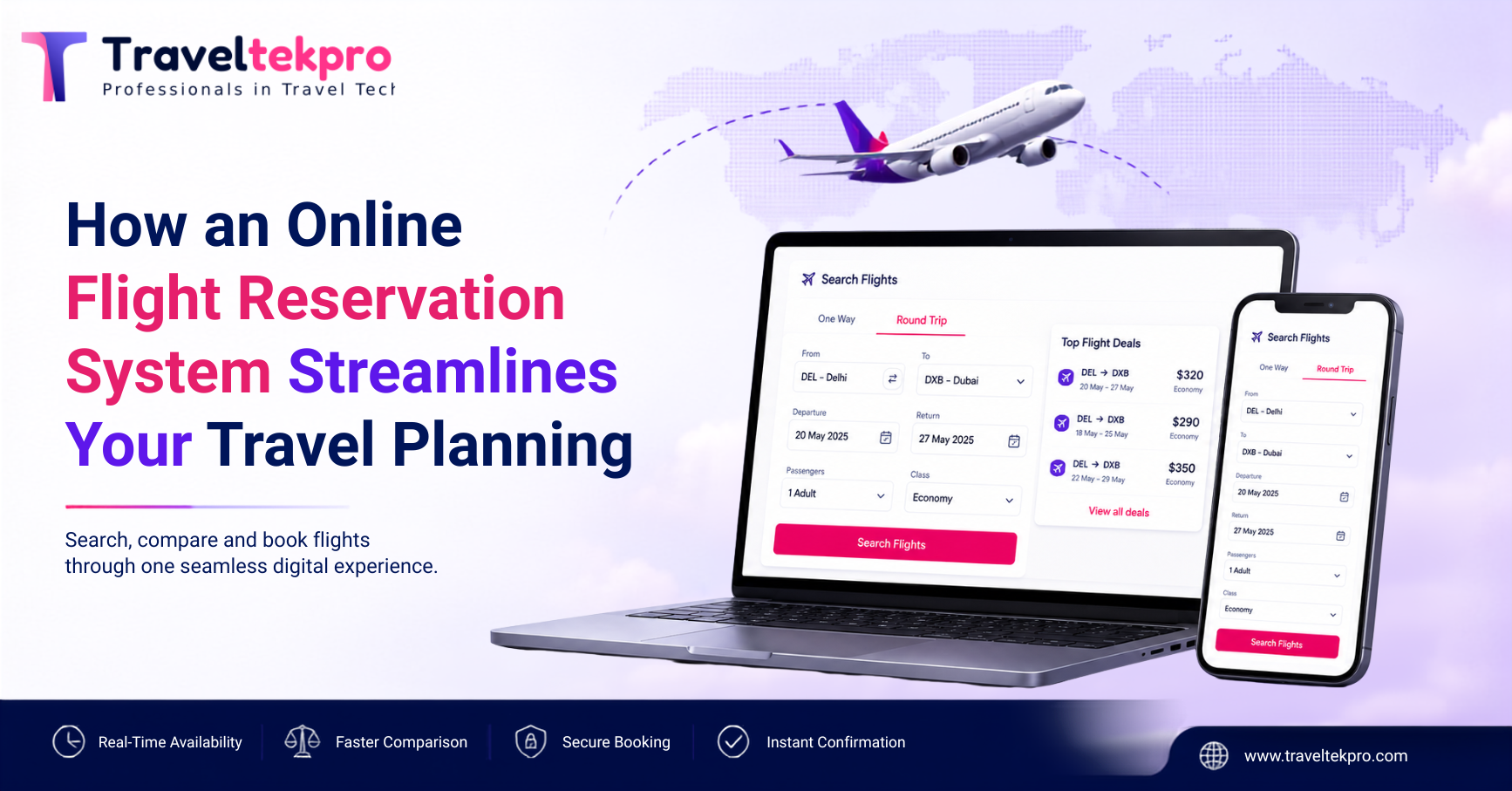
How an Online Flight Reservation System Streamlines Your Travel Planning
Booking a flight might look very simple from the outside. A traveller searches for a destination, compares a few options and makes the payment. But anyone working in the travel industry knows there is much more happening behind that simple journey. Flight schedules can change availability and might disappear between search and booking. Passenger information has to be collected accurately and payments need to be processed quickly. When these activities are handled manually even a moderate number of bookings can create a lot of work for a travel team. This is exactly where the Online Flight Reservation System truly makes a difference. It brings flight search availability, passenger details and confirmation into a more connected digital workflow. In simple terms, you can say an online flight reservation system helps you make the journey from search to confirmed reservation faster and more organized. It can also give you a convenient way to compare and book flights or depending on an employee for every setup.
What actually happens between a flight search and a confirmed reservation?
Just think about what happens when someone books a flight online. Firstly the traveller enters the destination and travel dates. The system then searches connected airline or travel inventory and returns available options. Then your customer compares schedules and fares before selecting an itinerary. Next comes passenger information and reservation. So every stage matters. If the search is slow, your customer might leave. If the fare shown is not accurate the customer loses confidence. This is why Flight Booking System Reservation Truly matters.
Where manual flight booking starts slowing or travel business down
Manual processes are not always a problem when your travel business is small. A travel consultant might receive an inquiry check availability, speak with the customer and confirm the itinerary. When there are only a few customers this can perform really well. The problem appears when your booking volume starts growing. Suddenly your team might be handling dozens or even hundreds of similar requests. Staff is repeatedly searching for available fares and preparing quotations. There can also be multiple communication channels involved like email phone, messaging apps and internal systems. At that point the problem is not just about the manual booking it also becomes difficult to scale your business without adding more administrative work. A Flight Reservation System can take many of the routine steps and bring them into one structured workflow. This allows travel professionals to spend less time repeating basic booking tasks and more time helping your customers with situations that genuinely require human expertise.
How Online Flight Reservation System changes the booking workflow
The biggest difference is that the booking process becomes more connected.
1. From repeated searches to digital flight discovery
Instead of asking an employee to check every flight option your customers or even travel agents can search for available flights through the online system. They can enter dates, destinations and passenger information and then review the available options themselves. This does not eliminate the role of a travel professional. It simply means the professional doesn’t have to perform the same basic search repeatedly.
2. From scattered information to centralized booking data
Manual reservations can leave information spread across emails and spreadsheets. A reservation system brings booking information into a more centralized environment. That makes it easier for your business to see what was booked and who made the booking.
3. From manual confirmation to structured booking communication
Once a reservation has been processed, confirmation information can be delivered through connected digital workflows. This reduces the need for staff to manually prepare and send the same information for every routine booking.
4. From separate payment and booking processes to one journey
Online payment can also become part of the reservation flow. Your customer selects a flight, provides the required information and receives a relevant confirmation through a connected process.
Real time flight data is what makes the reservation experience useful
A Flight Booking System Reservation Is only useful As the information it receives. Travellers expect flight schedules and availability to be responsibly current. That’s particularly important in air travel because availability and pricing can change quickly. Online flight reservation systems might connect with sources like gds platforms or other flight suppliers to access relevant inventory. That connectivity can influence your customer experience in several ways. If your traveller searches for a flight and receives outdated information they might select an option that is no longer available. If the price changes during the booking process the system needs to handle that situation clearly rather than leaving the customer confused.
An Online Flight Reservation System Has two users: the traveller and the travel business
1. For travelers
Travelers generally want the process to be very simple. They want to search quickly, compare suitable flights, understand the price and enter the details without unnecessary complications. They might also want to access the booking later if they need to check an itinerary or request a change.
2. For travel businesses
Your business has different requirements. It needs reliable inventory access, booking visibility, passenger information and payment status. Your business also needs to know what happens when something goes wrong. For example what happens if payment succeeds but ticketing doesn’t complete? What happens when fare changes? A system that looks great to your customers but creates extra work for the operations team is not necessarily a good option.
How flight reservation technology helps travel businesses handle more bookings?
Scalability is not just about processing more transactions. It’s all about handling more business without every additional booking creating the same amount of additional manual work. An online flight reservation system can support this by allowing more customers or agents to search flight inventory directly. Routine reservations can move through a structured workflow while booking information remains easier for internal teams to access. That can make a difference when demand increases.
What Should Travel Businesses Evaluate Before Choosing a Flight Reservation System?
| Evaluation Area | What to Look For |
| Flight Inventory | Relevant airline and supplier connectivity |
| Search Performance | Fast and reliable search results |
| Fare Accuracy | Current pricing and availability |
| Booking Workflow | Smooth search-to-confirmation process |
| Payment | Secure and reliable transaction flow |
| Ticketing | Clear post-booking process |
| Servicing | Changes, cancellations and refunds |
| Integrations | GDS, APIs, CRM and payment systems |
| Reporting | Useful booking and business information |
| Scalability | Ability to handle increasing booking volumes |
Test the Online Flight Reservation System with real travel scenarios before you choose it
A standard product demo can make almost any software look impressive. Instead of watching someone click through a prepared demonstration, ask the provider to show how the system handles realistic situations.
-
A customer searches for round trip international flight
You need to see how quickly the results appear and how easy it is to compare options.
-
The fare changes between search and booking
Ask what the customer sees and how the systems handle the updated price.
-
Payment succeeds where ticketing encounters an issue
This is especially important. You need to find out how the system identifies the problem and what the operations team can do next.
-
Passenger wants to change the itinerary
Understand whether the change can be managed within the system or requires a completely separate manual process.
You must know that Flight Booking System Reservation from Traveltekpro is valuable because it brings together all the small steps involved in flight planning and reservation. For travelers that can mean less friction between search and confirmation. For travel businesses like yours, it can mean fewer disconnected processes, better visibility into reservations and a stronger foundation for handling more bookings. But the goal should not be simply to put flight booking online. The real goal is to make the entire reservation journey easier to manage from the moment or traveler searches for a flight to what happens after the ticket has been issued. This is what turns a basic booking interface into a useful technology.
Read More: How Does a B2B Flight Booking Portal Work?
FAQ'S
Related Blogs
Understanding Razorpay Payment Gateway Integration: Key Steps and Benefits
Understanding Razorpay Payment Gateway Integration: Key Steps and Benefits A customer can spend 10 minutes comparing flights, checking hotel rooms or building a holiday package and still walk away at the final step. Not because…
Aug 20, 2026Read More
Get in touch
Email Us
sales@traveltekprogroup.com“We opted for Traveltekpro to construct and implement our Flight booking system, and I am thoroughly pleased with the outcomes. Their team displays remarkable efficiency, expertise, and utmost professionalism throughout the project.”

Arun Neli
Chief Operating Officer
“I had a fantastic experience with Traveltekpro! Their custom booking system designed for our platform is not only sleek and easy to use,but it has also received excellent feedback rom our customers. Kudos to the Traveltekpro team for their outstanding work!”

Benjamin Smith
Product Manager
“Traveltekpro has been a delight to collaborate with on two distinct occasions, showcasing professionalism and expertise. Their team demonstrates a commitment to surpassing expectations and adheringto deadlines.”

Kevin Brown
CTO
“We partnered with Traveltekpro for our travel booking platform, and the experience was excellent. The team understood our requirements quickly, delivered on time, and provided great support throughout the project. Highly recommended.”

Manish Singh
Director of IT
“Great experience working with Traveltekpro. They were responsive, knowledgeable, and always ready to suggest better solutions. The final product exceeded our expectations, and the after-launch support has been excellent.”

Shubham Rawat
Founder & CEO