
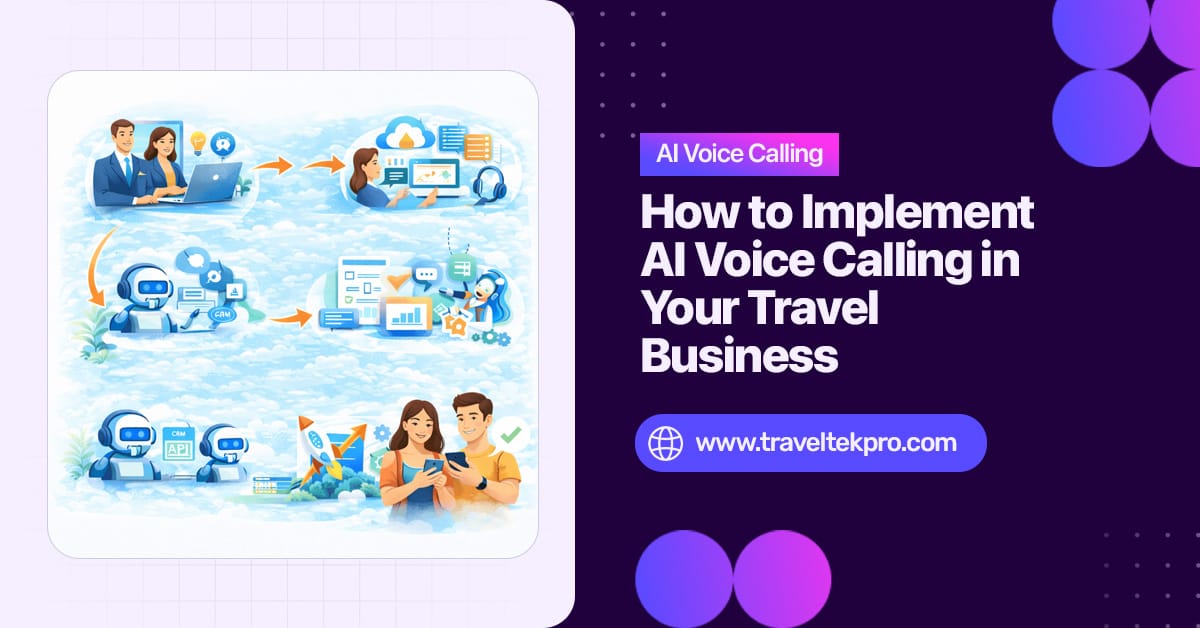
How to Implement AI Voice Calling in Your Travel Business
No matter how many apps booking engines and chat bots exist one truth remains in travel business people still trust voices more than screens. When your customer is booking a flight for their family, planning a honeymoon, and spending thousands on a holiday package, they don’t look forward to just clicking a button. They actually want to ask questions and want to feel sure that someone on the other side understands them. A phone call gives that confidence in a way no website form can ever. This is the only reason why phone calls continue to drive most travel sales. Your customer might browse online but the final decision usually happens on a call, where they ask about seat availability, hotel quality, visa help and pricing changes. That conversation often turns curiosity into booking.
But the problem is that you cannot keep up with this demand anymore as a travel company. Calls come from different countries, different time zones and at every hour of the day. During peak seasons a single campaign can trigger hundreds of calls. Human agents can do their best but they can only handle one call at a time. When lines are busy your customers just hang up. This is exactly where AI voice calling is quietly changing the travel industry. Instead of missing calls you can now have digital voice agents that answer instantly, speak naturally and handle customer requests just like a trained travel executive. The AI systems do not replace humans; they make sure no opportunity is ever lost while humans focus on higher value conversations.
What is AI voice calling in the travel business?
AI voice calling is not a robot reading scripts, it’s closer to having a smart virtual travel agent who can listen and talk. When your customer calls they do not hear a menu, they hear a friendly voice that invites them to speak freely. You might say I want to check prices for Dubai next month or I need to cancel my hotel booking. The AI listens to the words, understands what they mean and replies in a natural way. Behind the scenes this happens through speech recognition, natural language processing and intelligent decision making but for your customer it feels like talking to a real person who knows your business.
The biggest difference between AI voice automation and old style IVR systems is flexibility. IVR forces your callers to press numbers and follow narrow paths while AI allows people to talk the way they normally word. That matters a lot in travel. My questions are rarely simple or predictable. Travel conversations include dates and destinations besides urgency. AI voice systems are built to handle exactly that kind of complexity which makes them far more useful as compared to traditional Phone menus.
Why do travel companies need AI voice calling?
The travel industry has changed faster than most businesses. Today people book from different countries, different cultures, and different time zones. If you are a travel company in the USA then you might get a call from the Middle East or Europe and Asia all in one day. You cannot be online for all of them without burning out or becoming extremely expensive. On top of that, travel demand is completely uneven. One marketing campaign festive offer of flight deals can suddenly bring a flood of calls even well staffed agencies find themselves overwhelmed. Customers wait, get frustrated and leave.
Language is another barrier; travellers want to speak in the language they are comfortable with and training and hiring staff can get really cold mostly and difficult to even scale. That’s where AI voice calling makes a big difference. It removes all such barriers and works around the clock. It can answer hundreds or even thousands of calls at the same time. It doesn’t get tiring or overwhelming. If you operate in a global fast moving environment this is no longer a luxury it’s a necessity.
-
How does AI voice calling work inside a travel business?
From the customer’s point of view everything feels really simple. They just dial your number and someone answers and they get the help. But inside your travel business the AI is doing a lot of intelligent work. When a call comes AI first recognizes the customer’s voice and turns it into text then it analyzes what the customer is trying to do, book cancel or check prices. Once it understands all the requests it connects you to your booking system or Travel ERP. If the customer asks for flight prices it fetches real time data. If they want to change a booking it finds their record. If they need help beyond what AI is allowed to do it transfers the call to a human agent with all the context already shared. The result is a smooth experience for your customers and a fully automated workflow for your team.
What travel tasks the voice agents can handle?
Ideally AI voice calling in travel business can handle a large part of your daily work that is repetitive. Customers ask the same types of questions over and over if they want to know prices, availability rules and the next steps. AI voice agents can handle all of these without human involvement. They can take new inquiries, explain packages and check dates and also remind customers to pay, handle cancellations and even provide post booking help like check-in details or hotel confirmation. It actually frees you up so that you can focus on complicated itineraries, group bookings and customers who need personal attention.
-
How AI voice automation improves sales?
Every missed call is a lost customer. AI makes sure that never happens. Every inquiry is answered and every investor traveler is guided towards the booking. Follow-ups happen automatically, the speed of response increases and so does the trust. When your customers get instant answers they are more likely to complete the booking. With time this leads to higher conversion rates and higher revenue and a much more efficient sales operation.
AI Voice Calling vs Traditional Call Centers
| Feature | Traditional Call Center | AI Voice Calling |
| Working hours | Limited | 24/7 |
| Missed calls | Very common | Never |
| Cost | High salaries and training | Low running cost |
| Languages | Limited | Multiple languages |
| Call capacity | Few calls at once | Thousands at once |
| Speed | Slow during peak times | Always instant |
How does AI voice calling integrate with travel ERP and CRM?
This is the point where the AI voice stops being just a talking system and becomes a part of your real system. When AI voice connects with your travel ERP and CRM it no longer works in isolation it becomes aware about who the customer is, what they booked before and what they are asking about now. Just imagine our customer calling and saying I booked a Dubai package last week and I need to change my hotel. The AI voice does not treat this like a new call; it pulls a travel customer’s phone number, checks the CRM and finds the booking inside your travel ERP and instantly knows the package dates and hotel name. Instead of asking the customer to repeat everything the AI can say I see you booked the five night Dubai package staying at Marina Bay hotel are you calling to change that booking? The level of context is what makes an AI voice feel human.
Every call is also logged automatically the AI records what the customer asked and what was answered whether a booking was made and whether follow up needed. This data flows straight into your CRM. Your sales team can see which customers are interested and which ones did not work and who needs a callback.
Step by step how to implement AI voice calling in travel business?
Implementing AI voice automation is not complicated when done correctly. The keys to think like a travel business not a tech company.
The first step is to decide what calls you want AI to handle. You can start with inquiry calls and also use AI for post booking support or payment reminders. You can also do both; this clarity helps you design the system properly.
Next you can choose an AI platform that is built for travel not just a generic call bot. You basically need integrations with booking systems, pricing engines and ERP’s. A good platform already understands this.
Then comes the integration part. Your AI voices are connected to your CRM and travel ERP so it can easily read the customer data, create new leads and update the travel booking status.
After that AI needs training. That means feeding it to your packages, destinations , prices , cancellation rules and information. The AI learns how your business talks so it sounds natural and correct. Before going live real calls are tested. You’ll listen, adjust, improve response and even fine tune how AI handles different situations.
-
Data you need to train your AI voice agent
A wise person is only as smart as information is given. For travel businesses include full details of your packages including destinations and prices. It also includes hotel and airline roles. Your customers ask these questions constantly and AI must answer all of them correctly. Your payment rules, refund timelines and booking policies must be part of your system. AI should know when to offer a refund and when to suggest rescheduling. FAQs are another important piece. These include visa questions, baggage rules and check in times. When this data is updated AI becomes smarter and more accurate.
Real world uses of AI voice and travel business
in travel companies AI voices are already doing serious work. It answers inquiry calls coming from ads and websites making sure no leaders lose it also runs holiday campaigns by calling interested customers and explaining offers. It supports booked travelers by giving them check in times and hotel details. For many agencies the AI voice has become the digital call center, always open and always polite.
Security privacy and compliance in AI voice calling
Good AI voice systems encrypt all the call data so no one can listen or steal information. Payment links and card details are perfectly handled through secure systems and not spoken loud call recordings are stored safely and only accessible to your authorized staff. Modern AI platforms also follow data protection laws in different countries so it ensures that your customer privacy is respected.
How much does AI voice calling cost for you as a travel business?
As compared to hiring a large team, AI calling is very affordable. A lot of providers like Traveltekpro charge a small setup fee and then a per-minute or per call rate. There are no salaries or no sick days and no training expenses. The money that you save from fewer missed calls and higher booking conversion easily covers this cost.
-
AI replacing travel agents?
No and this is important. AI voice is not here to remove humans, it is here to remove repetitive work. When AI handles routine calls human agents are free to focus on what really matters: complex itineraries and group bookings besides luxury travel. Instead of replacing people, AI makes them more valuable.
The future of AI voice in the travel industry
Very soon you can even see that travelers will plan the entire trip just by speaking. They will ask for destinations, compare prices, book flights and choose hotels. AI will work like a personal travel concierge available anywhere in the world any language and anytime. For your travel business this means one thing: those who adopt AI voice early will lead the market and those who ignore it will slowly fall behind.
So AI voice calling is not some distant future idea, it is already happening. Travel companies reduce costs, increase bookings and serve customers better. In any industry where timing, trust and communication decide everything, having a voice that is always available and always helpful gives you a powerful advantage. If you want to grow without losing control AI wise calling is no longer optional is the next step.
Read More: AI-Powered Hotel Reservation System | Features & Benefits
FAQ'S
Related Blogs
How an Online Flight Reservation System Streamlines Your Travel Planning
How an Online Flight Reservation System Streamlines Your Travel Planning Booking a flight might look very simple from the outside. A traveller searches for a destination, compares a few options and makes the payment. But…
Aug 21, 2026Read More
Understanding Razorpay Payment Gateway Integration: Key Steps and Benefits
Understanding Razorpay Payment Gateway Integration: Key Steps and Benefits A customer can spend 10 minutes comparing flights, checking hotel rooms or building a holiday package and still walk away at the final step. Not because…
Aug 20, 2026Read More
Get in touch
Email Us
sales@traveltekprogroup.com“We opted for Traveltekpro to construct and implement our Flight booking system, and I am thoroughly pleased with the outcomes. Their team displays remarkable efficiency, expertise, and utmost professionalism throughout the project.”

Arun Neli
Chief Operating Officer
“I had a fantastic experience with Traveltekpro! Their custom booking system designed for our platform is not only sleek and easy to use,but it has also received excellent feedback rom our customers. Kudos to the Traveltekpro team for their outstanding work!”

Benjamin Smith
Product Manager
“Traveltekpro has been a delight to collaborate with on two distinct occasions, showcasing professionalism and expertise. Their team demonstrates a commitment to surpassing expectations and adheringto deadlines.”

Kevin Brown
CTO
“We partnered with Traveltekpro for our travel booking platform, and the experience was excellent. The team understood our requirements quickly, delivered on time, and provided great support throughout the project. Highly recommended.”

Manish Singh
Director of IT
“Great experience working with Traveltekpro. They were responsive, knowledgeable, and always ready to suggest better solutions. The final product exceeded our expectations, and the after-launch support has been excellent.”

Shubham Rawat
Founder & CEO