

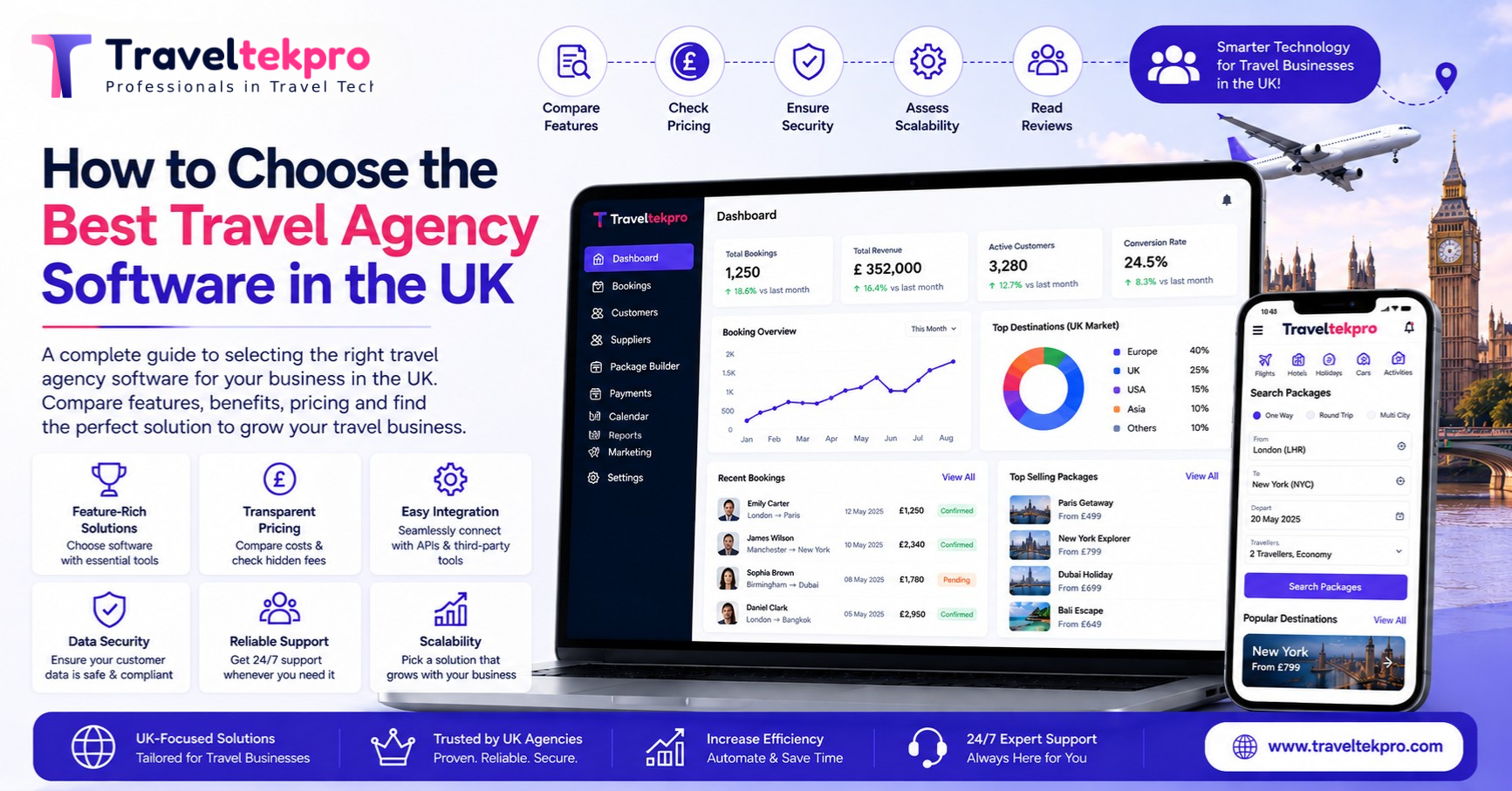
How to Choose the Best Travel Agency Software in the UK
Running a travel agency in the UK involves way more than just taking bookings. Depending on the business model your agency might be managing flights, hotels , packages , customers, suppliers, payments, agents, cancellations and post-booking service often across several different channels. As your business grows, keeping all of this organised can become difficult when your teams are relying on disconnected systems or manual processes. This is exactly why choosing software for travel agencies in the UK makes a difference. It can affect how effectively the agency sells how quickly staff handle bookings and how customers experience your business and how easily the agency can expand.
The important question is not simply which travel agency software is the best? It is what software fits how your agency actually operates. The answer will depend on your booking model, travel inventory sales channels and supply relationships.
How do you choose the best travel agency software UK?
The best software solution should match your business model and the products you sell. You need to start by checking inventory and supplier connectivity then evaluate booking workflows, payments customer and booking management.
Start with your agency’s booking model
Before comparing software providers, you must look at how your agency actually makes money. A small independent leisure agency might need an easy way to sell holidays or flights while keeping customers and booking information organized. An online travel agency might need deeper supplier connectivity and customer friendly booking journey. If you are a B2B travel agency, you have a different set of requirements. Tour operators might need technology capable of handling packages and multiple travel documents while corporate travel agencies might require more structured traveller and booking management. This is the only reason why a system that works well for a small retail agency might not be suitable for an OTA or B2B agency managing a large network of sub agents.
Decide what you actually want the software to fix
A useful way to narrow down travel agency software solutions in the UK is to start with your biggest operational problem. If your staff spends too much time creating bookings manually automation should be high on the list. If your inventory is limited, supplier and API connectivity might matter more than having dozens of additional features. If you are handling an increasing number of agent bookings, look for strong functionality. Finance can also be a major reason for changing systems. If payment tracking invoicing or reconciliation requires spreadsheets and repeated data entry look for software that brings these processes into the booking workflow.
Inventory connectivity should be one of your first checks
A travel agency can have an amazing website and a smooth booking interface. But none of that matters if your customers cannot find the inventory they want. When assessing software for travel agencies in the UK you need to ask where the travel products actually come from and how the sources connect to the platform. Depending on your business you might also need gds connectivity airline APIs NDC connections and bed banks. The important question for a provider is really simple with suppliers and inventory sources can this platform connect to. Do not leave this discussion until after you have selected the software. For example if your agency specializes in international hotels but the platform has limited hotel connectivity and attractive booking interface will not solve the underlying business problem.
Don’t confuse a booking engine with travel agency software UK
This is an important distinction when comparing travel technology. A booking engine primarily helps your customers search for travel products and complete a reservation. That is useful but a travel agency needs to manage everything happening around that reservation as well. You must know that a complete travel agency software should support areas like customer management agent management supplier management pricing markups commissions payments invoicing and booking servicing. Think about what happens after a customer clicks a book. Someone might need to check the payment status, issue an invoice and answer a customer question or even manage a cancellation. This is why a booking page alone should not be treated as a complete agency management solution. A booking engine helps you take a reservation. A complete booking system should help you run the business behind the reservation.
Follow the booking from search to after sales service
One of the best ways to evaluate travel agency software solutions in the UK is to follow a real booking from the customers first search through to after sales support.
1. Search
You need to start with inventory availability pricing and filters. Can customers quickly find relevant flights, hotels or other products? Is the information clear enough to compare options?
2. Booking
Next look at the traveller details or room selection add ONS and markups. The booking process should collect the information required without making your customer or agency staff repeat unnecessary steps.
3. Payment
You need to check how the payment gateway connects with booking. Can staff see transaction status clearly? What if a payment fails or remains pending?
4. Confirmation
Once payment is completed the system might need to handle tickets and vouchers. Just make sure you understand which parts are automated and which require staff intervention.
5. After booking
This is exactly where many systems become more difficult to assess. You need to ask how the platform handles amendments, cancellations , refunds and customer support.
Pricing and commercial controls can affect your bottom line
Two platforms can provide access to similar hotels or inventory and still deliver very different commercial value. Why? Because selling travel is not just about having inventory. It is also about how the inventory is priced and sold. When comparing a platform you need to look at its support for markups Commission rules agent specific pricing and promotional pricing. If you operate a B2B model check whether wallets or credit controls are available where required. Payment tracking invoicing and reconciliation are also very important. If staff have to move between several systems just to understand whether a booking has been paid invoice or reconciled, the software might not be reducing enough operational work
How to Compare Travel Agency Software Providers in the UK
Once you have shortlisted software for travel agencies in the UK, use a scorecard to compare them against the requirements of your own agency.
| Evaluation Area | What to Check |
| Inventory | Flights, hotels and other travel products |
| Connectivity | GDS, APIs, NDC and suppliers |
| Booking | Search-to-confirmation experience |
| B2B | Agent management and commercial controls |
| B2C | Customer-facing booking |
| Payments | Gateway and transaction workflows |
| Operations | Booking, customer and supplier management |
| Finance | Invoicing, commissions and reconciliation |
| Reporting | Sales and operational insights |
| Scalability | Users, bookings and suppliers |
| Support | Implementation and ongoing assistance |
| Security | Data protection and access control |
UK agencies should also examine compliance and data handling
If you deal with customer information, payment related information or booking details then data handling should form part of your software evaluation. You should ask providers where customer information is stored what access controls are available and how data is protected. UKGDPR should be considered when evaluating how the platform handles personal information. You do not need to turn the software selection process into a legal exercise but you should understand the providers approach to data protection and security. The important point here is not to assume that every UK travel agency needs the same regulatory workflow. Instead you need to understand your own responsibilities and ask whether the software can support the processes that your business requires.
When should a UK travel agency replace its existing software?
Sometimes the best way to know whether you need new travel agency software solutions in the UK is to look at what your existing system is forcing your team to do. If employees still rely heavily on spreadsheets you can use several supplier portals for every booking or spend hours preparing reports. Your current system might be creating more work than it removes. Other warning signs include customers being unable to complete bookings online, difficulties managing B2B agents, and manual pricing and markup calculations. You should also look closely at supplier management. If adding a new supplier is unnecessarily complicated or existing technology could just limit your ability to expand inventory.
Where Traveltekpro Into the decision
Once you have worked through all these questions you can start looking at specific providers with a much clearer idea of what you actually need. This is exactly where Traveltekpro, which can be considered as a technology option for travel business, is looking to build a more connected booking platform.
So you need to know that there is not one piece of software for travel agencies in the UK that will be perfect for every business. The right choice depends on what your travel agency sells, who you sell to, where your inventory comes from and how you expect the business to develop. So don’t get too caught up in the longest feature list or the most impressive demo. Look at the things that will actually affect your business that is supplier connectivity inventory booking management, B2B, B2C scalability.
Read More: Who Are the Leading Travel Portal Development Companies?
FAQ'S
Related Blogs
Booking Software for Tour Operators – All-in-One Reservation Platform
Booking Software for Tour Operators – All-in-One Reservation Platform Running a tour business sounds really exciting from the outside. You create itineraries, work with suppliers, plan departures and help people experience new places. But behind…
Sep 2, 2026Read More
Easebuzz Payment Gateway Integration and Charges Guide
Easebuzz Payment Gateway Integration and Charges Guide your customer spends several minutes comparing flights, checking hotel options or building holiday packages. They might finally find exactly what they want, enter their details and reach the…
Sep 1, 2026Read More
Get in touch
Email Us
sales@traveltekprogroup.com“We opted for Traveltekpro to construct and implement our Flight booking system, and I am thoroughly pleased with the outcomes. Their team displays remarkable efficiency, expertise, and utmost professionalism throughout the project.”

Arun Neli
Chief Operating Officer
“I had a fantastic experience with Traveltekpro! Their custom booking system designed for our platform is not only sleek and easy to use,but it has also received excellent feedback rom our customers. Kudos to the Traveltekpro team for their outstanding work!”

Benjamin Smith
Product Manager
“Traveltekpro has been a delight to collaborate with on two distinct occasions, showcasing professionalism and expertise. Their team demonstrates a commitment to surpassing expectations and adheringto deadlines.”

Kevin Brown
CTO
“We partnered with Traveltekpro for our travel booking platform, and the experience was excellent. The team understood our requirements quickly, delivered on time, and provided great support throughout the project. Highly recommended.”

Manish Singh
Director of IT
“Great experience working with Traveltekpro. They were responsive, knowledgeable, and always ready to suggest better solutions. The final product exceeded our expectations, and the after-launch support has been excellent.”

Shubham Rawat
Founder & CEO