

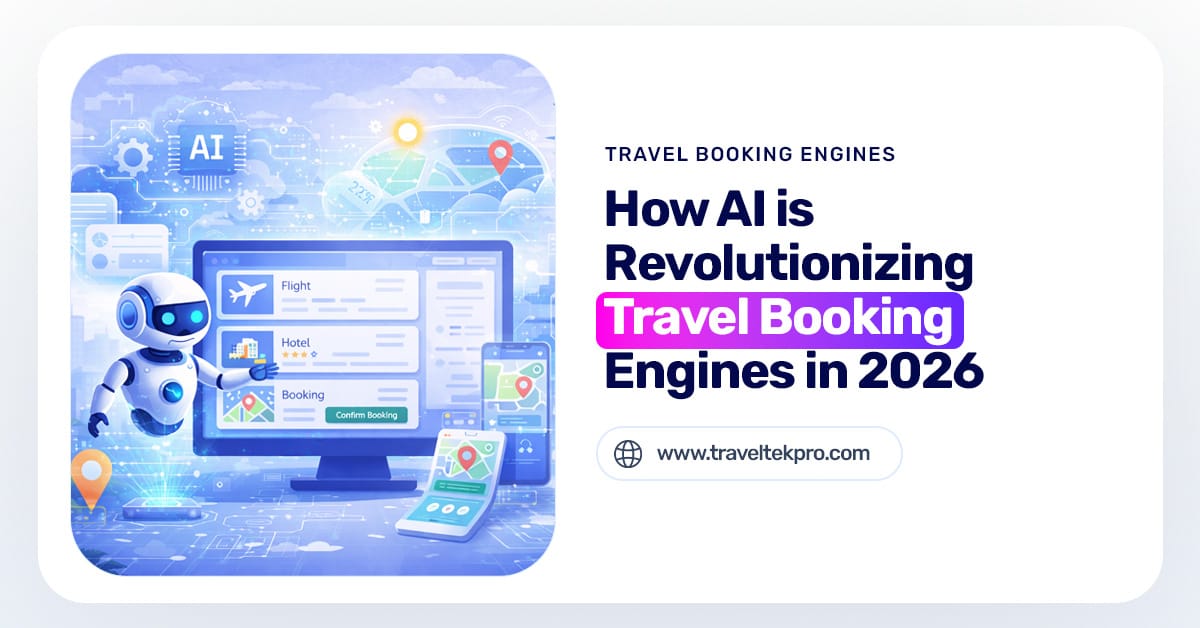
How AI Is Revolutionizing Travel Booking Engines in 2026
The global travel industry is undergoing a structural transformation driven by artificial intelligence. What once depended on static databases, fixed pricing rules, and manual workflows has evolved into highly adaptive, self-learning digital ecosystems. By 2026, AI is no longer an enhancement layer—it has become the core intelligence behind every modern travel booking system.
The Move From Static to Intelligent Travel Booking Engines
Traditional travel booking engines were designed to retrieve data, apply fixed rules, and return results. These systems relied heavily on manual configuration and human intervention. In contrast, today’s AI-powered platforms continuously analyze user behavior, market conditions, and supplier data in real time. This shift has transformed the travel booking engine from a passive transaction processor into an intelligent decision-making system.
Why 2026 Is the Breakthrough Year for Travel AI
Several forces converge in 2026 to accelerate AI adoption in travel: the maturity of machine learning models, widespread NDC adoption, cloud-native infrastructure, and traveler expectations for personalization. As a result, the AI travel booking system has become essential for competitiveness rather than a futuristic luxury.
Understanding Today’s Travel Booking System Architecture
To understand how AI revolutionizes booking engines, it is important to examine how modern travel platforms are structured.
-
Legacy vs. Next-Gen Cloud-Based Booking Engines
Legacy booking engines were monolithic, slow to adapt, and expensive to scale. They processed searches sequentially and relied on rigid workflows. Next-generation cloud-based booking engines are modular, API-driven, and capable of processing millions of requests simultaneously. This modern architecture provides the foundation needed for AI-driven intelligence.
-
Core Modules: Search, Pricing, Inventory, Reservations, Payments
Every travel booking system is built around five fundamental components: search, pricing, inventory management, reservations, and payments. AI does not replace these modules; instead, it enhances how each component functions by enabling real-time learning, prediction, and optimization.
-
Where AI Fits Inside the Travel Booking Engine
AI operates as an orchestration layer across all modules. It optimizes search relevance, adjusts pricing dynamically, predicts availability changes, detects fraud in payments, and automates post-booking communications. The result is a system that adapts continuously rather than following static logic.
What Defines an AI Travel Booking System in 2026?
An AI travel booking system in 2026 is defined not by individual features but by how intelligence is embedded across the entire booking lifecycle.
1. Intelligent Search Algorithms & Predictive Discovery
AI-powered search engines understand intent rather than keywords. Instead of filtering results mechanically, they predict what travelers are likely to book based on context, behavior, seasonality, and historical patterns.
2. Autonomous Pricing Engines Powered by Machine Learning
Pricing is no longer rule-based. Machine learning models analyze demand, competition, booking velocity, and user behavior to adjust prices in real time, improving both conversion rates and margins.
3. Contextual Recommendation Systems (CRS)
Contextual recommendation engines consider variables such as travel purpose, location, time of search, device type, and even emotional signals to deliver highly relevant recommendations across flights, hotels, and add-ons.
4. Real-Time Dynamic Packaging Using AI
AI dynamically bundles flights, hotels, transfers, and experiences based on traveler preferences and real-time availability, creating personalized packages without manual configuration.
5. Generative AI for Travel Planning
Generative AI creates itineraries, travel summaries, and destination insights tailored to individual travelers, reducing planning friction and increasing engagement.
How AI Enhances the Travel Booking Engine Workflow
AI transforms every step of the booking workflow into an automated, intelligent process.
Step 1: AI-Based Data Ingestion
AI aggregates and normalizes data from GDSs, low-cost carriers, hotels, tours, and direct APIs, resolving inconsistencies and duplicates automatically.
Step 2: Neural Search Models
Neural networks process massive datasets to rank results based on predicted conversion likelihood rather than static sorting rules.
Step 3: AI Fraud Detection in Payment Gateways
Machine learning models analyze transaction patterns in milliseconds to detect anomalies, reducing chargebacks and fraud without adding friction.
Step 4: AI-Powered Inventory Optimization
AI predicts seat sell-through, room occupancy, and tour availability, ensuring optimal inventory exposure while minimizing overbooking risks.
Step 5: Automated Confirmation & Trip Updates
AI systems generate confirmations, manage disruptions, send proactive notifications, and rebook travelers automatically when disruptions occur.
Key AI Technologies Driving 2026 Travel Booking Systems
Several AI technologies converge to power next-generation booking engines.
-
NLP & Conversational Search
Natural language processing enables voice-based booking and conversational search, allowing users to interact with systems as they would with a human agent.
-
Predictive Analytics
Predictive models forecast price movements, demand spikes, and availability constraints, enabling smarter booking decisions.
-
Deep Learning for Behavior Modeling
Deep learning analyzes complex behavioral patterns to anticipate traveler needs across different trip stages.
-
Machine Learning for Route Optimization
ML models optimize multi-city and complex itineraries by balancing cost, duration, and traveler preferences.
-
Computer Vision in Airports and Hotels
Computer vision supports biometric check-ins, facial recognition, and visual search experiences across the travel journey.
AI Travel Booking System Features Shaping User Experience in 2026
AI dramatically reshapes how travelers interact with booking platforms.
1. “No Click” Smart Booking
AI assistants proactively suggest and confirm bookings with minimal user input, reducing friction and decision fatigue.
2. Emotion-Aware UX
AI analyzes behavioral signals to adjust interfaces dynamically, presenting reassurance, urgency, or guidance when needed.
3. ChatGPT-like Virtual Travel Agents
Conversational agents handle planning, booking, modifications, and support across multiple channels with human-like accuracy.
4. AI-Assisted Document Automation
Visa requirements, insurance policies, and compliance documents are generated and validated automatically.
How AI Is Transforming Travel Supplier Connectivity
Supplier connectivity becomes more intelligent through AI.
-
AI-Enhanced GDS Connectivity
AI optimizes query routing across Amadeus, Sabre, and Travelport, reducing response times and costs.
-
API Normalization Using Machine Learning
Machine learning standardizes disparate supplier APIs into unified data models.
-
AI for Rate Scraping & Deduplication
AI continuously scans, maps, and deduplicates rates across suppliers, ensuring accuracy and consistency.
Backend Advancements: AI + Cloud + Microservices
Modern AI booking engines rely on advanced backend architectures.
1. Microservice-Based Architecture
Each function operates independently, allowing faster updates and better scalability.
2. Auto-Scaling & High Availability
Cloud infrastructure dynamically scales resources during peak demand periods.
3. AI Load Balancing
AI distributes traffic intelligently across services to maintain performance.
4. Serverless Functions
Event-driven serverless computing handles spikes in search and pricing requests efficiently.
Security & Fraud Prevention in AI Travel Booking Engines
Security becomes proactive rather than reactive.
-
AI Threat Identification
Real-time monitoring detects anomalies before breaches occur.
-
Biometric Authentication
Facial recognition and biometric verification improve security while simplifying user authentication.
-
AI Fraud Scoring
Transactions are scored in real time to block fraudulent behavior without disrupting legitimate users.
Impact on Travel Businesses: Why AI Is No Longer Optional
AI delivers measurable business impact across operations.
1. Faster Search Times
AI reduces search latency by up to 60%, directly improving user engagement.
2. Higher Conversion Rates
Personalized recommendations drive 20–35% higher conversions.
3. Reduced Support Costs
AI automation significantly reduces customer service workloads.
4. Lower Operational Expenses
AI-managed inventory and pricing reduce manual intervention and errors.
The Role of Traveltekpro in Building AI-Powered Travel Booking Systems
-
Our Intelligent Travel Booking Engine Solutions
Traveltekpro designs scalable AI-driven booking engines optimized for performance and personalization.
-
AI-Powered APIs
We provide intelligent APIs for flights, hotels, cars, cruises, and experiences.
-
Custom Cloud Architecture
Our cloud-native architectures are designed specifically for high-volume travel enterprises.
-
End-to-End AI Integration
From data ingestion to post-booking automation, Traveltekpro delivers complete AI integration.
-
Why Traveltekpro Leads the Future of AI Travel Tech
Our deep expertise in AI, travel distribution, and cloud engineering positions us at the forefront of next-generation travel technology.
Real-World Use Cases of AI in Travel (2026 Examples)
AI pricing engines optimize airline revenue in real time. Hotels use AI to allocate rooms efficiently during peak seasons. Complex itineraries such as multi-city or Umrah/Hajj travel are planned automatically with precision.
Challenges in Building AI Travel Systems & How Traveltekpro Solves Them
AI travel systems face challenges related to data complexity, model accuracy, traffic scale, and regulatory compliance. Traveltekpro addresses these challenges through robust data pipelines, continuous model training, scalable infrastructure, and compliance-first design.
Future of AI in Travel Booking Engines Beyond 2026
The future points toward autonomous travel planning, generative user interfaces, digital travel identities, and hyper-personalized dynamic bundles that adapt in real time.
AI is Re-Engineering the Foundation of Travel Booking Systems in 2026
AI is no longer enhancing travel booking systems it is redefining them. In 2026, the travel booking engine becomes an intelligent platform that anticipates needs, optimizes outcomes, and delivers seamless experiences. Businesses that embrace AI today are building the foundation for long-term competitiveness in an increasingly intelligent travel ecosystem.
Read More: How to Choose Customizable Travel Agency Booking Software
FAQ'S
Related Blogs
Travel Software Development Company – Custom Solutions | TravelTech Innovations
Travel Software Development Company – Custom Solutions | TravelTech Innovations The travel business rarely relies on just one thing to manage. A simple booking can involve a customer agent or government supplier APIs and pricing…
Sep 10, 2026Read More
Get in touch
Email Us
sales@traveltekprogroup.com“We opted for Traveltekpro to construct and implement our Flight booking system, and I am thoroughly pleased with the outcomes. Their team displays remarkable efficiency, expertise, and utmost professionalism throughout the project.”

Arun Neli
Chief Operating Officer
“I had a fantastic experience with Traveltekpro! Their custom booking system designed for our platform is not only sleek and easy to use,but it has also received excellent feedback rom our customers. Kudos to the Traveltekpro team for their outstanding work!”

Benjamin Smith
Product Manager
“Traveltekpro has been a delight to collaborate with on two distinct occasions, showcasing professionalism and expertise. Their team demonstrates a commitment to surpassing expectations and adheringto deadlines.”

Kevin Brown
CTO
“We partnered with Traveltekpro for our travel booking platform, and the experience was excellent. The team understood our requirements quickly, delivered on time, and provided great support throughout the project. Highly recommended.”

Manish Singh
Director of IT
“Great experience working with Traveltekpro. They were responsive, knowledgeable, and always ready to suggest better solutions. The final product exceeded our expectations, and the after-launch support has been excellent.”

Shubham Rawat
Founder & CEO