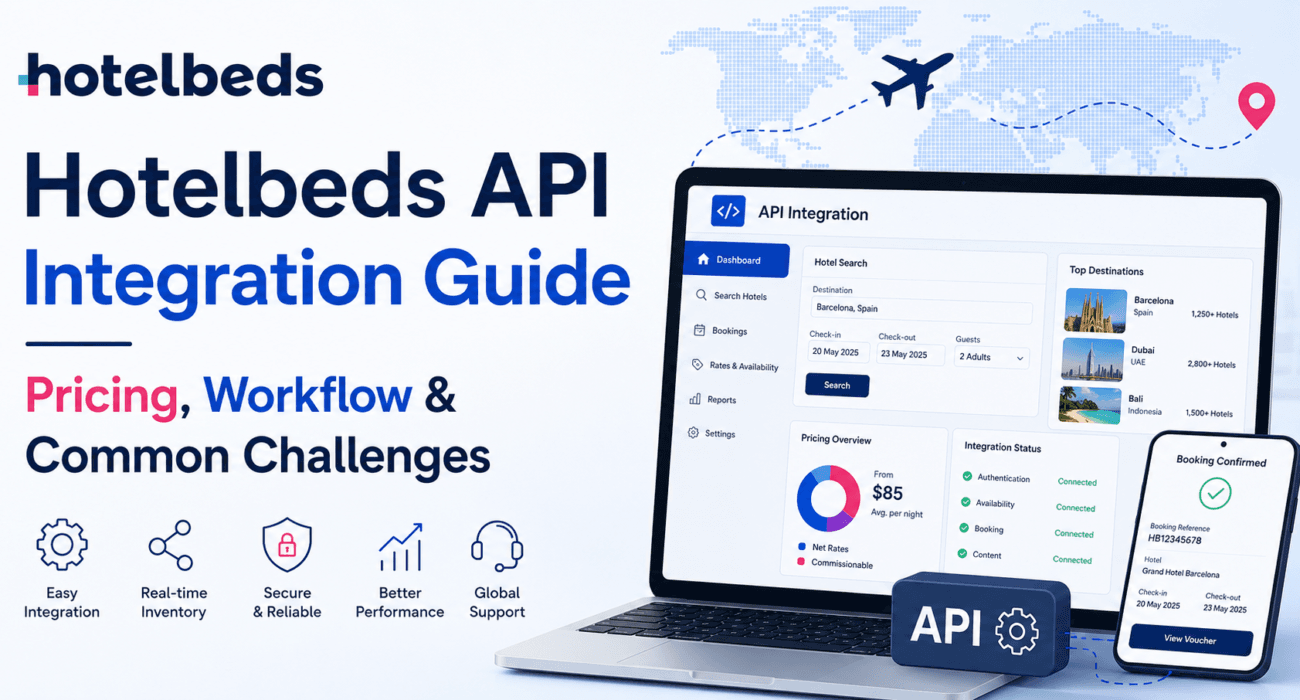
Hotelbeds API Integration: Complete Guide for OTA Platforms and Travel Businesses
As the travel industry continues to evolve through digital transformation, travel businesses are increasingly relying on APIs to deliver faster, more accurate, and seamless booking experiences. Whether you’re building an Online Travel Agency (OTA), a travel marketplace, or a hotel booking platform, integrating reliable hotel inventory is essential for offering customers a wide range of accommodation options.
One of the most widely used hotel distribution solutions in the travel industry is the Hotelbeds API. It allows travel businesses to access a vast network of hotels, apartments, resorts, and other accommodation providers through a single integration. Instead of managing multiple hotel suppliers individually, developers can connect to Hotelbeds and retrieve real-time hotel availability, pricing, room details, booking confirmations, and rich hotel content using a standardized API.
For travel technology companies, the Hotelbeds API simplifies hotel distribution while improving booking efficiency and expanding inventory coverage. For developers, it provides a structured set of APIs that support hotel search, pricing, content management, and reservation workflows. These capabilities make it easier to build scalable hotel booking engines for both B2B and B2C travel platforms.
However, integrating a hotel booking API involves more than simply connecting to an endpoint. Developers must understand authentication methods, booking workflows, content synchronization, pricing models, performance optimization, and security best practices to build a reliable and scalable solution. This guide explores all these aspects in detail, helping both technical and business stakeholders understand how to successfully implement Hotelbeds API integration.
Before diving deeper, it is important to understand the core value that Hotelbeds API integration brings to travel platforms. This guide will help you understand how the API supports hotel distribution, how different APIs such as Booking, Content, and Cache APIs work together, and how the complete booking workflow operates from search to confirmation.
You will also gain insights into authentication methods, pricing strategies, and common challenges faced during integration. Additionally, the guide highlights performance optimization techniques and security best practices that are essential for building scalable and reliable OTA platforms. By the end, you will have a clear understanding of how to approach Hotelbeds API integration effectively.
What is Hotelbeds API?
The Hotelbeds API is a set of web services that allows travel businesses to access Hotelbeds’ global inventory of accommodations. It acts as a bridge between travel platforms and hotel suppliers, enabling real-time communication for searching, booking, and managing hotel reservations.
Hotelbeds aggregates inventory from thousands of hotels worldwide and distributes it through its API to travel agencies, OTAs, tour operators, and travel technology providers. This eliminates the need for businesses to establish individual contracts with multiple hotel suppliers, significantly reducing operational complexity and integration time.
Core Features Overview
| Feature | Description |
| Global Inventory | Access to thousands of hotels worldwide |
| Real-Time Data | Live availability and pricing updates |
| Rich Content | Images, descriptions, and amenities |
| Booking Management | Reservation, cancellation, and modification |
| Scalability | Supports high-volume transactions |
These features make Hotelbeds API a powerful solution for businesses aiming to expand their hotel offerings while maintaining efficiency and reliability.
Types of Hotelbeds APIs
Hotelbeds provides multiple APIs designed to handle different aspects of hotel booking and content management. Each API serves a specific purpose, and together they create a complete ecosystem for hotel distribution.
1. Booking API
The Booking API is the core component used for searching hotels, checking availability, and completing reservations. It enables real-time interaction between the user and the hotel inventory, ensuring that customers receive accurate pricing and availability information. This API also supports booking confirmations, cancellations, and modifications, making it essential for managing the entire reservation lifecycle.
2. Content API
The Content API focuses on delivering static hotel information that enhances the user experience. It provides detailed descriptions, images, amenities, and location data that help users make informed decisions. By integrating this API, travel platforms can present visually rich and informative hotel listings, improving engagement and conversion rates.
3. Cache API
The Cache API is designed for high-performance applications that require quick access to large volumes of data. It allows developers to preload hotel data, reducing the need for frequent API calls and improving response times. This is particularly useful for platforms handling high traffic or offering advanced search functionalities.
Hotelbeds API Integration Workflow
Integrating the Hotelbeds API involves a structured workflow that ensures smooth communication between your platform and the Hotelbeds system. Each step plays a critical role in delivering a seamless booking experience.
Integration Process Overview
| Step | Description |
| API Access | Obtain API credentials from Hotelbeds |
| Authentication | Generate secure request signatures |
| Hotel Search | Retrieve hotel listings based on user input |
| Availability Check | Verify real-time pricing and availability |
| Booking | Confirm reservations and receive booking details |
| Post-Booking | Manage cancellations and modifications |
The process begins with obtaining API credentials, including an API key and secret key. These credentials are used to authenticate requests and ensure secure communication. Once authentication is set up, users can search for hotels by specifying parameters such as destination, travel dates, and number of guests.
After retrieving search results, the system performs a real-time availability check to confirm pricing and room availability. This step is crucial because hotel data can change rapidly. Once confirmed, the booking request is processed, and a confirmation response is generated. Post-booking operations such as cancellations and modifications are also handled through the API, ensuring a complete end-to-end solution.
Authentication and Security
Security is a critical aspect of Hotelbeds API integration. The API uses a signature-based authentication mechanism to ensure that all requests are secure and verified. Each request requires a signature generated using the API key, secret key, and a timestamp. This approach prevents unauthorized access and ensures data integrity.
Developers must implement secure practices when handling API credentials and user data. Using HTTPS for all API calls is essential to protect data during transmission. Additionally, proper request validation and monitoring should be in place to detect and prevent suspicious activities. By following these practices, businesses can ensure a secure and reliable integration.
Hotelbeds API Pricing and Rate Management
Hotelbeds operates on a dynamic pricing model, where rates are influenced by factors such as demand, availability, and market conditions. This dynamic nature requires travel platforms to handle pricing carefully to ensure accuracy and competitiveness.
Pricing Models Comparison
| Model | Description | Benefit |
| Net Rates | Fixed rates provided to partners | Allows custom markup |
| Commission-Based | Includes built-in commission | Simplifies pricing strategy |
Managing pricing effectively involves implementing caching strategies for frequently accessed data and regularly updating pricing information. Accurate currency conversion is also essential for global platforms to provide consistent pricing across different regions. By optimizing pricing management, businesses can improve profitability and user satisfaction.
Hotelbeds Common Integration Challenges
Integrating the Hotelbeds API can present several challenges, especially for platforms handling large volumes of data and real-time transactions. One of the primary challenges is managing large datasets, which can impact system performance if not handled efficiently. Implementing caching and pagination can help mitigate this issue.
Another common challenge is dealing with real-time availability changes. Since hotel prices and availability can fluctuate rapidly, it is essential to perform a final availability check before confirming a booking. Additionally, the booking workflow itself can be complex, requiring careful handling of multiple steps and potential errors.
API rate limits can also pose challenges, as exceeding these limits may disrupt service. Optimizing API calls and using caching strategies can help maintain performance while staying within limits. Addressing these challenges effectively ensures a smoother integration process and a better user experience.
Performance Optimization Tips
Optimizing performance is crucial for delivering a fast and responsive booking experience. Using the Cache API can significantly reduce response times by minimizing the need for repeated API calls. Implementing asynchronous processing allows the system to handle multiple requests efficiently, improving scalability.
Database optimization is another important factor, as efficient queries can reduce latency and improve overall performance. Content delivery networks (CDNs) can be used to serve images and static content بسرعة, enhancing user experience. Regular monitoring of API performance helps identify bottlenecks and ensures continuous improvement.
Security Best Practices
Ensuring the security of user data and transactions is essential for any travel platform. Sensitive data should always be encrypted, both in transit and at rest. Secure authentication methods must be implemented to prevent unauthorized access.
Access control mechanisms should be in place to restrict system access based on user roles. Regular security audits help identify vulnerabilities and ensure compliance with industry standards. Protecting against common threats such as SQL injection and cross-site scripting is also critical for maintaining system integrity.
Hotelbeds API Integration Solutions
Hotelbeds API integration is a powerful solution for travel businesses looking to expand their hotel inventory and improve booking efficiency. By leveraging its comprehensive set of APIs, developers can build scalable, high-performance hotel booking platforms that deliver seamless user experiences.
Although the integration process requires careful planning and technical expertise, following best practices in authentication, performance optimization, and security can ensure a successful implementation. Understanding the workflow, managing pricing effectively, and addressing common challenges are key to building a reliable system.
Whether you are launching a new OTA or enhancing an existing travel platform, the Hotelbeds API provides the tools and flexibility needed to compete in today’s digital travel ecosystem. As a certified Hotelbeds integration partner, Traveltekpro helps travel businesses seamlessly integrate the Hotelbeds API into their OTA platforms, enabling reliable hotel distribution, scalable booking workflows, and high-performance travel technology solutions.
Read More: PNR Explained: What is a Passenger Name Record in Airline Reservation Systems?
FAQ’S
1. Why should travel businesses integrate the Hotelbeds API?
Hotelbeds API integration allows travel businesses to access a global inventory of hotels, apartments, resorts, and vacation rentals through a single connection. Instead of managing multiple hotel suppliers separately, OTAs, travel agencies, and tour operators can retrieve real-time availability, pricing, booking confirmations, and hotel content from one platform, helping improve booking efficiency, reduce operational costs, and deliver a better customer experience.
2. Can the Hotelbeds API be integrated into an existing travel booking platform?
Yes. The Hotelbeds API is designed to integrate with existing travel booking engines, OTA platforms, B2B travel portals, and hotel reservation systems. Developers can connect the API with existing workflows while preserving current business logic, enabling businesses to expand hotel inventory without rebuilding their entire platform.
3. What technologies are commonly used for Hotelbeds API integration?
Hotelbeds API can be integrated using modern development technologies such as Java, PHP, Python, .NET, Node.js, and other REST API-compatible frameworks. Most travel technology companies also combine Hotelbeds integration with cloud infrastructure, caching solutions, payment gateways, and hotel mapping tools to improve performance and scalability.
4. How can travel businesses improve Hotelbeds API performance?
The best way to optimize Hotelbeds API performance is by implementing intelligent caching, asynchronous API processing, efficient database queries, hotel content synchronization, and real-time availability validation before booking confirmation. These techniques reduce API response time, improve search speed, and create a faster hotel booking experience for users.
5. Is Hotelbeds API suitable for B2B and B2C travel platforms?
Yes. Hotelbeds API supports both B2B and B2C travel business models. Travel agencies, wholesalers, tour operators, DMCs, OTAs, and corporate travel companies can use the API to build customized hotel booking platforms with dynamic pricing, agent markups, multi-currency support, and scalable booking workflows based on their business requirements.
6. How do you choose the right Hotelbeds API integration partner?
The right Hotelbeds API integration partner should have proven experience in travel technology, hotel booking engine development, supplier API integrations, hotel mapping, security implementation, and OTA platform development. An experienced partner helps reduce development time, optimize API performance, minimize booking errors, and build a scalable hotel booking platform that supports long-term business growth.
Let's Start Your Project
Let us help you achieve your goals, by creating the best solution for you!