Agoda API Integration Guide: Architecture, Authentication, Booking Flow, Certification & Best Practices
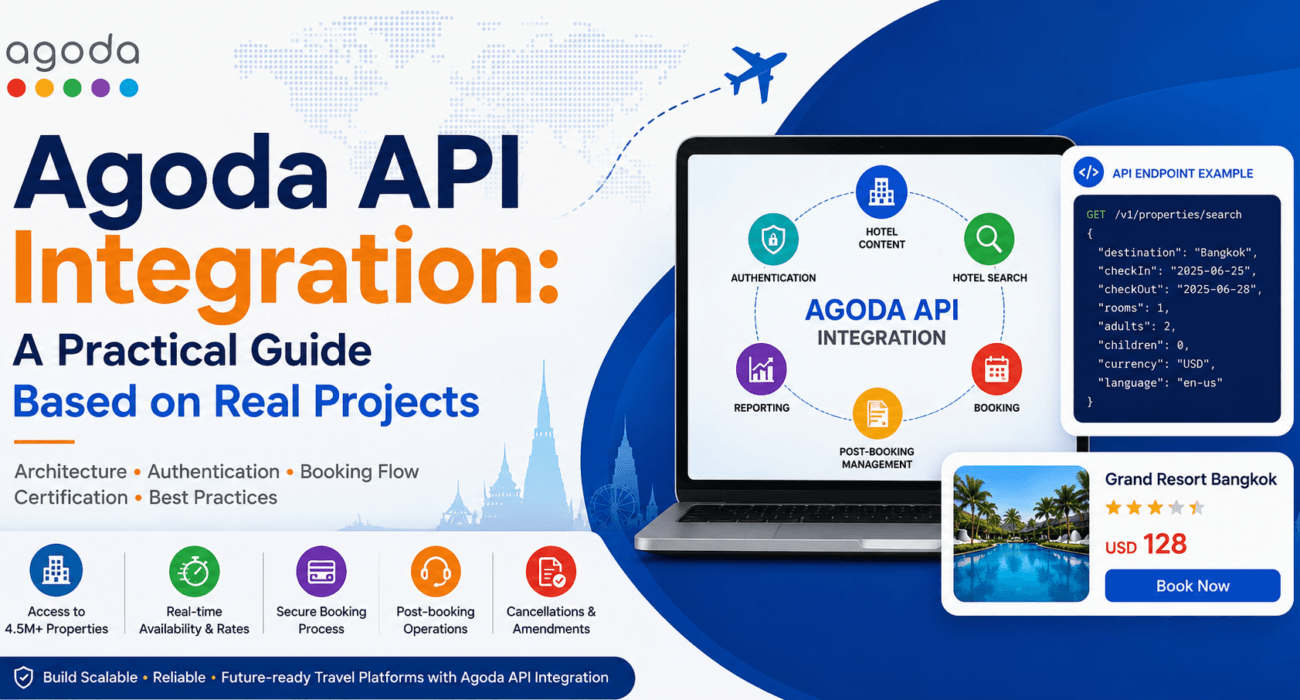
Agoda API Integration has become a common requirement for Online Travel Agencies (OTAs), B2B travel platforms, Destination Management Companies (DMCs), corporate travel platforms, and travel technology providers looking to access global hotel inventory through a single connectivity solution. The Agoda Demand API is one of the most widely used hotel distribution APIs in the travel industry, providing access to more than 4.5 million properties across 200+ countries and territories.
As part of the Booking Holdings ecosystem, Agoda has established a particularly strong presence across Asia-Pacific markets, where it often provides deeper accommodation coverage and competitive pricing compared to many global wholesalers. This makes Agoda an important supplier for travel businesses targeting destinations such as Thailand, Vietnam, Indonesia, Malaysia, Singapore, Japan, South Korea, India, and other high-demand tourism markets.
Unlike many traditional hotel wholesalers, Agoda operates a modern API-first distribution model that allows partners to integrate content, availability, pricing, bookings, cancellations, and amendments directly into their own platforms. Depending on the selected partnership model, businesses can either redirect users to Agoda for booking completion or manage the entire booking lifecycle within their own applications.
This Agoda API Integration Guide provides a detailed overview of Agoda API onboarding, authentication methods, content management, search architecture, booking workflows, certification requirements, operational considerations, and implementation best practices.
Agoda Supplier Overview
Attribute | Details |
Supplier Type | Hotel & Accommodation API |
Parent Company | Booking Holdings |
Inventory | 4.5M+ Properties |
Coverage | 200+ Countries & Territories |
Content Languages | 51+ |
Strongest Markets | Asia-Pacific |
Commercial Model | Commission-Based |
Authentication | OAuth 2.0 |
Integration Complexity | Medium |
Typical Go-Live Timeline | 4–8 Weeks |
Agoda inventory includes:
- Hotels
- Resorts
- Villas
- Apartments
- Serviced Apartments
- Guest Houses
- Hostels
- Vacation Rentals
In addition to Agoda’s direct supply, inventory may also include accommodation sourced through other supplier partnerships within the Booking Holdings ecosystem.
What Is the Agoda Demand API?
The Agoda API allows travel businesses to access Agoda’s accommodation inventory programmatically. Through Agoda API Integration, partners can search hotels, retrieve availability, access room rates, display property content, create reservations, manage cancellations, process amendments, and retrieve booking details through a centralized hotel connectivity platform.
The Agoda API supports multiple business models ranging from affiliate websites and metasearch engines to enterprise-level OTA platforms managing the entire booking lifecycle. One of the platform’s major strengths is its post-booking functionality, allowing partners to retrieve bookings, process amendments, handle cancellations, and support customer service workflows through API connectivity.
Through the API, partners can:
- Search hotels
- Retrieve availability
- Access room rates
- Display property content
- Create reservations
- Manage cancellations
- Process amendments
- Retrieve booking details
The API supports multiple business models ranging from affiliate websites and metasearch engines to enterprise-level OTA platforms managing the entire booking lifecycle.
One of Agoda’s major strengths is its post-booking functionality. While many suppliers primarily focus on availability and reservations, Agoda also provides APIs for booking retrieval, amendments, cancellations, and customer support workflows.
Agoda Partnership Models
Before starting development, businesses must determine which partnership model best aligns with their operational requirements.
1. Online Affiliate / Metasearch Model
This model is designed for:
- Metasearch Engines
- Travel Affiliates
- Hotel Comparison Websites
Partners only implement the Search API and display Agoda inventory. When users select an offer, they are redirected to Agoda to complete the booking.
Advantages
- Fastest implementation
- Minimal development effort
- No payment processing
- No customer support obligations
Limitations
- No control over booking experience
- Lower branding opportunities
- Limited customer ownership
2. Agoda Fulfill Assisted
In this model:
- Search and booking occur on the partner platform.
- Agoda processes payments.
- Agoda issues vouchers.
- Agoda manages customer support.
This approach allows businesses to maintain a branded booking experience without building extensive operational infrastructure.
Advantages
- Integrated booking experience
- Reduced operational burden
- Faster time-to-market
Limitations
- Limited control over post-booking operations
- Agoda remains responsible for customer fulfillment
3. Partner Fulfillment
Partner Fulfillment provides complete control over the booking lifecycle.
The partner:
- Collects payments
- Issues vouchers
- Handles customer service
- Manages cancellations
- Processes amendments
This model is typically adopted by:
- Large OTAs
- B2B Travel Platforms
- Corporate Travel Systems
- Enterprise Travel Companies
Advantages
- Full customer ownership
- Greater flexibility
- Enhanced branding opportunities
- More sophisticated business workflows
Limitations
- Higher development complexity
- Increased operational responsibilities
Commercial Qualification Process
Unlike some hotel suppliers that provide instant sandbox access, Agoda requires commercial approval before API credentials are issued.
Typical requirements include:
- Registered travel company
- Live website or booking platform
- Business registration documents
- Tax registration details
- Ownership information
- Distribution model description
- Technical implementation plan
Businesses should also prepare:
- Existing supplier list
- Monthly booking volume estimates
- Expected traffic levels
- Target markets
Having this information ready can significantly accelerate the onboarding process.
Agoda API Architecture
Understanding Agoda API architecture is an important part of any successful Agoda API Integration project. Agoda separates content, search, booking, reporting, and post-booking operations into dedicated API modules, allowing travel businesses to build scalable hotel booking platforms while maintaining flexibility across different business models and operational requirements.
The Agoda integration architecture consists of five major components:
- Content APIs
- Search APIs
- Booking APIs
- Reporting APIs
- Post-Booking APIs
Each component serves a specific purpose within the reservation lifecycle.
1. Content Layer
Responsible for:
- Hotel information
- Room descriptions
- Amenities
- Images
- Policies
- Geographic hierarchy
2. Search Layer
Responsible for:
- Availability
- Pricing
- Room inventory
- Promotions
- Tax calculations
3. Booking Layer
Responsible for:
- Precheck validation
- Reservation creation
- Confirmation handling
4. Reporting Layer
Responsible for:
- Booking synchronization
- Reservation monitoring
- Financial reporting
5. Post-Booking Layer
Responsible for:
- Amendments
- Cancellations
- Special requests
- Booking retrieval
Authentication Using OAuth 2.0
Agoda is transitioning all partners to OAuth 2.0 authentication.
The authentication process follows a standard token-based workflow:
- Submit Client ID and Client Secret.
- Receive JWT access token.
- Include token in API requests.
- Refresh token before expiration.
Recommended Practices
- Cache tokens centrally.
- Refresh five minutes before expiry.
- Implement automatic retry on authentication failures.
- Store secrets in a secure vault.
- Monitor token expiration dates.
Access tokens remain valid for approximately one hour and should not be requested unnecessarily to avoid rate-limit issues.
Content Management Strategy
Agoda separates static content from dynamic availability.
Static Content
Includes:
- Hotel names
- Addresses
- Descriptions
- Facilities
- Images
- Room types
This data is used to build the property catalog.
Dynamic Content
Includes:
- Rates
- Inventory
- Availability
- Promotions
- Taxes
This information changes frequently and must be retrieved through search APIs.
A common implementation pattern includes:
Weekly Full Refresh
Used to:
- Validate content consistency
- Identify newly added properties
- Reconcile missing data
Daily Incremental Updates
Used to:
- Process changes
- Update hotel details
- Remove disabled properties
- Add new inventory
Proper synchronization significantly improves search accuracy and customer experience.
Search API Best Practices
The Search API returns live rates and availability.
Successful implementations typically:
- Cache content aggressively
- Cache rates cautiously
- Use block IDs for inventory tracking
- Display complete pricing information
- Present cancellation policies clearly
Special attention should be paid to:
- Taxes
- Resort fees
- City taxes
- Mandatory surcharges
These elements must be displayed transparently to avoid customer disputes and certification failures.
Booking Flow
Agoda’s recommended booking workflow consists of three stages:
Step 1: Search
The traveler selects a room offer.
Step 2: Precheck
The system validates:
- Price
- Availability
- Inventory status
Precheck ensures that the selected offer remains available before booking.
Step 3: Book
Once validation succeeds:
- Reservation is created
- Confirmation is generated
- Booking status is returned
A common implementation mistake is parameter inconsistency between Search, Precheck, and Book requests. Values such as dates, occupancy, room count, currency, and country information must remain identical throughout the workflow.
Post-Booking Operations
Agoda provides advanced post-booking capabilities.
Supported functions include:
- Booking retrieval
- Guest name changes
- Special requests
- Date amendments
- Reservation cancellations
Not all bookings support every modification. Eligibility depends on supplier rules, rate conditions, and cancellation policies.
Travel businesses should always verify amendment permissions before displaying modification options to customers.
Certification Requirements
Before production approval, Agoda performs certification testing.
Common certification areas include:
- Search implementation
- Hotel content display
- Pricing calculations
- Booking workflows
- Cancellation processing
- Reporting functionality
- Voucher generation
- Hotel confirmation handling
Preparing for certification early significantly reduces delays during go-live.
Common Integration Challenges
Identifier Overflow
Some Agoda identifiers exceed standard 32-bit integer limits.
Use:
- BIGINT
- Long Integer
for all Agoda IDs.
Timezone Handling
Agoda uses different timezone references for:
- Content updates
- Booking reports
- Cancellation policies
Timezone normalization should be planned carefully during implementation.
Rate Limiting
Excessive requests can trigger throttling.
Recommended solutions:
- Intelligent caching
- Request batching
- Background synchronization
- Retry logic
Parameter Drift
Search, Precheck, and Book requests must remain synchronized.
A centralized booking context object is often used to ensure consistency.
Agoda vs Other Hotel Suppliers
Supplier | Strength |
Agoda | Asia-Pacific Inventory |
Hotelbeds | European Wholesale Distribution |
Expedia Rapid | Global OTA Coverage |
WebBeds | Wholesale Inventory |
RateHawk | Rapid Onboarding |
Many travel platforms combine multiple suppliers to maximize inventory coverage and pricing competitiveness.
Planning a Successful Agoda API Integration
The Agoda Demand API provides a mature and feature-rich hotel distribution platform that supports the complete booking lifecycle, from hotel discovery and availability searches to booking management, amendments, and cancellations. Its strong inventory coverage across Asia-Pacific markets, combined with advanced post-booking capabilities, makes it a valuable supplier for OTAs, B2B travel platforms, DMCs, metasearch engines, and corporate travel systems.
Successful Agoda API Integration projects require careful planning across commercial onboarding, authentication, content synchronization, search architecture, booking validation, reporting workflows, and certification requirements. Organizations that invest in robust implementation practices, monitoring, and operational readiness are better positioned to deliver reliable hotel booking experiences while minimizing production issues and support overhead.
This Agoda API Integration Guide is intended to help travel businesses, developers, product teams, and technology leaders better understand Agoda API capabilities, implementation requirements, and operational considerations before starting an Agoda API Integration project.
As part of the broader travel technology ecosystem, Traveltekpro supports OTAs, travel agencies, DMCs, and travel startups with supplier integrations, booking engine development, and travel platform solutions designed to simplify connectivity and accelerate digital transformation.
Read More: Top 5 B2B Online Travel Software for Travel Agencies
FAQ’S
1. What is the Agoda API used for?
The Agoda Demand API lets OTAs, B2B portals, and metasearch platforms access Agoda’s 4.5M+ properties programmatically searching live rates, creating bookings inside their own platform, and managing cancellations and amendments without contracting hotels individually.
2. How long does Agoda API integration take?
Typically 4–8 weeks end to end: commercial approval and welcome package, sandbox development, certification, production UAT (a real booking plus cancellation, verified with logs), and Agoda’s customer-service configuration, which alone takes 7–10 working days.
3. How much does the Agoda API cost?
Agoda runs a commission-based model with no published access fee. Commercial terms commission structure, permitted payment models, and any financial arrangements are negotiated individually with your account manager and formalised in the contract and AVRF.
4. Do I need IATA accreditation to use the Agoda API?
No. Agoda is a hotel supplier, not a GDS (Global Distribution System), so IATA accreditation is not required. You need a registered travel company, a live platform, completed KYC, and Agoda’s commercial approval.
5. What is the difference between Agoda API and Hotelbeds API?
Unlike Hotelbeds, which sells NET (wholesale) rates with its deepest inventory in Europe, Agoda runs a commission model with its strongest inventory in Asia-Pacific and includes post-booking amendment APIs. Most multi-supplier OTAs run both: Agoda for Asian markets, Hotelbeds or Expedia as the global layer.
6. Can metasearch sites use the Agoda API?
Yes. Agoda has a dedicated Online Affiliates/MSE model requiring only the Search API customers complete the booking on Agoda via landing URLs returned with the metaSearch parameter.
Let's Start Your Project
Let us help you achieve your goals, by creating the best solution for you!