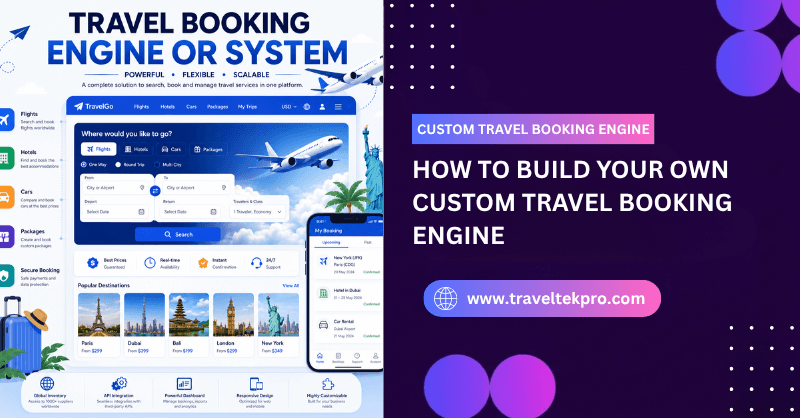
How to Build Your Own Custom Travel Booking Engine
The travel industry has changed completely over the last few years . They want to search flights quickly, compare hotel prices in seconds and make sure payments are completed in just a few seconds. Nobody wants to wait for manual quotations or slow booking responses anymore. The shift in customer behavior has forced travel businesses to rethink how they operate online. Many travel agencies and companies that once depended on generic booking software are now realizing that standard platforms often create limitations instead of supporting growth. Modern travel businesses need more flexibility and better automation. This is the exact reason why the demand for Custom Travel Booking Engine Development is growing rapidly. Whether you operate a B2C travel agency or a B2B travel portal, building a custom travel booking engine gives your business the flexibility and scalability needed for long term success.
What is Custom Travel Booking System Development?
A custom travel booking engine is a customized software platform that allows you to search, compare and even manage travel services online. The services might include flights, hotels, holiday packages and transfers. It is different from ready made booking systems as custom platforms are specifically designed around the workflow of your travel business. Every travel company operates differently. Some focus mainly on B2C customers while others work with travel agents and corporate clients. A standard booking system might offer general features but it often cannot fully support specialized operational requirements. The flexibility becomes one of the biggest advantages of custom travel booking engine development businesses gain full control over. Instead of adjusting operations accordingly to software limitations the software is developed according to your business goals.
Why are Travel businesses moving towards Custom Travel Booking Engine?
The travel industry has become highly competitive. Customers compare multiple travel websites before making bookings and they expect smooth digital experiences throughout the process. This creates pressure on your travel business to provide faster cooking experiences and also better pricing. Unfortunately a lot of off the shelf booking systems struggle to support growing travel businesses. As your travel business grows, operational complexity usually grows faster than off the shelf software can handle. For example if you’re a small travel agency then you might initially work well with standard operational booking platforms. But As your business expands new operational challenges might appear. Generic systems often become restrictive at this stage. Which is the only reason why a lot of companies today are investing in Custom Travel Booking Engine Development. A custom platform allows you to scale without depending on 3rd party platform limitations.
Before development begins define the type of travel business you are building for
One of the most important steps before Custom Travel Booking System Development The type of travel business booking engine will support. If you are a B2B travel portal the systems typically require agent login systems and credit management. If you are running a corporate travel platform then you need employee approval systems and company travel policies. Besides that, DMC platforms need destination management companies that focus on local tours and activities.
Understanding the core architecture of Custom Travel Booking Engine
The search engine layer is where users search for travel services. It processes customer requests and also fetches results from connected suppliers or APIs. Inventory and API layer connects the platform with travel suppliers and sources. These might include flight API’s and activity providers. Pricing and travel is rarely simple. Its strong pricing engine handles dynamic pricing markups discounts and agent commission once your user confirms the booking the booking management system handles reservations and booking confirmations for stop-payment processing layer manages online transactions securely. It includes payment gateway integration, fraud protection and refund handling.
Define your booking workflow before writing code
You might just rush into development without properly planning the booking workflow. This often creates problems later on. Before writing a single line of code you need to map the entire customer journey. A poorly planned booking flow creates friction long before development problems appear.
Decide which APIs and inventory sources you need
The strength of your booking engine depends heavily on the inventory sources. You must decide which APIs and suppliers you want to use. This might include flight APIs, hotel APIs, activity APIs, or car rental APIs. Some platforms rely only on a single supplier while others combine multiple sources to improve inventory coverage.
Design the working experience around user behavior
A technically powerful platform means very little if users find it difficult to use. Your users don’t compare booking in this technically they compare how easy they feel to use. This is the only reason why user experience design becomes one of the most important parts of Custom Travel Booking Engine Development.
1. Build the search and filtering logic carefully
Search functionality directly impacts booking conversions. Your users expect fast and highly accurate search results. The platform should support smart filters and strong options besides rising comparisons and flexible data searches. Search experience directly affects your conversions. The booking engine should also optimize API response carefully to avoid delays during heavy traffic time.
Develop real time pricing and availability handling
Travel pricing changes constantly. Airfares fluctuate within a few minutes. Activity slots might appear or disappear instantly. This is the only reason why real time synchronization becomes so important. Your booking engine must constantly refresh prices and seats availability or room availability. If your customers repeatedly encounter pricing mismatches or unavailable inventory during checkout, they’ll quickly lose confidence in the platform.
Integrate Secure payment systems
The payment stage is one of the most sensitive parts of the booking journey. Your customers must feel safe while entering payment details. The booking experience is only complete when your payment feels timeless and seamless. Travel booking engines usually integrate multiple payment gateways to support credit cards, debit cards, net banking and digital wallets. Security measures like encryption fraud detection and authentication checks help protect transactions.
Create an admin system that simplifies operation
You might just focus heavily on customer facing features while ignoring operational tools. But internal management is very important. Operational simplicity matters as much as your customer experience. A strong admin dashboard helps your teams manage bookings, customer request refunds and supplier coordination. Without a proper admin system your operations become slow and difficult as booking volume increases.
Test the booking engine under real conditions
Testing is one of the most underestimated parts of custom travel booking system development. Many platforms work perfectly during internal demonstrations that fail under real time customer traffic. Travel booking engines should undergo load testing and API stress testing. The system should also be able to handle situations like API downtime and payment gateway failures.
Ready-Made Booking Engine vs Custom Travel Booking Engine
| Ready-Made Booking Engine | Custom Travel Booking Engine |
| Limited flexibility | Fully customizable |
| Faster setup | Tailored development |
| Shared workflows | Business-specific logic |
| Limited scalability | Growth-focused architecture |
| Restricted integrations | Flexible API connectivity |
When you first enter the travel industry, ready made booking systems often seem like the easiest option. They’re faster to launch and often require minimum investment. For startups or small agencies with smaller requirements these platforms might work really well.
Why scalability should be planned from day one
Scalability is one of the most important parts of custom travel booking engine development. Yet many businesses underestimated during the early stages. You might just focus on launching quickly. You think that the current booking volumes are more important instead of future both. Unfortunately the short term thinking often creates major technical and operational challenges later on.
1. Increasing booking volumes
As your travel business grows the number of search bookings and payment transactions increases rapidly. The booking engine must be capable of handling thousands of simultaneous searches without slowing down.
2. Expanding inventory
Most travel companies begin with limited inventory sources. With time you might just integrate additional flight suppliers or activity APIs and transfer systems. Every new integration adds more complexity to your war temple stopper scalable booking engine can manage multiple APIs effectively without impacting your search speed or pricing accuracy.
3. Multiple users types
As your business expands you might just often start serving different user groups at the same time. These might include direct customers or travel regions. Each group might require different pricing structures and booking permissions. Or properly planned system architecture allows you to manage the user types smoothly.
4. Global market expansion
Many travel businesses eventually expand into international markets. This creates new technical requirements like multicurrency support and multilingual functionality.
Common mistakes businesses make during Custom Travel Booking System Development
building a travel booking engine is a highly technical process. Unfortunately you might just focus on the wrong priorities during development.
Focusing only on front end design
One of the most common mistakes is prioritizing design while ignoring background performance. A visually attractive website is important but the real strength of the booking engine comes from its system architecture. You might rely heavily on API response speed and search performance. If the back end is poorly designed, even the best looking platform will struggle operationally.
Poor API strategy
API integration is one of the most important areas of Hey Cortana custom travel booking systems development. You might integrate APIs without properly evaluating supplier reliability and API stability. Poor integration strategy often creates inconsistent pricing or booking failures.
Why integration expertise it was more than you might realize
Many businesses assume that connecting APIs is a really simple technical task. And reality travel integrations are far more complex than you might even think. APIs alone are not enough. Travel booking engines constantly exchange large amounts of live data between multiple suppliers and internal systems. This includes pricing, availability and booking status. Each supplier might use different response formats and booking logic. The quality of integration often determines the quality of the entire booking experience. Integration expertise becomes equally important when combining multiple suppliers into a single booking flow. The system must perfectly manage data mapping or error handling. Without strong integration management even powerful APIs cannot deliver a smooth customer experience.
Future trends in custom travel booking system development
The travel technology industry continues evolving rapidly. Modern booking platforms are becoming smarter and more customized. Artificial intelligence is changing how travel recommendations work. Modern booking engines can analyze the behavior and suggest customized destinations or preferred hotels. Travel chat bots are becoming increasingly common. Your customers now expect instant assistance during the booking process. AI powered chat systems can help your users search travel options and compare prices. This improves custom support availability while reducing manual workload. Pricing in the travel industry changes constantly. Future booking engines will rely more heavily on automated pricing systems that adjust rates dynamically based on your demand seasonality, user behavior and competitor pricing.
So you need to know that building a Custom Travel Booking Engine is way more than just creating a travel website. It involves developing a complete digital ecosystem that supports customer experiences, operational efficiency, supplier management and pricing control. The travel industry has become highly competitive and you cannot depend entirely on rigid generic software platforms. Custom travel booking systems development gives you the flexibility to innovate scale operations and improve customer experiences while creating a stronger brand entity. The most successful booking engines are not necessarily the ones with the most features. They’re actually the ones that make well booking fast and reliable. Ready to build your custom travel booking engine? At Traveltekpro Most experts specialize in custom travel booking engine development and scalable travel technology solutions designed around your business model. Whether you are building a B2B portal or DMC platform our team helps you create booking solutions built for long term growth.
Read More: Why Invest in Custom Travel Booking Software for Your Business?
FAQ’S
1. What are the key features of a custom travel booking engine?
A custom travel booking engine should include real-time flight, hotel, transfer, and activity search, dynamic pricing management, supplier API integrations, secure payment gateways, booking management, user-friendly search filters, multi-currency support, mobile responsiveness, and an advanced admin dashboard. These features help travel businesses automate operations, improve customer experience, and scale efficiently as booking volumes increase.
2. Why should travel businesses choose a custom booking engine over ready-made software?
A custom travel booking engine gives businesses complete control over workflows, branding, supplier integrations, pricing logic, and user experience. Unlike ready-made platforms that often limit customization and scalability, a custom solution can be tailored to specific business models such as B2B travel portals, OTAs, DMCs, corporate travel platforms, and tour operators, making long-term growth easier and more sustainable.
3. How much does custom travel booking engine development cost?
The cost of custom travel booking engine development depends on factors such as required features, supplier API integrations, booking modules, payment gateways, scalability requirements, and user roles. A basic booking platform may require a lower investment, while enterprise-level travel booking engines with advanced automation, multi-supplier connectivity, AI-powered recommendations, and global inventory management require significantly higher development resources.
4. Which APIs are commonly integrated into a custom travel booking engine?
Most custom travel booking engines integrate flight APIs such as Amadeus, Sabre, and Travelport, hotel APIs like Hotelbeds and Expedia, transfer APIs, activity booking APIs, payment gateways, and CRM systems. Choosing the right API strategy is important because inventory quality, pricing accuracy, and booking reliability directly impact customer satisfaction and conversion rates.
5. How long does it take to build a custom travel booking engine?
The development timeline for a custom travel booking engine varies based on project complexity, integrations, and business requirements. A simple booking platform may take a few months, while a fully customized travel booking ecosystem with multiple APIs, dynamic pricing, B2B modules, mobile applications, and advanced automation can take significantly longer. Proper planning, testing, and scalability considerations are essential for successful implementation.
6. How does a custom travel booking engine help increase travel business revenue?
A custom travel booking engine improves revenue by providing faster booking experiences, real-time inventory access, dynamic pricing, personalized travel recommendations, automated operations, and better customer retention. It also allows travel businesses to reduce dependency on third-party platforms, increase direct bookings, improve conversion rates, and expand into new markets with flexible and scalable technology infrastructure.
Let's Start Your Project
Let us help you achieve your goals, by creating the best solution for you!