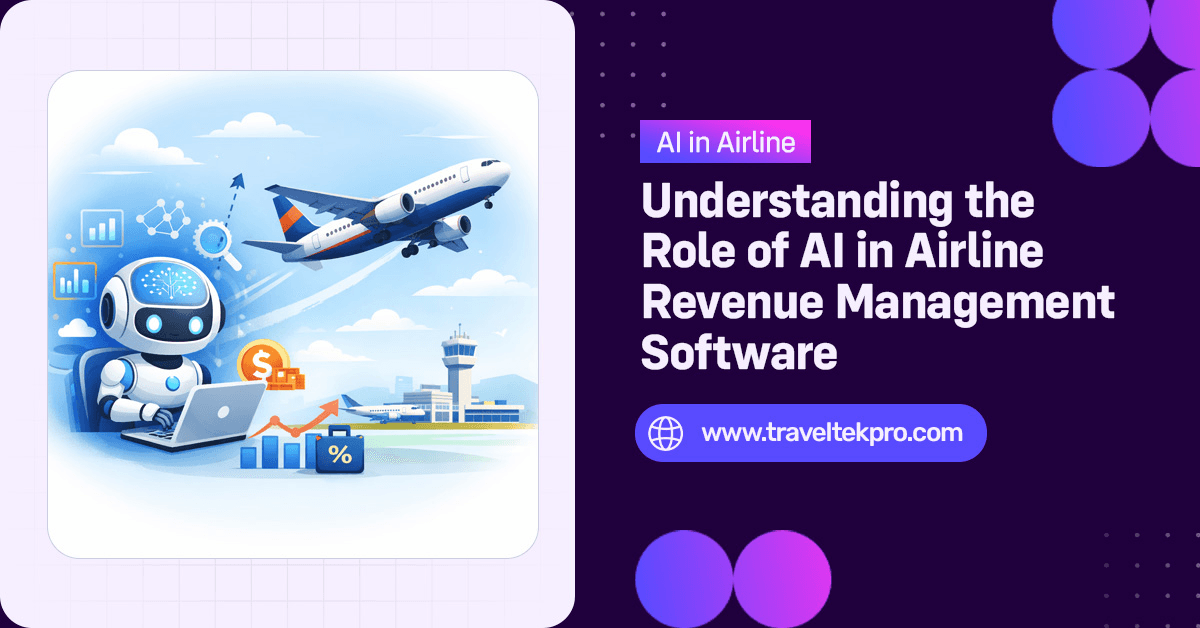
Understanding the Role of AI in Airline Revenue Management Software
If you work in the airline industry you already know how challenging revenue management has become. Full pricing a seat is no longer just about filling your aircraft, it’s all about dealing with fluctuating fuel prices and aggressive competitors and travellers who compare fares in just a few seconds.
every pricing decision you make directly impacts your profitability. a small forecasting error or delayed response to the market can cost your airline millions. That is exactly where airline revenue management software comes in the picture. It has evolved so rapidly that now artificial intelligence is at the center of the transformation.
The changing landscape of revenue management software
Airline revenue Management Today looks very different from what it was 10 years ago. The market moves faster, competition is tougher and even customer behavior has completely changed.
Evolution from Fixed fares to dynamic pricing
In the early days airlines operated with fixed fares. Once prices were published they rarely changed. Year revenue planning depends mainly on their schedules and the seasonal demand. As competition increased airlines introduced fare classes and yield management. This allowed you to sell a limited number of seats at lower prices while protecting higher fares for late booking passengers. Today pricing is completely dynamic. Your fares can change multiple times within a single day and competitive pricing or influence ticket prices instantly, managing this level of complexity manually is no longer Realistic
Rising market volatility and competition
Today you are operating in a highly volatile environment. Fuel costs rise unexpectedly, weather disruptions impact schedules or economic shifts and sudden changes in travel demand can impact the entire network overnight. At the same time travelers have more choices than ever before. Low cost carriers, regional airlines and global alliances compete aggressively on the price. If your fare is slightly higher, passengers can switch airlines within just a few seconds. This validity means you can no longer rely on slow or static pricing anymore.
Why do you need smarter revenue management?
Modern and line operations generate massive volumes of data. To stay competitive your revenue management software must analyze the information in real time and convert it into actionable pricing decisions. You need systems that can forecast demand accurately and monitor competitors continuously. This is exactly where the airline revenue management system makes a difference.
What is airline revenue management software?
Airline revenue management software is designed to help you maximize revenue from every flight by selling the right seat to the right passenger at the right price and at the right time. It supports your revenue team in making challenging pricing and inventory decisions across thousands of flights every day.
The main objective of revenue management software is simply to help you with the highest possible revenue from limited capacity. To achieve this the system focuses on main functions like forecasting how many passengers are likely to book each flight and also managing seat availability across different price levels. These functions work together to balance early booking with opportunity to sell higher.
Every pricing decision your system makes influences your airline’s financial performance. Even a small improvement in forecast accuracy or pricing decision can generate incremental revenue. This is exactly where airlines across the world consider revenue management software one of the most valuable technology investments ever.
Why do traditional revenue management models no longer work?
Even though traditional systems helped airlines grow for many years, today the struggle is real.
1. Rule based limitations
Rule based models assume that your passenger behaviour follows predictable patterns. For example business travelers booked late and leisure travelers book early. And reality travel behaviour has changed. Business travelers are now more price sensitive while leisure travelers often book late due to flexible plans.
2. Static forecasting patterns
Traditional forecasting relies mainly on historical booking data but historical Commons does not always reflect the future demand. New competitors and capacity changes or macroeconomic factors can dramatically change the demand patterns.
3. Inability to react to real time demand and completed pricing
Competitors adjust the fares constantly throughout the day. If your system updates only once or twice daily you risk losing bookings that are undervaluing seats. Without real time responsiveness your pricing decisions quickly become outdated.
The role of artificial intelligence in revenue management software
Artificial intelligence fundamentally changes how you approach revenue management. Instead of reacting to past trends AI now allows you to anticipate demand and optimize pricing proactively. AI analyzes massive data sets across routes markets and pricing history. It identifies the patterns that humans cannot detect manually. Automation performs tasks faster but intelligence proves decision quality. AI also goes further by learning from outcomes. If your pricing decision increases revenue the system reinforces that behavior. If it fails the model adjusts automatically. This learning capability continuously improves performance over time.
With AI you no longer have to wait for demand changes to appear in booking data. The system predicts future behavior using early indicators like search trends and market activity.
Main technologies used in revenue management software
AI driven revenue management relies on multiple technologies working together. Machine learning models learn how demand responds to price changes, seasonality and market conditions. As new data enters the system the models also continuously improve forecast accuracy. Furthermore you must know that predictive analytics allow you to estimate future demand with complete confidence. It evaluates unexpected booking curves and capacity utilization across the booking horizon.
Dynamic pricing algorithms automatically adjust the fare based on remaining seats and demand popularity. This helps you eliminate the rigid fare buckets and enables flexible pricing strategies. AI systems today process data in real time and competitor prices. This ensures that your pricing aligns with the current demand conditions.
How AI improves Demand forecasting accuracy
Instead of relying on just one or two data points AI considers multiple variables simultaneously. It basically includes route performance, seasonal trends, surprising sensibility and events. AI systems also analyze external data like travel search activity, competitor movements and industry trends. As real bookings occur the recalibrates forecast automatically. There is no need for you to wait for long weekly updates. The continuous learning keeps the forecasts accurate throughout the booking cycle.
AI driven Dynamic pricing
When you manage an airline as in today you no longer just set the pricing once and then review them later. Pricing has become a continuous process that evolves every minute for struggles exactly where AI dynamic pricing completely changes how you manage revenue. Instead of depending on fixed rules or predefined booking thresholds, AI allows your pricing to move in real time. The system constantly evaluates demand behavior and remaining inventory. Traditional fare structures operate in steps. You open or close the fare classes and move passengers from one bucket to another. This approach creates artificial pricing gaps and often leads to lost revenue opportunities. With continuous pricing AI removes rigid boundaries instead of jumping from one fire to another prices move smoothly within a defined range. Every seat can be priced individually based on its revenue value at that moment.
Not every passenger values a seat the same way. Some are extremely price sensitive while others focus on timing or convenience. AI models even analyze historical behaviour and booking windows to actually estimate how much different customer segments are willing to pay when you apply willingness to pay modelling your pricing reflects customer value rather than assumptions. You protect higher fees when demand supports it and stimulate bookings when price sensitivity increases.
The biggest advantage of AI driven sizing is speed. As booking trends shift or competitor updates where the system recalculates optimal prices instantly. You are no longer waiting for overnight updates or manual reviews.
Intelligent inventory and seat optimization
Pricing alone does not maximize our revenue. You also need to decide how many seats should be sold at each price level. AI traxnsforms the process through intelligent inventory optimization. Instead of managing seat availability using static limits, the airline revenue management system constantly evaluates demand probability for every remaining seat. It understands how likely each seat is likely to sell at different price points based on this probability, you can decide whether To accept a lower fan now or protect inventory for higher value demand later. Legacy fare class controls rely on fixed booking limits. These limits often remain unchanged even when your market conditions shift. AI removes all the rigidity. Fare availability is just automatically as forecasts, updates and demand evolves.
Overbooking optimization using predictive airline revenue management software
Overbooking has always been one of the most sensitive areas of airline revenue management. If you underbook seats go empty and if you overbook too aggressively you risk denied boarding and customer dissatisfaction. AI allows you to manage the risk with far greater precision. Instead of relying on historical averages revenue management software Evaluates booking channel and passenger history or time of departure. This allows you to make far more accurate overbooking decisions. AI does not treat all the passengers equally. It understands that some segments have higher cancellations or no show likelihood than others.
Optimizing ancillary revenue with AI
Airline revenue is no longer limited to ticket sales. Ancillary services now represent a major share of total income. AI helps you manage ancillaries as a part of a unified revenue strategy rather than isolated products. AI analyzes passenger behavior, trip purpose and booking timing. Instead of offering the same baggage or seat price to everyone, the airline revenue management system identifies what each traveller is most likely to purchase. Different passengers value different services. A business traveler might prefer seat selection while a leisure traveler might focus on baggage. AI adjusts all the ancillary offerings dynamically based on your traveler profile and booking context. This ensures that you maximize your revenue without overwhelming your customers.
Integrating AI revenue management software into airline ecosystems
Revenue management software must connect smoothly with your passenger service system, global distribution systems and other channels. The integrations ensure that pricing and availability decisions flow constantly across all the sales platforms. Modern AI revenue management Solutions are completely cloud native. This allows scalability and faster processing. Cloud platforms also support continuous model updates and rapid deployment. Real time APIs also allow instant data exchange between systems. Without real time connectivity even the most advanced AI models lose effectiveness.
Business benefits of AI powered airline revenue management software
AI improves the price per session and inventory allocation directly increasing revenue per available seat kilometer and overall yield. Better forecasts lead to better decisions. AI continuously recalibrates predictions based on live data, improving accuracy across the network. What once took hours or days now happens in just a few seconds most of your revenue team gains speed without sacrificing control. AI can now automate routine tasks allowing your analysts to focus on strategy rather than just constant fare adjustment.
Driving smarter revenue growth with Traveltekpro
As airline revenue management becomes more complex you need technology that goes beyond traditional optimization. Traveltekpro Delivers advanced analytics and AI driven optimization design specifically for modern airline environments. With intelligent forecasting and dynamic inventory control the experts allow you to move from reactive revenue management to predictive growth. Its scalable architecture allows our airline to adapt quickly to changing demand patterns while maintaining pricing discipline.
So if you want to compete in today’s airline market traditional revenue management approaches are no longer enough. AI allows you to price dynamically, forecast accurately and optimize inventory intelligently. It transforms revenue management from manual control into continuous optimization. With the right AI driven revenue management software you can get clarity, agility and confidence in every pricing decision that you make. The future of airline growth belongs to airlines that embrace intelligence and automation and the future that starts now.
Read More: What Is an Online Flight Booking System?
FAQ’S
1. What is airline revenue management software?
Airline revenue management software is a system that helps airlines maximize revenue by forecasting demand, optimizing seat availability, and dynamically adjusting ticket prices so the right seat is sold to the right passenger at the right price and time.
2. How does AI improve airline revenue management?
AI improves airline revenue management by analyzing real-time booking data, competitor pricing, and demand signals to predict future demand, automate pricing decisions, and continuously optimize inventory far more accurately than traditional rule-based systems.
3. Why is AI-based dynamic pricing important for airlines?
AI-based dynamic pricing allows airlines to update fares continuously based on demand, remaining seats, and market conditions, helping prevent revenue loss from underpriced seats and improving yield during high-demand periods.
4. How does AI help with airline demand forecasting?
AI enhances demand forecasting by using machine learning models that evaluate historical bookings, search trends, seasonality, competitor behavior, and real-time market signals to produce more accurate and continuously updated demand predictions.
5. What role does AI play in airline overbooking optimization?
AI helps optimize overbooking by predicting no-show and cancellation probabilities at a passenger-segment level, enabling airlines to safely sell extra seats while minimizing denied boarding and customer dissatisfaction.
6. What are the business benefits of AI-powered revenue management systems?
AI-powered revenue management systems increase airline profitability by improving forecast accuracy, enabling faster pricing decisions, maximizing revenue per seat, reducing manual workload, and allowing revenue teams to focus on strategic growth instead of constant fare adjustments.
Let's Start Your Project
Let us help you achieve your goals, by creating the best solution for you!