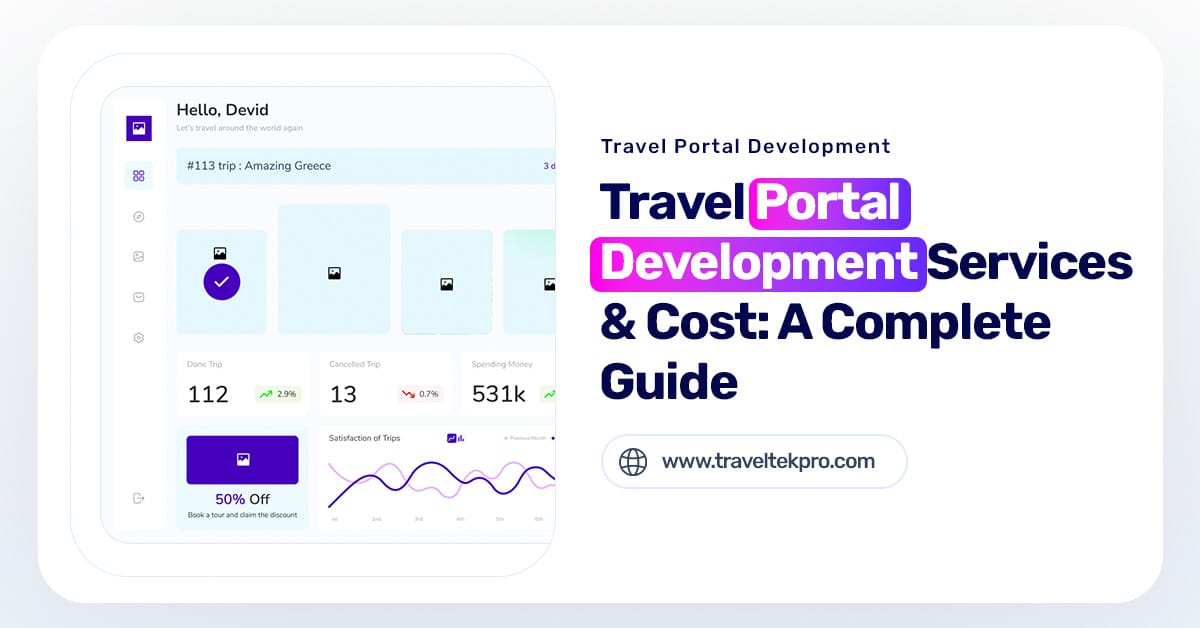
Travel Portal Development Services & Cost: A Complete Guide
The travel industry is no longer driven by phone calls or walk-in bookings. It has shifted completely towards digital first decision making. Today travelers plan to compare books and rebook the trips online often. If you’re looking for a flight or a hotel today you might expect three things: accurate pricing, real time availability and instant confirmation. If a website takes too long to load shows outright prices or requires manual follow-ups your customer just leaves. They don’t complain, they don’t wait, they just move on. The shift has forced travel businesses like yours whether a startup or established agents to rethink how you operate online. A basic travel website is no longer enough.
A static website can showcase destinations and contact details but it cannot handle live bookings or automated confirmations. That’s exactly where travel portal development comes in the picture. A travel portal is not just a website it’s a complete digital system that connects your customers, suppliers and administrators in real time. It automates the bookings, payments and reporting, reducing your manual work while increasing speed and accuracy.
What is travel portal development?
Before you consider travel portal development costs you need to understand the basics. It is the process of building a web-based or app based platform that allows you to search books and manage your travel services in real time. The services usually include flights and hotels. Unlike a regular website or travel portal works dynamically. Every search result you see today is pulled live from airline systems and third party travel suppliers.
How does the travel portal work behind the scenes?
Behind the scenes a travel portal consists of multiple interconnected systems. Venues search for a flatter hotel, the portals and the request to one or more travel APIs or global distribution systems. The systems return data related to availability and rules. The portal then applies the business logic like markups, commissions and discounts before displaying the final result to the user. Once you confirm the booking and make payment the portal completes a transaction and generates a booking confirmation.
A travel portal usually serves several types of users at the same time. And customers use it to book trips while travel agents like you can use it to book on behalf of your customers while earning commissions. If you are an administrator, then you can use it to manage suppliers’ pricing and reports. Suppliers are directly connected to it through APIs, and each user requires a different interface and level of access.
The complexity of travel portal development lies not just in building screens but in managing data accuracy and performance. A portal that just works fine for a few bookings per day might collapse when traffic increases if it is not designed properly.
Types of travel portals that you can build
Not all travel portal development services actually serve the same purpose. The structure features and cost depend greatly on the business model that you choose.
A B2C travel portal is designed for direct customer bookings. A lot of people choose this model. Customers search for flights or hotels, compare options and make payments. The success of B2C portal depends largely on speed and competitive pricing and mobile experience.
A B2B travel portal is built for travel agents rather than just end customers. In this model the portal works like a distribution system for wholesalers or consolidators. You can log in and book travel services for your clients and earn commissions. B2B portal requires features like agent wallets and credit limits. The focus is on control and long term relationships rather than just flashy design.
B2B-B2C Travel portal combines both elements. You can sell travel services directly to the end customers using their own branding while the mean system controls inventory and pricing. The model is your best bet if you want to scale quickly through agent networks without managing every customer directly.
Corporate travel portals are designed for organizations managing employee travel. The portals enforce travel policies, approval workflows and expense tracking. The goal is not to offer the cheapest prices but to provide visibility and control over company travel spending.
Niche travel portals focus on specific segments like medical tourism, ecotourism or religious travel. The portals often succeed just by offering specialised content and curated packages.
Core features of a travel portal
Your travel portal development must balance functionality with simplicity. Overloading your users with features can be just as harmful as missing essential ones. Next line from a user’s perspective the most important feature is search accuracy, speed and clarity. Today your users expect to filter results of surprised date airline and hotel type. They want to see final prices clearly without hidden fees appearing at the last step. They also want easy access to booking history.
On the administrative side the portal must provide full control over suppliers and discounts. You need dashboards that show bookings revenue cancellations and performance trends. Content management is very important especially for your portals that rely on organic traffic.
For B2B and B2BC portals agent-specific features are very important. These include wallet systems credit limits and Commission roles. Without these managing agent networks becomes manual and also error prone.
Payment and finance features are another core area. A modern travel portal must support multi payment gateways and automatic invoice generation. You need to know that security standards like encryption and compliance with payment regulations are very important for you to maintain your trust.
These advanced features like AI based recommendations and dynamic pricing loyalty programs can add value but they should be built on top of a stable core system rather than just rushed into early versions.
Travel API integration
Travel APIs are what make your travel portal functional. They connect your portal to airlines and hotels. Through these APIs, your portal can receive live pricing and availability. Some APIs are a part of global distribution systems that provide access to a huge range of airlines. Others are actually direct integrations with specific airlines or aggregators. you must know that each API comes with its own pricing model performance characteristics and limitations.
Choosing the right combination of APIs is a great decision. Relying just on a single API might simplify development but it can limit inventory or increase risk if that API experiences downtime. API integration also brings challenges. Response times can just vary. Data might be inconsistent across sources and booking failures can occur if not handled well. A well built portal includes folder mechanisms and error handling to ensure a smooth user experience even when external systems fail.
Read More: What Is a Travel API and How Does It Work?
Technology stack used in travel portal development
The technology stack of a travel portal impacts the performance and scalability. On the front end modern frameworks are used to create fast responsive interfaces that work well on both your desktops and mobile devices. You can say mobile first is no longer optional as a large portion of travel bookings happen on smartphones.
The back end handles API integrations and pricing logic. Scalable architecture is preferred, especially for portals that expect growth in traffic or bookings. Databases store user data and bookings, while cloud infrastructure allows your system to scale up or down based on demand.
Security is built into every layer. This includes encrypted connections, secure payment handling and role based access control, besides compliance with data protection regulations. A travel portal handles sensitive personal and financial information or security failures can be catastrophic.
Travel portal development
The development process usually starts with the requirement analysis. You can say that the first step is understanding the business model features, APIS and successful metrics. Skipping or rushing the stage often leads to rework and budget overruns later.
UI and UX Design actually come next. Good design is not just about aesthetics alone but all about reducing friction in the booking process. Clear flows, intuitive navigation and minimal steps increase the conversion rates. API selection and contract discussions follow. The stage determines what inventory the portal can actually offer and at what cost. Development and integration then begin combining front end back end API logic into a working system.
Testing is a very important stage that includes functional testing, load testing, security testing and API testing.
Travel portal development cost
The cost of travel portal development services are likely to vary depending on the scope and the development team’s location. There is no single fixed price but realistic range helps with planning costs also basically depend on the feature complexity and the basic portal with standard search and booking features costs less than a portal with AI recommendations or custom workflows. You need to know that custom built modules are more expensive as compared to ready made components. API and GDS costs are also ongoing expenses. They might include setup fees and monthly minimums. The costs continue as long as your portal operates and should be factored into long term budgets.
Development team costs are likely to vary by region. Teams in countries with low labor expenses can offer competitive pricing while teams in higher cost regions might charge you more upfront but also offer close time zone alignment or local market experience.
| Portal Type | Typical Development Cost | Suitable For |
| B2C Travel Portal | $8,000 – $18,000 | Startups, OTAs |
| B2B Travel Portal | $15,000 – $30,000 | Wholesalers, Agent Networks |
| Corporate Travel Portal | $20,000 – $40,000 | Medium to Large Enterprises |
Timeline: How long does travel portal development take?
A basic MVP can take around 2 to three months if the requirements are clear and features are limited. A full scale portal with multiple APIs and a custom project usually takes four to six months. Timelines depend on the API approvals, feature scope and customization level and testing requirements. Timelines basically depend on the API approvals, feature scope and customisation level. Russian development often leads to technical debt and higher costs later on.
Custom travel portal versus ready-made solution
Custom travel portals are built specifically for your business model. They offer you a lot of flexibility and better long-term ROI. Ready-made solutions allow quick launches and lower initial expenses, but also come with a lot of limitations. Customisation is restricted, and scalability might be limited. The right choice will depend on whether you view the portal as a short-term tool or a long term business asset.
How to choose the right travel portal development company?
Choosing the right development partner is a very important decision when choosing the right technology. You need to look for a team with proven experience in travel technology, not just general web development. API integration experience, clear communication and post launch support is very important. Cheap vendors who lack domain knowledge often cost more in the long run because of rework or failed integrations.
Common mistakes to avoid
A lot of travel portals fail not because of bad ideas but because of poor execution. Common mistakes include choosing API is basically on cost ignoring scalability and underestimating ongoing expenses and making poor decisions. Most of the mistakes can be avoided with proper planning or experienced guidance.
Future trends and travel portal development
Travel portals are completely evolving towards customization automation and ecosystem based models. AI driven recommendations and super app platforms and sustainability focused features are completely shaping the future. Portals built now should be completely flexible enough to adapt all the trained changes without complete rewrites.
So a travel portal is no longer optional for serious travel businesses. It is a core system that drives bookings revenue and growth. Building 1 requires planning, a clear budget and the right technical expertise. If you are planning to upgrade or build a travel portal approach it as a long term investment other than just a quick project. The right decisions early on can save a lot of time, money and frustration later. To get the best travel portal development cost choose Traveltekpro.
Read More: AI Travel App Development: Cost, Features & Real-World Use Cases
FAQ’S
1. What is travel portal development?
Travel portal development is the process of building a dynamic online platform that allows users to search, book, pay for, and manage travel services like flights, hotels, and packages in real time. Unlike a static website, a travel portal integrates live APIs or GDS systems, automates bookings and payments, and connects customers, agents, and administrators through a single digital system.
2. How much does travel portal development cost?
The cost of travel portal development typically ranges from $8,000 to $40,000, depending on the portal type, features, APIs, and customization level. A basic B2C portal costs less, while B2B or corporate travel portals cost more due to agent management, wallets, credit limits, and complex workflows, along with ongoing API and maintenance expenses.
3. How long does it take to develop a travel portal?
Travel portal development usually takes 2 to 6 months, depending on project scope, API approvals, and customization requirements. A simple MVP can be launched in around 8–10 weeks, while a fully featured portal with multiple APIs, payment gateways, and advanced admin controls may take several months to build and test properly.
4. What features are essential in a travel booking portal?
Essential features of a travel booking portal include real-time search and availability, secure payment processing, booking management, user dashboards, admin controls, API integrations, and reporting tools. For B2B portals, additional features like agent wallets, credit limits, commission rules, and markup management are critical for smooth operations and scalability.
5. What is the difference between B2B and B2C travel portals?
A B2C travel portal is designed for direct customers to search and book travel services online, while a B2B travel portal is built for travel agents and wholesalers to book on behalf of customers using special fares, commissions, and credit systems. B2B portals focus on automation, speed, and agent management, whereas B2C portals prioritize user experience and conversion.
6. Is custom travel portal development better than ready-made solutions?
Custom travel portal development is better for long-term growth because it offers full control over features, integrations, branding, and scalability. Ready-made solutions allow faster launches with lower upfront costs but often limit customization, API flexibility, and performance as traffic grows, making custom portals a stronger investment for serious travel businesses.