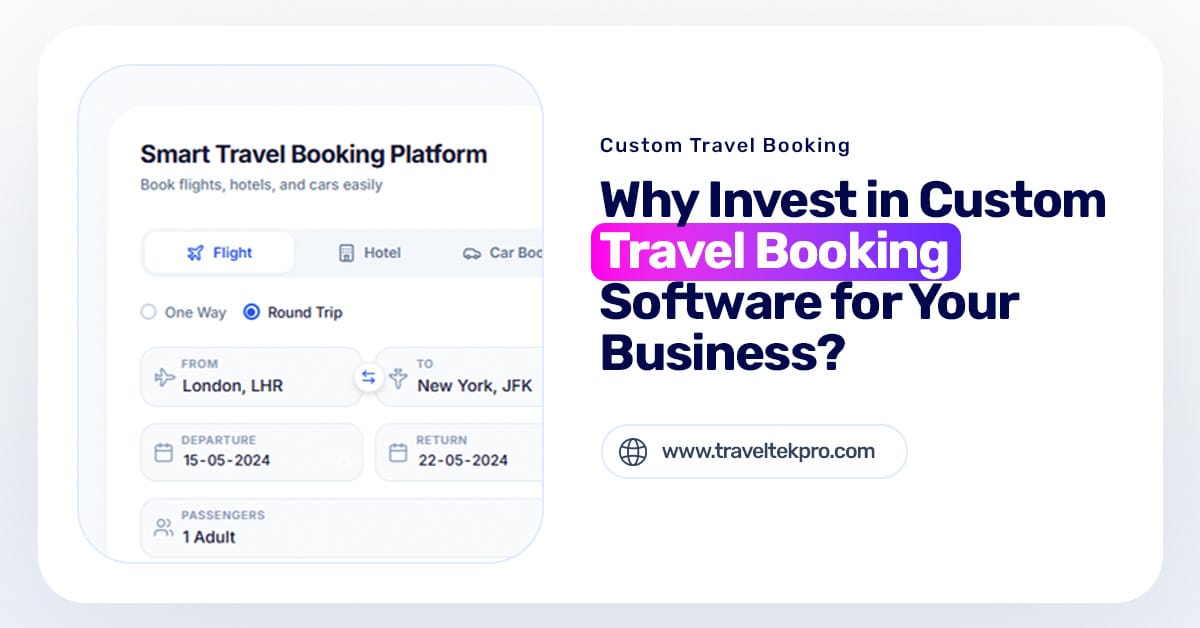
Why Invest in Custom Travel Booking Software for Your Business?
The travel industry has transformed dramatically, driven by technology, automation, and changing customer behaviors. Today’s travelers expect faster, smarter, and more personalized booking experiences something traditional tools can no longer deliver. As businesses expand across markets and traveler needs evolve, investing in custom travel booking software has become a strategic necessity rather than a luxury.
How consumer expectations have changed in the digital travel era
Consumers now demand a seamless digital experience that mirrors the best global brands. They expect:
- Instant access to real-time availability so they can compare multiple travel options without delays or outdated information.
- Transparent pricing and taxes, ensuring complete visibility into fare rules, cancellation policies, and fees.
- Mobile-friendly booking journeys, allowing them to search, book, and manage trips directly from their smartphones.
- Frictionless payments, including secure online checkouts, digital wallets, and regional payment methods.
- Hyper-personalized recommendations based on travel history, preferences, or real-time behavior.
These expectations require businesses to adopt smart, flexible, and deeply integrated systems that can handle enormous amounts of live travel data.
Why ready-made travel tools are not enough anymore
Pre-built or generic travel platforms rarely support the dynamic needs of modern travel brands. Their main limitations include:
- Rigid architecture, meaning businesses cannot add new travel products, local suppliers, or custom business rules as they grow.
- Limited design and branding options, restricting your ability to create a unique, memorable user journey.
- Inability to integrate niche suppliers or proprietary APIs, which prevents you from offering exclusive inventory.
- Poor scalability, making the system slow down or become unstable when traffic increases.
- Higher long-term costs, since you rely on third-party vendors for every upgrade or customization.
As travel becomes more competitive, companies need full control over their digital ecosystem — something only custom software can offer.
The rise of personalized travel experiences through software
Travelers today prefer experiences tailored to their interests — not generic packages. Custom software enables businesses to:
- Design unique travel combinations, such as multi-city itineraries, special-purpose tours, or curated local experiences.
- Offer personalized product bundles, like flight + hotel + transfers with dynamic pricing.
- Track customer behavior to recommend the best suited options, making the booking journey more intuitive.
- Build loyalty and retention, because customers appreciate platforms that “understand” their preferences.
What Is a Travel Booking System?
A travel booking system is a comprehensive digital platform that manages every step of the booking journey from searching for travel services to completing payments and generating tickets or vouchers. It acts as a centralized hub for live inventory, pricing, and supplier connections.
Definition and main components of a digital travel booking system
A modern travel booking system includes the following core elements:
- Front-end user interface, where customers or agents search and book travel services.
- Travel booking engine, which fetches real-time data from suppliers and processes bookings.
- Admin & agent back-office, used for managing users, commissions, markups, reports, and suppliers.
- Inventory management for tours, packages, contracted hotels, and regional travel products.
- Payment gateways supporting secure transactions in multiple currencies.
- Rule-based pricing engine for intelligent markups, commissions, discounts, and taxes.
- Reports & analytics, enabling travel companies to make informed business decisions.
Each component works together to provide a fast, reliable, and automated travel booking experience.
How it connects travelers, suppliers, and agencies
A travel booking system acts as a bridge between all stakeholders:
- Travelers get instant access to accurate availability, pricing, and booking confirmation.
- Suppliers such as airlines, hotels, and DMCs share real-time inventory through API or GDS connections.
- Agencies can manage bookings, track revenue, handle markups, and deliver superior customer service from one central platform.
This interconnectedness eliminates manual work, reduces errors, and speeds up the entire booking process.
Difference between traditional portals and next-gen booking platforms
Traditional portals relied heavily on human intervention, manual ticketing, and limited supplier access.
Next-generation solutions offer:
- Automated fare calculation, reducing dependency on staff.
- Real-time GDS/API connections ensuring fast, accurate search results.
- Customizable modules tailored to niche travel segments.
- Integrated marketing tools, improving customer engagement.
- Optimized mobile experiences, capturing the growing smartphone-driven market.
Understanding the Power of a Travel Booking Engine
The travel booking engine is the heart of any online travel platform. It processes searches, verifies availability, and executes bookings in real time.
Real-time inventory search across flights, hotels, tours, and transfers
A robust booking engine can:
- Retrieve live flight schedules, fare families, and availability from GDS and airline APIs.
- Search thousands of hotel rooms by region, price, amenities, and supplier.
- Display real-time tour availability from DMCs and activity providers.
- Combine multiple travel products into dynamic, personalized packages.
This unified experience enhances convenience for users while maximizing product visibility.
The role of automation in pricing, availability, and ticketing
Automation ensures accuracy and efficiency by:
- Automatically verifying fares before booking to prevent price mismatches.
- Managing PNR creation, ticket issuance, and revalidation processes.
- Adjusting pricing based on supplier rules, demand, or market trends.
- Handling cancellations and amendments without manual intervention.
Automation reduces operational overhead and improves user satisfaction.
How booking engines reduce manual workload for travel teams
A well-built booking engine eliminates repetitive tasks like:
- Manually searching fares across multiple supplier portals.
- Entering customer details into airline systems.
- Verifying ancillary availability and SSR requirements.
- Manually calculating commissions or markups for each booking.
This frees staff to focus on sales, support, and building client relationships.
Why Businesses Are Shifting to Custom Travel Booking Software
1. Flexibility to adapt to niche markets
Custom platforms allow companies to explore specialized sectors such as:
- Religious travel like Umrah and Hajj with customizable routing logic.
- Adventure travel requiring multi-day itineraries and vendor coordination.
- Corporate travel with complex policy rules and approval workflows.
- Regional travel agencies serving local suppliers and unique inventory.
Each niche can be supported with specialized modules and workflows.
2. Ability to integrate with unique suppliers, APIs, and GDSs
A custom travel booking system supports integration with:
- Global GDS providers (Amadeus, Sabre, Travelport).
- Airline direct APIs (NDC, LCCs, hybrids).
- Hotel wholesalers and aggregators.
- Activities, transfers, rail, cruise, and insurance APIs.
This expands product diversity and boosts conversions.
3. Custom workflows designed for your business model
Every travel business operates differently. Custom platforms support rules such as:
- Specific commission structures.
- Corporate billing requirements.
- Agent hierarchy and reseller networks.
- Unique pricing and packaging formulas.
Your technology adapts to your business — not the other way around.
4. Improved customer experience with tailored features
Custom software enhances the booking journey through:
- Clean, intuitive UI/UX tailored to your brand.
- Faster loading times and optimized search results.
- Personalized recommendations based on user profile and history.
- Custom notifications, vouchers, and loyalty features.
Key Features Found in Today’s Custom Travel Booking Solutions
Intelligent search and filter functionalities
Advanced search tools help users quickly find the best option by filtering:
- Prices, stops, travel dates, airlines, baggage policies, amenities, and more.
Multi-currency and multi-language support
This ensures your travel business can serve:
- International customers
- Cross-border OTAs
- Regional agents and resellers
Role-based dashboards
Different users need different controls:
- Admin dashboard for full system management
- Agent dashboard with markups/commissions
- Customer dashboard for booking management
- Sub-agent dashboard for reseller tracking
Automated policies
These workflows streamline operations by:
- Auto-calculating refunds based on supplier rules
- Applying cancellation penalties
- Updating ticket statuses and rebooking flows
- Managing agency credit limits and payment rules
Smart recommendations powered by algorithms
AI-driven insights suggest:
- Best fare options
- Upsells like meals, bags, or seat upgrades
- Relevant tours or hotels based on purchase history
Read More: 7 Travel Agency Booking Software Features that you cannot overlook
How Custom Travel Booking Software Supports Revenue Growth
Higher direct bookings & reduced third-party dependency
Owning your booking engine reduces reliance on external portals and increases profit margins.
Data insights refine pricing & strategies
Analytics help optimize:
- Customer acquisition
- Supplier performance
- Profit margins
- Market segmentation
Enhanced cross-sell and up-sell opportunities
Platforms can automatically recommend:
- Ancillaries
- Hotel upgrades
- Transfers
- Insurance packages
- Add-on tours
Seamless customer journey improves conversion
A simple, intuitive workflow ensures more users complete their bookings.
Integration Capabilities: The Heart of a Custom Travel System
GDS integrations (Amadeus, Sabre, Travelport)
These connections power global flight search, pricing, and ticketing.
API integrations
Custom platforms integrate with:
- Airlines
- Hotels
- Transfers
- Rail, cruise, and tours
- Payment and marketing systems
Payment gateway integration
Secure payments include:
- Global and regional processors
- Fraud detection tools
- PCI-compliant storage
CRM, ERP, and marketing automation integrations
Connect your booking engine to your existing software for a unified ecosystem.
When Off-the-Shelf Solutions Fall Short
Limitations in scalability
Such systems cannot handle rapid growth or large search volumes.
Lack of control over features
You cannot add unique modules or adjust platform workflows freely.
Challenges with niche suppliers
Custom regional partners often require unique integrations unavailable in standard tools.
Branding limitations
Your portal will look generic, making differentiation harder.
Benefits of Choosing a Custom-Built Travel Booking System
Personalized UI/UX
Design your booking journey exactly how your customers expect it.
Ability to add exclusive modules
You can expand your system into:
- B2B reseller marketplace
- B2C public portal
- Corporate booking engine
- Agent network management
Stronger system security
You control encryption, user access, API token management, and data rules.
Future-proof architecture
Scale your business with new products, regions, and traffic effortlessly.
Real-World Examples: When Custom Travel Software Makes the Difference
Scenario 1: A travel startup requiring unique routing logic
Startups often need specialized engines for multi-destination or theme-based routing.
Scenario 2: Corporate travel firm
Such companies need strict policies, approval chains, expense tracking, and customized travel classes.
Scenario 3: Regional travel companies
They often depend heavily on local suppliers whose APIs must be integrated manually.
Scenario 4: Multi-country OTAs
They need multi-language, multi-currency, tax handling, and high-performance architecture.
Technical Considerations When Building Custom Travel Booking Software
Cloud infrastructure & security
Use AWS, Azure, or GCP for high availability, redundancy, and compliance.
Load handling
A scalable engine ensures fast performance even during high traffic periods.
Caching systems
Caching reduces API usage and accelerates search results.
Mobile-first development
Most travelers now book flights and hotels directly from mobile devices.
Cost Factors Involved
API licensing & supplier contracts
GDS, wholesalers, and airline APIs each have unique pricing models.
Development, design & testing
Costs depend on features, complexity, and integrations.
Maintenance & upgrades
Systems require ongoing improvements as your business grows.
Common Challenges & Practical Solutions
1. Synchronizing inventory from multiple sources
Caching, queues, and supplier prioritization help keep results accurate and fast.
2. Maintaining fare accuracy
Revalidation tools ensure the final booking price matches the airline or supplier fare.
3. Ensuring UX simplicity
Modular UI ensures customers enjoy a clean design even with complex backend systems.
4. Compliance
Meet global standards like GDPR, PCI DSS, and regional tourism regulations.
Is Custom Travel Booking Software Right for Your Business?
Key questions to evaluate
- Do you need unique workflows?
- Are you serving niche markets?
- Do you plan to scale globally?
When customization brings maximum ROI
- When your business relies on unique supplier connections
- When you want end-to-end branding control
- When you plan to expand internationally
The Future of Travel Belongs to Customizable Digital Platforms
As the travel industry accelerates, businesses must invest in platforms that offer speed, flexibility, personalization, and scalability. A custom travel booking system empowers your business with cutting-edge technology, operational efficiency, and long-term competitive advantage. Whether you’re an OTA, corporate travel manager, or growing travel startup, the future belongs to platforms designed specifically for your business.
Read More: How Does a Travel Booking Engine Improve Customer Experience?
FAQ’S
1. What is custom travel booking software?
Custom travel booking software is a tailor-made digital platform designed to manage flight, hotel, tour, and ancillary bookings based on a business’s unique workflows, suppliers, and customer needs. Unlike ready-made tools, it allows full control over pricing logic, integrations, branding, automation, and scalability, making it ideal for OTAs, corporate travel firms, and niche travel businesses seeking long-term growth and flexibility.
2. Why should travel companies invest in custom booking software?
Travel companies invest in custom booking software to gain full ownership of their technology, reduce dependency on third-party platforms, and deliver faster, more personalized booking experiences. It enables seamless API and GDS integrations, smarter pricing automation, better performance under high traffic, and the ability to adapt quickly to changing market demands—key factors that directly improve conversion rates and profitability.
3. How is custom travel software better than off-the-shelf solutions?
Custom travel software outperforms off-the-shelf solutions by offering flexibility, scalability, and deep customization that generic platforms cannot provide. Businesses can integrate exclusive suppliers, apply unique commission rules, support niche travel models, and scale globally without platform limitations, while off-the-shelf systems often restrict growth, branding, and advanced integrations.
4. What features should a modern travel booking system include?
A modern travel booking system should include real-time inventory search, GDS and API integrations, automated pricing and ticketing, multi-currency and multi-language support, secure payment gateways, role-based dashboards, analytics, and intelligent recommendation engines. These features ensure faster bookings, fewer errors, better customer experience, and efficient back-office operations.
5. Is custom travel booking software suitable for startups?
Yes, custom travel booking software is suitable for startups, especially those targeting niche markets or planning rapid scale. Startups benefit from building only the features they need, integrating preferred suppliers from day one, and avoiding long-term limitations of generic platforms, which ultimately results in better ROI as the business grows.
6. How does custom travel software help increase revenue?
Custom travel software increases revenue by enabling direct bookings, personalized offers, dynamic pricing, and automated cross-selling of ancillaries like baggage, transfers, insurance, and tours. With built-in analytics and customer behavior tracking, businesses can optimize pricing strategies, improve conversion rates, and retain customers more effectively.